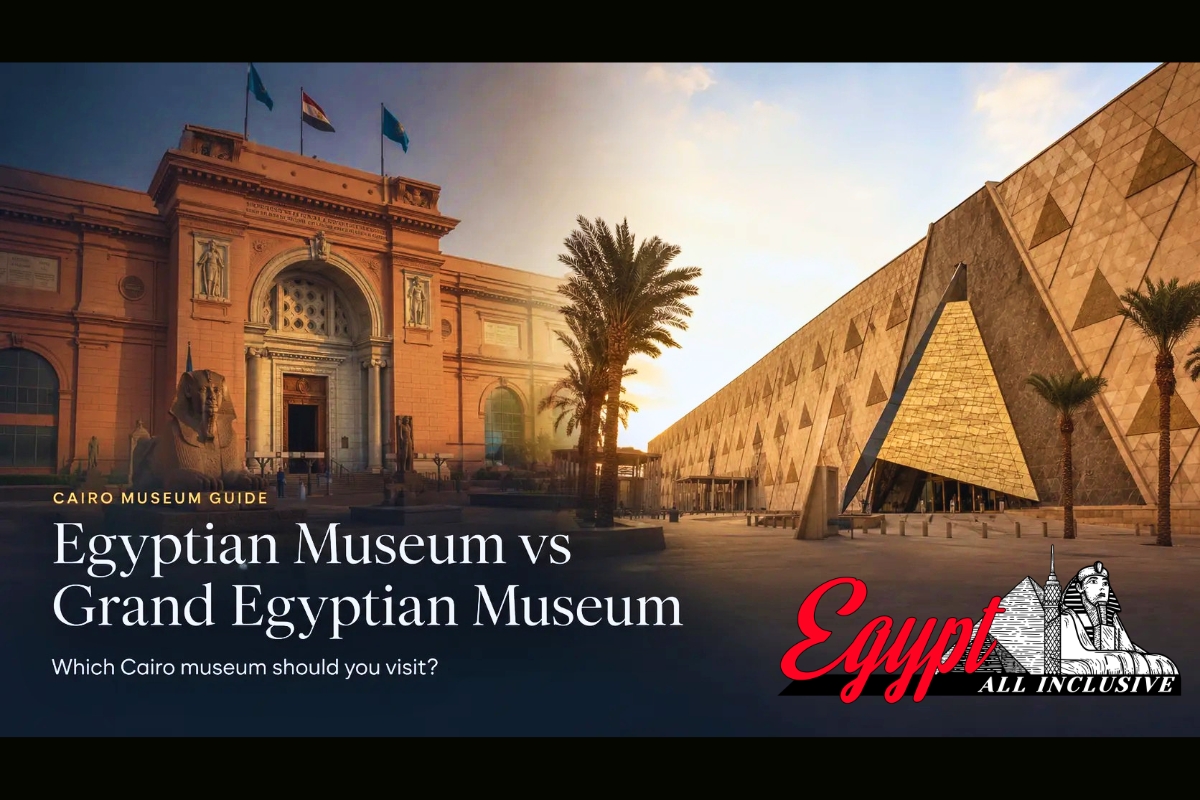
If you are trying to decide between the Egyptian Museum Cairo vs Grand Egyptian Museum, you are not alone. Thousands of travelers planning their 2027 trip to Egypt ask the exact same question every single day, and the honest answer is more interesting than a simple “pick one.”
Here is the four-line summary before we go any further: the Egyptian Museum in Tahrir Square is the historic, old-world museum that has guarded Egypt’s antiquities since 1902, while the Grand Egyptian Museum (GEM) near the Giza Pyramids is the new, ultra-modern home of the complete Tutankhamun collection and the largest archaeological museum on earth.
Depending on your travel style, your schedule, and what you want to see, you may actually want to visit both. By the end of this guide, you will know exactly which museum fits your trip, how much time and money to budget, and how to book everything smoothly with a trusted local partner.
This article is written for real travelers heading to Cairo and Giza in 2027 , not for search engines. We have organized thousands of Egypt tours, and we have watched firsthand how visitors react when they walk into each museum for the first time.
Some are overwhelmed by the sheer scale of the Grand Egyptian Museum. Others fall in love with the charming, slightly chaotic energy of the old Egyptian Museum in Tahrir Square, where dusty glass cases still hold treasures that have not moved in a hundred years. Both experiences are valid. Both are worth your time if your schedule allows it, and if it doesn’t, this guide will help you choose the one that matches your goals.
Below, we break this comparison into every angle that matters: history, location, architecture, artifact collections, the Tutankhamun treasures, the Royal Mummies, ticket prices, opening hours, how long to budget, and which museum suits families, photographers, and serious history lovers. We have also added practical tables and insider tips throughout, based on real visits and real client feedback, so that you are not left guessing.
Book Your Tour [ Egyptian Museum and Grand Egyptian Museum Tour ]
Quick Overview Table: Egyptian Museum Cairo vs Grand Egyptian Museum
Before diving into the details, here is a side-by-side table that most travelers ask for first. This snapshot answers the most common question we get: “just tell me the difference between the Egyptian Museum and Grand Egyptian Museum in one glance.”
| Feature | Egyptian Museum (Tahrir) | Grand Egyptian Museum (GEM) |
|---|---|---|
| Location | Tahrir Square, downtown Cairo | Near the Giza Pyramids |
| Opened | 1902 | Fully opened in 2026 |
| Size | Around 15,000 square meters | Over 490,000 square meters |
| Total artifacts | Around 160,000 pieces | Over 100,000 pieces (curated) |
| King Tut treasures | Partial collection (moved out gradually) | Full Tutankhamun collection, all 5,000+ pieces |
| Royal Mummies | Moved to NMEC in 2021, not here anymore | Not held here either; mummies are at NMEC |
| Khufu Solar Boat | Previously at Giza, now inside GEM | Yes, fully restored and displayed |
| Architecture | Neoclassical, historic building | Ultra-modern glass and stone structure |
| Average visit time | 2 to 3 hours | 4 to 6 hours (or more) |
| Best for | History lovers, quick city stops | First-time visitors, families, photographers |
| Price range 2027 | Lower cost, budget friendly | Higher cost, premium experience |
This table alone answers a huge portion of the questions travelers type into Google, including “Grand Egyptian Museum vs Egyptian Museum,” “Cairo Museum vs Grand Egyptian Museum,” and “Egyptian Museum vs GEM.” But there is so much more nuance behind these numbers, so let’s unpack each point properly.
Quick tip: If you only have one day in Cairo and you are trying to choose between the Egyptian Museum Cairo or Grand Egyptian Museum, prioritize GEM for the complete Tutankhamun collection, then add the old Egyptian Museum only if you have a spare half day, since it still holds pieces you cannot see anywhere else.
The History Behind Each Museum: Why They Exist Side by Side in 2027
Understanding the difference between the Egyptian Museum and Grand Egyptian Museum starts with their history, because these two institutions were never meant to compete. They were built more than a century apart, for very different purposes, and that context changes how you should experience each one.
- The Egyptian Museum in Tahrir Square opened its doors in 1902, commissioned by the Egyptian government and designed by French architect Marcel Dourgnon. For over 120 years, this building has been the guardian of Egypt’s ancient treasures, surviving revolutions, protests, and even a break-in during the 2011 uprising. Walking through its halls today feels like stepping into a time capsule of Egyptology itself. The wooden display cases, the handwritten labels, and the sheer density of objects packed into every room tell the story of how museums used to work before modern curation became the standard. This is part of its charm, and honestly, part of its frustration too, since many rooms feel cluttered compared to what you will see at the newer museum.
- The Grand Egyptian Museum, often shortened to GEM, was first announced in the early 2000s as Egypt’s answer to a growing problem: the old museum simply ran out of space, and Egypt’s archaeological discoveries kept multiplying every year. Construction began in 2005 near the Giza Plateau, just a few kilometers from the Pyramids, and after years of delays, partial openings, and soft launches, GEM reached its full grand opening in 2026, marking one of the most significant cultural milestones in modern Egyptian history. This is not simply a bigger building. It represents a complete rethink of how a national museum should function, with modern conservation labs, climate-controlled galleries, and a layout designed specifically around chronological storytelling rather than the somewhat random arrangement found in the older museum.
So why do both museums still operate in 2026 instead of one simply closing? The answer is capacity and history. The Egyptian Museum in Tahrir still holds roughly 160,000 artifacts, and moving every single piece to GEM would take years and risk damaging fragile items. Egypt’s Ministry of Tourism and Antiquities made the practical decision to gradually transfer priority collections, like the full Tutankhamun treasures, while leaving a rich and still fascinating archive in the original building. This is exactly why the debate over Egyptian Museum Cairo vs Grand Egyptian Museum exists at all in 2026: both museums are open, both hold genuinely important artifacts, and neither one is a full replacement for the other yet.
Tip for history lovers: If you want to understand the evolution of Egyptology as a science, visiting the old Egyptian Museum first, then GEM afterward, creates a powerful narrative arc. You literally walk through 120 years of how humanity has studied ancient Egypt, from colonial-era collecting to today’s high-tech conservation.
Tip for time-limited travelers: If you are only in Cairo for a layover or a short stopover in 2026, GEM alone gives you the highlight reel of Egyptian history in one modern, air-conditioned, well-organized space.
Location and Accessibility: Which Museum Is Easier to Reach in 2027?
Location matters more than most travelers expect, especially in Cairo, where traffic can turn a short drive into an hour-long ordeal. This is one of the biggest practical differences when comparing Egyptian Museum Cairo vs Grand Egyptian Museum, and it directly affects how you should plan your day.
The Egyptian Museum sits right in Tahrir Square, in the heart of downtown Cairo. It is surrounded by government buildings, busy streets, and the general urban energy of the city center. If your hotel is downtown, near the Nile Corniche, or in Garden City, you can reach this museum in ten to twenty minutes by car or taxi. It is also walkable from several downtown hotels, and it sits close to other attractions like the Cairo Tower, Tahrir Square itself, and the Nile boat docks. For travelers who are combining a Nile cruise stopover with a Cairo city tour, this central location is extremely convenient.
The Grand Egyptian Museum, on the other hand, is located near the Giza Plateau, close to the Pyramids of Giza and the Great Sphinx. This is roughly a 40 to 60 minute drive from downtown Cairo, depending on traffic and the time of day. However, this location is actually a major advantage for most 2027 travelers, because it means you can combine your GEM visit with a Pyramids tour on the same day. Many of our clients start their morning at the Giza Pyramids, take a break for lunch nearby, then spend their afternoon and evening exploring GEM, since the museum stays open late on several days of the week. This pairing saves an entire day of your itinerary compared to treating them as two separate excursions.
Here is a simple comparison to help you visualize the logistics:
| Factor | Egyptian Museum (Tahrir) | Grand Egyptian Museum (GEM) |
|---|---|---|
| Distance from downtown Cairo | Very close, city center | 40-60 minutes by car |
| Distance from Giza Pyramids | 45-60 minutes by car | 5-10 minutes, right next door |
| Best paired with | Cairo city tour, Nile cruise stops | Pyramids of Giza, Sphinx, Solar Boat Museum |
| Parking | Limited, street-side | Large dedicated parking area |
| Public transport access | Metro station nearby (Sadat Station) | Limited, taxi or private transfer recommended |
| Accessibility features | Older building, some stairs | Fully modern, wheelchair and stroller friendly |
Tip: Book a private driver or a guided tour that includes transportation between these sites. Cairo traffic is unpredictable, and trying to arrange transport yourself between the Pyramids, GEM, and downtown Cairo can eat up hours you would rather spend inside the museums. This is exactly the kind of logistics our travel agency, Egypt All Inclusive, handles for every guest, so you never waste a single hour of your 2027 trip stuck in traffic.
Tip for solo travelers: The Sadat Metro Station is a short walk from the Egyptian Museum, making it one of the easiest major attractions in Cairo to reach independently if you prefer public transport and want to save on taxi costs.
Architecture and Design: Old-World Elegance vs Futuristic Vision
The physical experience of walking through each museum is night and day, and this is one of the most talked-about aspects when people search for a Grand Egyptian Museum comparison or an Egyptian Museum Cairo review.
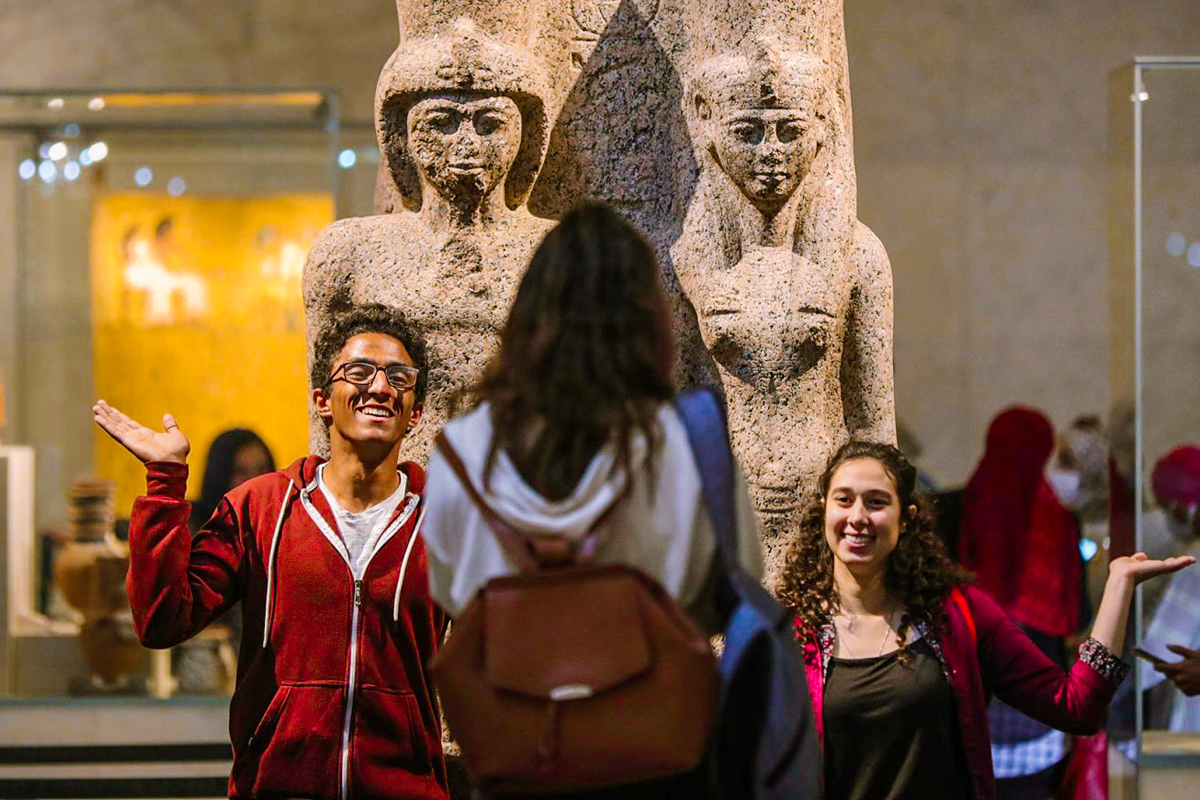
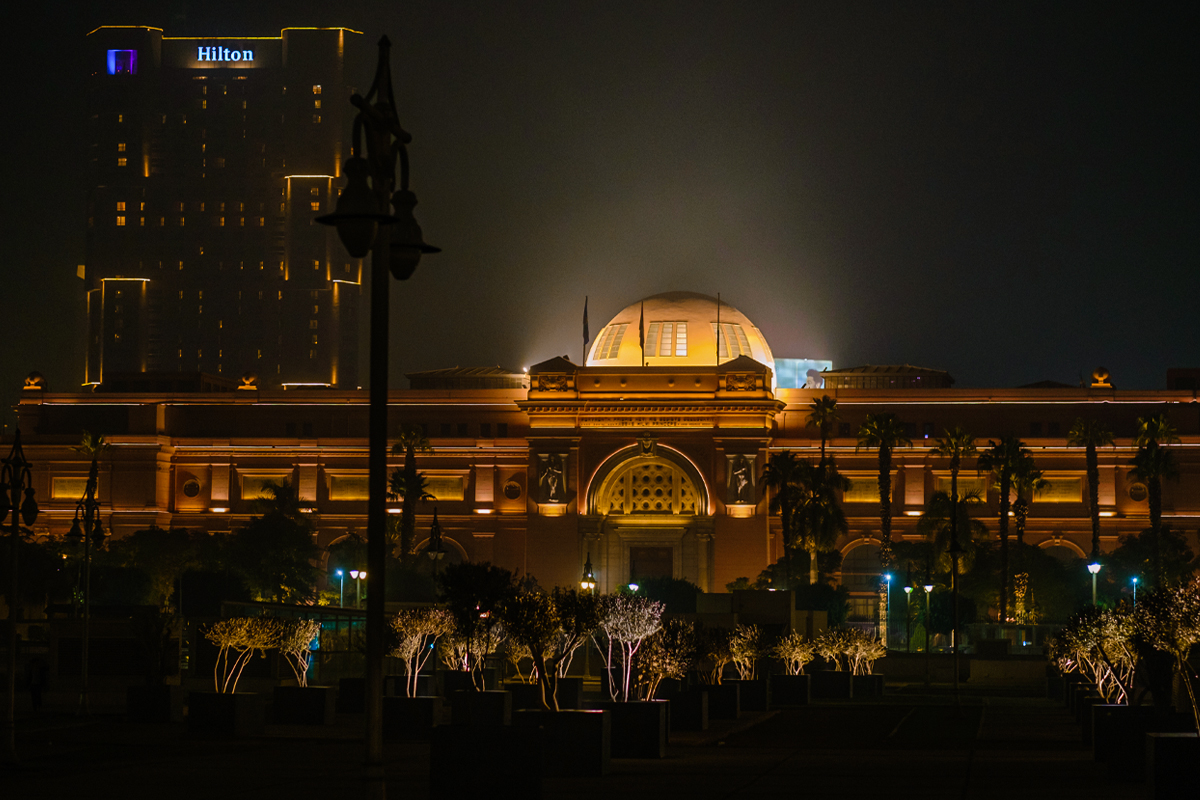
The Egyptian Museum in Tahrir Square is a neoclassical building painted in its signature soft pink-red color, with high ceilings, ornate columns, and a layout that feels more like a 19th-century European museum than a modern facility. The galleries are organized loosely by dynasty and theme, but after more than a century of continuous use and additions, the flow can feel a bit maze-like. Many rooms are packed floor to ceiling with statues, sarcophagi, and artifacts, sometimes with minimal spacing between pieces. For some visitors, this density is part of the charm, a reminder that this building has been quietly accumulating history since before either World War. For others, especially first-time visitors expecting a slick modern experience, it can feel overwhelming or even a little disorganized.
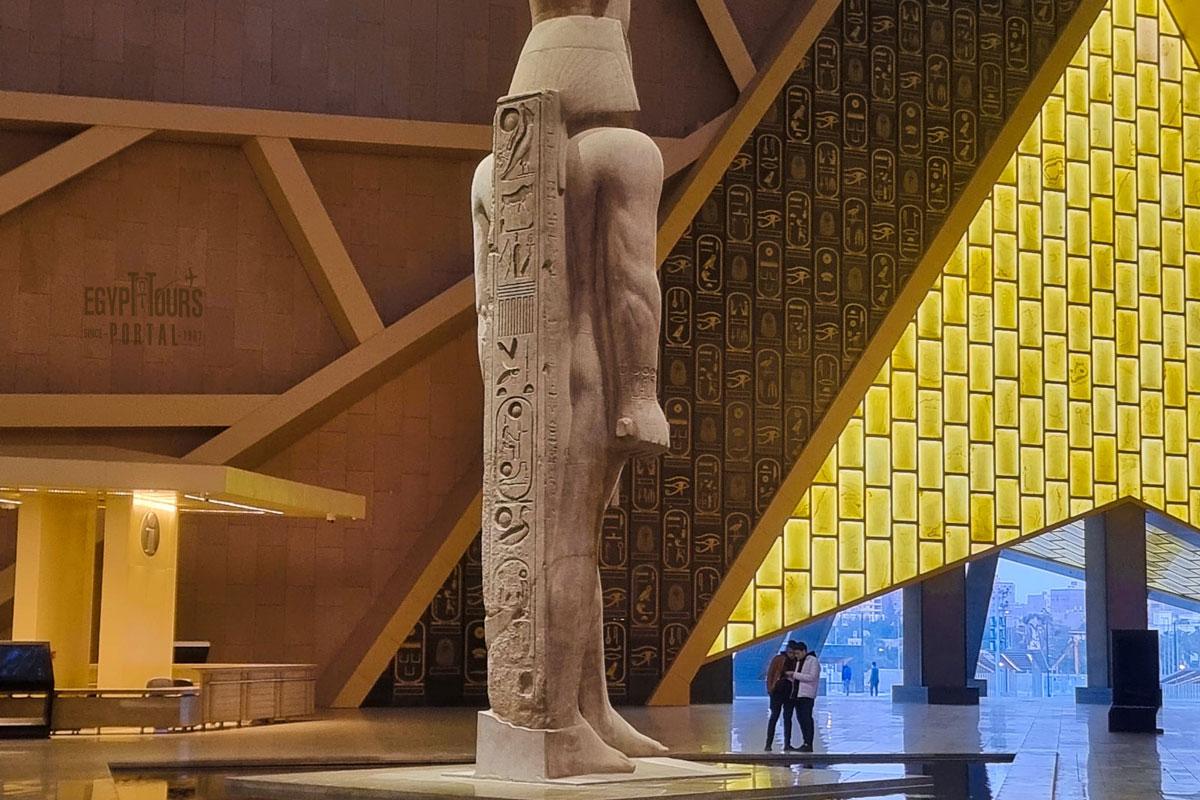
The Grand Egyptian Museum takes the complete opposite design philosophy. Designed by the Irish firm Heneghan Peng Architects, the building itself is a work of art, with a massive triangular facade that echoes the shape of the Pyramids visible just beyond it. Inside, natural light floods through enormous windows, and the Grand Staircase, lined with dozens of colossal statues, leads visitors upward with a view of the Giza Plateau as a dramatic backdrop. The exhibition halls are spacious, climate-controlled, and organized in clear chronological order, from prehistoric Egypt through the Old, Middle, and New Kingdoms, all the way to the Greco-Roman period. Interactive displays, multimedia walls, and thoughtfully designed lighting make the entire experience feel closer to a world-class modern museum in London, Paris, or New York, but with the added advantage of housing the single largest collection of ancient Egyptian artifacts on the planet.
- Tip for photographers: GEM’s architecture, especially the Grand Staircase and the glass facade with the Pyramids in the background, is significantly more photogenic and better lit for photography than the older museum, where flash photography restrictions and tighter spacing make good shots harder to capture.
- Tip for architecture enthusiasts: Even if ancient history is not your main interest, GEM is worth visiting purely as a piece of modern architecture. The building itself has become one of the most photographed structures in Egypt since its 2026 opening.
Collections and Artifacts: What Each Museum Actually Holds in 2027
This is the section most travelers care about the most, because at the end of the day, the real question behind “Egyptian Museum vs GEM” is simple: which one has the artifacts I actually want to see?
The Egyptian Museum in Tahrir still holds an enormous and historically rich collection, estimated at around 160,000 objects, even after various pieces have been transferred to GEM over the past several years. You will still find the Narmer Palette, considered one of the earliest historical documents in the world, along with an extensive collection of Old Kingdom statues, Middle Kingdom jewelry, and New Kingdom artifacts that have not yet made the move across the city. The museum also retains a fascinating and slightly eerie Mummy Room, home to several royal mummies still on display here as of 2026, offering a rare and intimate encounter with actual preserved remains of ancient pharaohs and queens.
The Grand Egyptian Museum holds over 100,000 carefully curated artifacts, and this is where the phrase “curated” really matters. Unlike the older museum’s dense, sometimes cluttered approach, GEM’s galleries are designed to tell a coherent story, with fewer objects per room but far richer context, better lighting, and detailed multilingual information panels. The absolute centerpiece of GEM is the complete Tutankhamun collection, all 5,000-plus items found in his tomb, displayed together for the first time in history in a dedicated wing spanning multiple floors. This alone makes GEM a must-visit for anyone even remotely interested in ancient Egypt.
| Collection Highlight | Egyptian Museum (Tahrir) | Grand Egyptian Museum (GEM) |
|---|---|---|
| Narmer Palette | Yes | No |
| Full Tutankhamun collection | Partial, historically | Yes, complete, all 5,000+ items |
| Khufu Solar Boat | No (previously at separate Giza site) | Yes, fully restored |
| Royal Mummies on display | Some remain here | Not held here (see NMEC section below) |
| Old Kingdom statues | Extensive | Extensive, better lit |
| Middle Kingdom jewelry | Yes | Yes |
| Greco-Roman artifacts | Limited | Dedicated gallery |
| Total estimated artifacts | ~160,000 | 100,000+ curated pieces |
Tip: If Tutankhamun is your main reason for visiting Egypt, GEM is non-negotiable. This is the only place in the world where you can see his entire treasure collection reunited in one location.
Tip for antiquities enthusiasts: Do not skip the old Egyptian Museum assuming everything important has “moved.” The Narmer Palette alone, one of the most historically significant objects in the study of ancient Egypt, remains in Tahrir as of 2027.
King Tutankhamun’s Treasures: Where Are They Now in 2027?
Few questions come up as often in our client consultations as “where are Tutankhamun’s treasures now?” and it deserves its own dedicated section, because the answer directly shapes which museum you should prioritize.
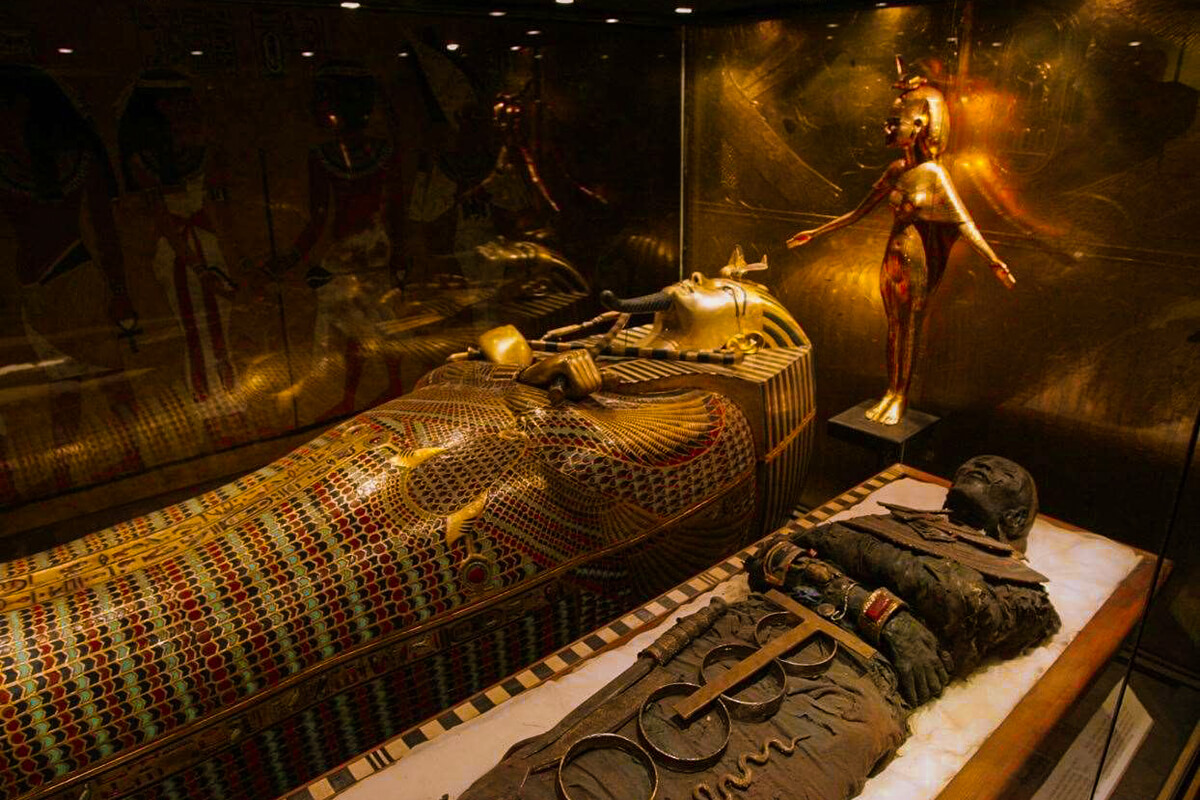
For decades, the golden mask of Tutankhamun and a portion of his burial treasures were the star attraction of the Egyptian Museum in Tahrir. Millions of travelers over the past century have stood in front of that famous golden mask in a dimly lit room on the museum’s upper floor. However, following the completion of the Grand Egyptian Museum’s dedicated Tutankhamun wing, the entire collection, including the golden mask, the nested coffins, the golden throne, the chariots, and thousands of smaller objects such as jewelry, furniture, and ceremonial items, has been consolidated and displayed together at GEM. This is the first time in history that the full collection discovered in 1922 by Howard Carter has been exhibited as one unified display, rather than split across different rooms or, in earlier decades, sent on international touring exhibitions.
The significance of this cannot be overstated for any traveler asking “which museum has King Tut’s treasures?” As of 2027 , the answer is clearly the Grand Egyptian Museum. The dedicated Tutankhamun galleries span an entire floor, arranged to mirror the actual layout of the tomb’s antechamber, burial chamber, treasury, and annex as they were discovered by Carter’s team. Multimedia displays recreate the moment of discovery, giving visitors context that the older museum’s presentation, while beloved for generations, could never fully deliver due to space limitations.
This does not mean the old Egyptian Museum has nothing to offer Tutankhamun enthusiasts. It still displays some related historical documentation, period photographs from the original 1920s excavation, and additional New Kingdom artifacts from the same era that provide useful historical context. But if your goal is to stand in front of the golden mask and the complete treasury as Carter himself might have imagined it displayed, GEM is where you need to go.
| Tutankhamun Question | Answer for 2027 |
|---|---|
| Which museum has King Tut’s treasures? | Grand Egyptian Museum (GEM) |
| Is the collection complete at GEM? | Yes, all 5,000+ items displayed together |
| Can you still see anything Tut-related at the old museum? | Yes, historical documentation and related period pieces |
| Best time to visit the Tut galleries | Early morning or weekday evenings to avoid crowds |
| Recommended time for this wing alone | 1.5 to 2 hours |
Tip: Book your GEM tickets with timed entry for the Tutankhamun wing specifically, since this is the single most crowded section of the entire museum, especially during peak season between October and April 2026.
Tip for photography lovers: Flash photography is prohibited around the golden mask and several fragile items, so bring a camera that performs well in low light if you want quality photos without disturbing the historic display.
The Royal Mummies Collection: Which Museum Has Them in 2027 ?
This is one of the most misunderstood parts of the entire Egyptian Museum Cairo vs Grand Egyptian Museum debate, so let’s clear it up completely.
Many travelers assume the Royal Mummies automatically moved to the Grand Egyptian Museum along with the Tutankhamun collection, since GEM is the newer, larger facility. That assumption is incorrect.
In April 2021, Egypt held a spectacular event known as the Pharaohs’ Golden Parade, transporting 22 royal mummies, including Ramses II and Hatshepsut, from the old Egyptian Museum to the National Museum of Egyptian Civilization (NMEC), located in Fustat, in Old Cairo. This is a separate museum entirely, distinct from both the Egyptian Museum in Tahrir and the Grand Egyptian Museum near Giza.
So if you are specifically searching for “which museum has the royal mummies?” as of 2026, the honest and accurate answer is neither the Egyptian Museum nor GEM. The Royal Mummies Hall is housed at NMEC, a purpose-built facility with advanced climate control and low lighting specifically engineered to preserve these incredibly fragile human remains for future generations. That said, the Egyptian Museum in Tahrir still displays a separate collection of mummies in its own Mummy Room, which includes some royal and non-royal mummies that were not part of the 2021 transfer, so it is not entirely without this experience.
For travelers who want the complete “royal mummy experience,” we generally recommend treating NMEC as a third stop alongside GEM and the Egyptian Museum, especially if you are staying in Cairo for three days or more. It is a relatively quick add-on since NMEC is not far from central Cairo, and the presentation of the mummies there, with dim lighting, respectful signage, and DNA-based historical context, is considered one of the most moving museum experiences in the country.
| Location | What You’ll Find |
|---|---|
| Egyptian Museum (Tahrir) | Some remaining mummies (not the main royal collection) |
| Grand Egyptian Museum (GEM) | No royal mummies displayed here |
| National Museum of Egyptian Civilization (NMEC) | The main Royal Mummies Hall, including Ramses II and Hatshepsut |
Tip: If seeing an actual pharaoh’s preserved remains, like Ramses II, is on your bucket list, make sure your itinerary includes NMEC specifically. Do not assume GEM or the old museum will cover this for you.
Tip for history lovers: Ask your guide about the Pharaohs’ Golden Parade of 2021. It was broadcast internationally and remains one of the most remarkable modern events in Egyptology, a genuinely unique story to bring up at dinner after your trip.
The Khufu Solar Boat and Giza-Area Exhibits
The Khufu Solar Boat is another artifact that has physically relocated in recent years, and it plays directly into the Grand Egyptian Museum comparison many travelers are researching before their 2027 trip.
This 4,500-year-old wooden boat was discovered in 1954, buried in a sealed pit right next to the Great Pyramid of Khufu at Giza. It was believed to have been built for the pharaoh’s journey into the afterlife, or possibly used in his funeral procession. For decades, it was displayed in a dedicated Solar Boat Museum located right at the Giza Plateau, a short walk from the Great Pyramid itself. That original boat museum has since closed, and the fully restored Khufu Solar Boat has been carefully transported and reassembled inside the Grand Egyptian Museum, where it now sits in its own specially designed gallery with the Great Pyramid visible through massive windows behind it.
This move makes a lot of sense from a preservation standpoint. GEM’s climate-controlled environment protects the ancient wood far better than the older, more basic structure at Giza ever could. It also means that when you visit GEM in 2027, you get a genuinely emotional moment: standing in front of a real 4,500-year-old boat with the actual pyramid it was buried beside visible through the window just behind it. Few museum experiences anywhere in the world create that kind of direct visual link between an artifact and its original context.
The Egyptian Museum in Tahrir never held the Solar Boat, so this is purely a GEM highlight, but it is worth mentioning because many travelers ask specifically “which museum has more artifacts tied directly to the Pyramids themselves,” and the answer is clearly GEM, thanks to both its proximity to the Giza Plateau and the Solar Boat’s new home inside its walls.
Tip: Save the Solar Boat gallery for later in your visit when natural light is best for photography, typically mid-morning to early afternoon, since the gallery’s windows face the Giza Plateau directly.
Tip for combining sites: Many of our 2027 itineraries pair a Giza Pyramids and Sphinx tour in the morning with a GEM visit in the afternoon, allowing you to see the actual Pyramid first, then the boat that once sailed symbolically beside it, all within a few hours.
Grand Egyptian Museum vs Egyptian Museum Tickets and Prices in 2027
Budgeting correctly matters for almost every traveler comparing Egyptian Museum Cairo vs Grand Egyptian Museum prices, especially since ticket structures differ quite a bit between the two.
The Egyptian Museum in Tahrir has traditionally been the more budget-friendly option, with a standard general admission ticket, plus optional add-on tickets if you want access to the Royal Mummy Room (when mummies are on display there) or if you want a photography permit, since standard ticket prices typically do not include the right to take photos inside. Foreign visitors pay a different rate than Egyptian and Arab nationals, which is standard practice across almost all Egyptian heritage sites.
The Grand Egyptian Museum uses a tiered ticket system, reflecting its status as a premium, world-class facility. There is a general admission ticket that grants access to the main galleries, and a separate, higher-priced ticket that includes access to the dedicated Tutankhamun exhibition, since this wing operates on a timed-entry basis due to overwhelming demand. There are also combined tickets available that bundle GEM admission with a Giza Pyramids visit, which tends to offer better value than purchasing everything separately, especially for travelers who know they want to do both on the same day.
Because ticket prices, categories, and included add-ons can change throughout 2027 as GEM continues to roll out new wings and exhibitions, we always recommend booking through a licensed travel agency rather than trying to piece together tickets yourself at the gate, particularly during peak season when walk-up lines can stretch for hours.
| Ticket Type | Egyptian Museum (Tahrir) | Grand Egyptian Museum (GEM) |
|---|---|---|
| General admission | Lower cost, single tier | Moderate to higher cost |
| Tutankhamun wing access | Not applicable | Separate, timed-entry ticket required |
| Photography permit | Extra fee, required for cameras | Often included in higher tiers |
| Student/child discounts | Available with valid ID | Available with valid ID |
| Combined Pyramids + Museum ticket | Not typically offered | Yes, popular bundled option |
| Skip-the-line options | Limited | Available through licensed operators |
Tip: Buying skip-the-line or pre-booked tickets is especially valuable at GEM in 2027 , since the museum has become one of the most visited attractions in the Middle East, and walk-up queues during high season (October through April) can be long, particularly at the ticket counters and security checkpoints.
Tip for budget travelers: If cost is a major factor, the Egyptian Museum in Tahrir remains the more affordable option and still delivers a rich, memorable experience, especially if photography add-ons are skipped and you focus on simply enjoying the artifacts.
Booking tip: Our team at Egypt All Inclusive bundles museum tickets, private transportation, and licensed Egyptology guides into single, hassle-free packages, so you never have to worry about ticket categories, timed entry slots, or standing in line under the Cairo sun.
Opening Hours in 2026: Planning Your Museum Day the Right Way
Timing your visit correctly can make or break your museum experience, and this is one area where the Grand Egyptian Museum opening hours differ noticeably from the Egyptian Museum Cairo opening hours.
The Egyptian Museum in Tahrir generally operates on a fairly standard daytime schedule, opening in the morning and closing in the early evening, seven days a week, with slightly adjusted hours during religious holidays such as Ramadan. Because it sits in the middle of downtown Cairo, arriving right at opening time is strongly recommended, both to beat tour bus crowds and to avoid the worst of the surrounding traffic congestion that builds up as the day goes on.
The Grand Egyptian Museum operates on an extended schedule for 2026, with several days offering evening hours that stretch well past sunset. This extended schedule exists partly because GEM was designed to handle enormous visitor volumes and partly because an evening visit offers a genuinely different atmosphere, with the museum’s dramatic lighting design and the Giza Plateau glowing in the distance through the massive windows. Many travelers specifically request an evening slot for their GEM visit because the crowds thin out significantly after around 4 or 5 PM, and the building’s architecture looks even more spectacular under its evening lighting design.
Because opening hours can shift depending on the season, national holidays, and ongoing gallery openings throughout 2026, always confirm the current schedule before finalizing your itinerary, or better yet, let a local travel agency handle this for you so you are never caught off guard by a sudden closure or schedule change.
| Timing Factor | Egyptian Museum (Tahrir) | Grand Egyptian Museum (GEM) |
|---|---|---|
| Typical opening time | Morning | Morning |
| Typical closing time | Early evening | Extended evening hours on select days |
| Best time to arrive | Right at opening | Either early morning or late afternoon |
| Ramadan schedule | Adjusted hours | Adjusted hours |
| Crowd levels by time of day | Busiest mid-morning to early afternoon | Busiest late morning through midday |
Tip: If you are a night-owl traveler or simply want to avoid the midday heat during your 2026 trip, book a late-afternoon GEM slot. Watching the sun set behind the Giza Plateau through the museum’s windows is one of the most memorable moments our clients report from their entire Egypt trip.
Tip for early risers: Arriving at the Egyptian Museum in Tahrir right when it opens gives you nearly an hour of relatively empty galleries before tour groups start arriving, which is ideal if you want quiet time with the Narmer Palette or the Mummy Room.
How Much Time Do You Actually Need at Each Museum?
This is one of the most practical questions travelers ask us directly: “how much time do you need at the Grand Egyptian Museum” and “how much time do you need at the Egyptian Museum” when building a Cairo itinerary.
The Egyptian Museum in Tahrir can realistically be covered in two to three hours for a general visitor who wants to see the highlights, including the Narmer Palette, the remaining New Kingdom artifacts, and the Mummy Room. If you are a serious history enthusiast who wants to read every placard and examine every statue, you could easily spend a full day here, since the sheer density of objects means there is always something new to notice in a corner you missed the first time.
The Grand Egyptian Museum requires significantly more time due to its scale. We recommend a minimum of four to six hours to properly appreciate the main galleries, the Tutankhamun wing, and the Khufu Solar Boat display, plus time for the Grand Staircase and the museum’s shops and cafes. Many travelers who plan to see literally everything, including all specialized galleries and temporary exhibitions, end up spending a full eight-hour day here, especially first-time visitors who are seeing the complete Tutankhamun collection reunited for the first time.
If your schedule truly cannot accommodate both museums, here is our honest advice based on years of guiding clients through Cairo: choose GEM if this is your only opportunity to see Tutankhamun’s complete treasures and the Khufu Solar Boat, since these experiences do not exist anywhere else in the world. Choose the Egyptian Museum in Tahrir if you have a strong interest in Egyptology’s history as a discipline, want a shorter, more affordable visit, or if your itinerary is centered around downtown Cairo rather than Giza.
| Visitor Type | Recommended Time at Egyptian Museum | Recommended Time at GEM |
|---|---|---|
| Quick highlights tour | 1.5 to 2 hours | 3 to 4 hours |
| Standard, balanced visit | 2 to 3 hours | 4 to 6 hours |
| Serious history enthusiast | Half a day or more | Full day |
| Families with young children | 1 to 1.5 hours | 2 to 3 hours |
Tip: Break your GEM visit into sections mentally before you arrive: the Grand Staircase, the chronological galleries, and the Tutankhamun wing. Trying to see all of GEM without a plan often leads to museum fatigue before you even reach the golden mask.
Tip for combining both museums in one day: It is possible but demanding. Start at the Egyptian Museum right at opening, spend two focused hours there, then head to GEM by early afternoon for the remainder of the day. This works best with a private driver who can navigate Cairo traffic efficiently between the two locations.
Which Museum Is Better for Families and Children in 2027 ?
Parents planning a 2027 Egypt trip often ask us directly which museum is better for families, and the answer genuinely favors the Grand Egyptian Museum, though the older museum still has its place for certain family situations.
GEM was designed with modern visitor comfort in mind, which matters enormously when you are traveling with children. The building is fully wheelchair and stroller accessible, with wide walkways, elevators, and plenty of open space so kids are not squeezed between fragile glass display cases. There are dedicated family facilities, including baby-changing stations, a food court with a wider variety of options than the older museum offers, and interactive multimedia displays that tend to hold children’s attention far better than static glass cases filled with dense historical text. The sheer visual drama of the Grand Staircase and the Tutankhamun galleries also tends to genuinely excite children in a way that translates into a more enjoyable family day out, rather than a chore.
The Egyptian Museum in Tahrir, while historically rich, presents more challenges for families. The building has stairs in several sections without full accessibility accommodations, the galleries are more crowded and tightly packed, and there is less designed specifically for younger visitors in terms of interactive content. That said, some parents specifically enjoy the old museum’s slightly eerie, adventurous feel with their older children or teenagers, particularly the Mummy Room, which tends to leave a lasting impression on kids old enough to appreciate ancient history without being frightened by it.
If you are traveling with toddlers or very young children, we generally recommend keeping visits to either museum shorter and more focused, since museum fatigue sets in quickly for young kids regardless of how impressive the surroundings are.
| Family Consideration | Egyptian Museum (Tahrir) | Grand Egyptian Museum (GEM) |
|---|---|---|
| Stroller accessibility | Limited | Excellent |
| Baby facilities | Basic | Modern, dedicated facilities |
| Food options for kids | Limited nearby | Full food court on-site |
| Interactive/multimedia content | Minimal | Extensive |
| Recommended age for Mummy Room | 8 years and older | Not applicable (mummies not displayed here) |
Tip: If visiting GEM with young children, plan your visit around nap times if possible, and take advantage of the on-site food court for a proper break rather than trying to power through the entire museum in one stretch.
Tip for teenagers: The old Egyptian Museum’s Mummy Room often becomes the highlight of the whole Egypt trip for teenagers, so do not skip it purely because GEM is the newer, flashier option.
Which Museum Is Better for Photographers in 2027 ?
For travelers whose Instagram feed or personal photography portfolio matters as much as the history lesson, the Grand Egyptian Museum or Egyptian Museum question has a fairly clear answer, though both offer unique opportunities.
GEM was essentially built with photography in mind. The Grand Staircase, lined with colossal statues and bathed in natural light from floor-to-ceiling windows, is arguably one of the most photogenic indoor spaces in the entire Middle East right now. The building’s exterior, especially at golden hour with the Pyramids visible in the background, has already become one of the most shared architectural photographs from Egypt since its 2027 opening. Inside, most galleries allow photography without flash, and the spacious layout means you can actually compose a shot without ten other visitors crowding into your frame, something that is nearly impossible in several rooms of the older museum.
The Egyptian Museum in Tahrir has more restrictions. A photography permit is typically required for cameras, phone photography rules can vary by gallery, and the tighter, more crowded layout of many rooms makes clean compositions harder to achieve. That said, the museum’s historic architecture, ornate ceilings, and old-world atmosphere offer a completely different aesthetic that some photographers specifically seek out, precisely because it looks nothing like a modern museum. If you are documenting the contrast between old and new Egypt, or specifically want images with a vintage, archival feel, the older museum delivers that mood in a way GEM’s ultra-modern design simply cannot replicate.
| Photography Factor | Egyptian Museum (Tahrir) | Grand Egyptian Museum (GEM) |
|---|---|---|
| Natural lighting | Limited | Excellent |
| Space for composition | Tight, crowded | Spacious |
| Photography permit required | Often yes | Usually included |
| Best subject matter | Vintage displays, ornate architecture | Grand Staircase, Tutankhamun wing, Solar Boat |
| Golden hour exterior shots | Not applicable (city center) | Excellent, Pyramids visible |
Tip: For the best exterior shot of GEM, arrive about an hour before sunset and position yourself near the museum’s main plaza, where the glass facade catches the changing light beautifully against the Pyramids.
Tip for interior shots: Bring a fast lens or a camera that handles low light well for both museums, since flash photography is restricted around fragile and light-sensitive artifacts in both locations.
Which Museum Should First-Time Visitors Choose in 2027?
If this is your very first trip to Egypt, the Grand Egyptian Museum or Egyptian Museum for first-time visitors question deserves a direct, honest answer, and here it is: start with GEM if you can only choose one, but try to fit in both if your schedule allows even a short window for the second.
GEM gives first-time visitors the complete highlight reel of ancient Egyptian civilization in one modern, well-organized, air-conditioned space, with the added bonus of standing right next to the Giza Pyramids. For someone who has never studied Egyptology deeply and simply wants an unforgettable, comprehensive introduction, GEM’s chronological layout and world-class presentation of Tutankhamun’s treasures deliver an experience that is very hard to top anywhere else on earth.
However, we would gently push back against the idea that first-time visitors should skip the old Egyptian Museum entirely. There is something genuinely moving about standing in a 120-year-old building that has protected these treasures since before either World War, especially if you enjoy history that feels lived-in rather than polished. Several of our first-time clients have told us that the contrast between the two museums, visited on the same trip, gave them a far deeper appreciation for both ancient Egypt and modern Egypt’s ongoing relationship with its own heritage.
Our honest recommendation for first-time visitors in 2027 : if you have three or more days in Cairo, visit both. If you have a single day, prioritize GEM, then decide based on how much time is left whether a shorter stop at the old museum fits your remaining schedule.
Tip: First-time visitors often underestimate how emotionally powerful standing in front of the actual golden mask of Tutankhamun feels in person. Budget extra time in the Tutankhamun wing at GEM rather than rushing through it.
Tip for trip planning: Let a licensed local agency sequence your museum visits around your flight times, hotel location, and energy levels. First-time visitors often try to cram too much into day one and end up exhausted before reaching the Pyramids themselves.
Can You Visit Both Museums in One Day? A Realistic Answer
This is one of the most searched practical questions among 2027 travelers, and the honest answer is: yes, but only with careful planning and realistic expectations.
Visiting both the Egyptian Museum in Tahrir and the Grand Egyptian Museum in a single day is physically possible, especially if you start early and have private transportation arranged in advance. A realistic schedule looks like this: arrive at the Egyptian Museum right at opening time, spend a focused two hours covering the Narmer Palette, key Old and Middle Kingdom galleries, and the Mummy Room, then depart by mid-morning. From there, a 40 to 60 minute drive brings you to GEM, where you can spend the remainder of your day, ideally four to five hours, covering the main galleries, the Grand Staircase, and the Tutankhamun wing, finishing with an early dinner at GEM’s on-site food options as the museum transitions into its evening lighting.
This plan works best for travelers who are comfortable with a fast-paced day and who genuinely prioritize seeing both collections over a more relaxed, leisurely pace. It is not ideal for families with very young children, travelers recovering from jet lag, or anyone who prefers to fully absorb each gallery without watching the clock.
| Approach | Best For |
|---|---|
| Both museums, one long day | Efficient travelers, limited total days in Egypt |
| Egyptian Museum one day, GEM another day | Families, relaxed travelers, photographers |
| GEM only | First-time visitors with very limited time |
| Egyptian Museum only | Budget-focused, downtown-based itineraries |
Tip: If attempting both museums in one day, eat a substantial breakfast and carry water, since museum fatigue combined with Cairo’s climate can catch travelers off guard, especially between March and October.
Tip: Book a private guide and driver for this specific itinerary. Public transport or taxis alone make the tight timing between these two museums considerably harder to manage reliably.
Is the Egyptian Museum Still Worth Visiting in 2027?
With so much attention on the Grand Egyptian Museum since its 2027 grand opening, a fair question arises: is the Egyptian Museum still worth visiting, or has it become a relic overshadowed by its modern successor?
Based on years of guiding travelers through both institutions, our answer is a confident yes, the Egyptian Museum in Tahrir is still absolutely worth visiting in 2027 . It remains open, it still holds around 160,000 artifacts, and it continues to display genuinely irreplaceable pieces like the Narmer Palette, along with a significant portion of Old and Middle Kingdom statuary that has not been transferred to GEM. Beyond the objects themselves, the museum offers something GEM simply cannot replicate: the atmosphere of a century-old institution that has witnessed Egypt’s modern history unfold around it, from British colonial rule through independence, revolutions, and the country’s ongoing transformation today.
There is also a practical argument for keeping the old museum on your itinerary. Its central Tahrir Square location makes it an easy, low-effort addition to any downtown Cairo day, whether you are killing a few hours before a flight, taking a break from a Nile cruise, or simply want a shorter, more affordable museum experience that does not require a dedicated half-day trip out to Giza.
Some travelers worry that visiting the old museum after already seeing GEM will feel like a downgrade, but many of our clients report the opposite reaction. Seeing the more modern, polished presentation at GEM first often deepens appreciation for the older museum’s raw, historical character, almost like comparing a beautifully restored classic car to seeing the actual factory where it was originally built.
Tip: Do not skip the Egyptian Museum in Tahrir under the assumption that GEM has “replaced” it. As of 2027 , both museums operate simultaneously, each offering a genuinely different and valuable experience.
Tip for return visitors: If you visited Egypt before 2027 and only saw the old museum, a return trip focused specifically on GEM’s newly completed galleries offers an entirely fresh experience worth planning a dedicated trip around.
Which Museum Is Better Overall? Our Honest Final Verdict for 2027
After walking through history, architecture, collections, pricing, timing, and audience-specific recommendations, you are probably still wondering: which museum is genuinely better, all things considered?
Here is our honest, experience-based verdict. For sheer scale, modern presentation, and the complete Tutankhamun collection, the Grand Egyptian Museum is the better choice for most travelers in 2027 , particularly first-time visitors, families, and photographers. Its location next to the Giza Pyramids, extended evening hours, and world-class curation make it the single most impressive museum experience currently available in Egypt, and arguably one of the best in the world.
That said, “better” does not mean the Egyptian Museum in Tahrir has become irrelevant. For travelers who value historical authenticity, a more affordable ticket, a central downtown location, and access to pieces like the Narmer Palette that remain exclusively there, the old museum still holds genuine, irreplaceable value. Serious history enthusiasts and returning visitors who have already experienced GEM often find the older museum surprisingly rewarding precisely because it offers a completely different atmosphere and a different slice of the collection.
Our real recommendation, based on what actually makes clients happiest after their trip, is this: if your schedule and budget allow it, visit both. If you must choose only one, let your personal priorities decide. Choose GEM if Tutankhamun’s treasures, modern architecture, and pairing with the Pyramids matter most to you. Choose the Egyptian Museum if historical atmosphere, budget, and a shorter, downtown-friendly visit matter more.
| Your Priority | Recommended Museum |
|---|---|
| Complete Tutankhamun treasures | Grand Egyptian Museum |
| Modern, comfortable, family-friendly facilities | Grand Egyptian Museum |
| Photography and architecture | Grand Egyptian Museum |
| Historical atmosphere and authenticity | Egyptian Museum (Tahrir) |
| Budget-conscious, shorter visit | Egyptian Museum (Tahrir) |
| Central downtown Cairo location | Egyptian Museum (Tahrir) |
| Pairing with a Giza Pyramids day trip | Grand Egyptian Museum |
| Seeing the Narmer Palette | Egyptian Museum (Tahrir) |
Tip: Do not treat this as a strict either-or decision if your itinerary has flexibility. Many of our most satisfied 2026 clients specifically requested both museums after realizing how different, and how complementary, the two experiences actually are.
Insider Tips for Visiting Both Museums in 2027
To wrap up the practical side of this guide, here are additional insider tips gathered directly from years of organizing Egypt tours, tips you will not find on a typical museum brochure.
Arrive with cash in small denominations for tips to guides, restroom attendants, and any additional photography permit fees, since not every payment point inside either museum reliably accepts cards. Wear comfortable walking shoes, especially for GEM, where the sheer size of the building means significantly more walking than most visitors expect. Bring a light jacket for GEM’s air-conditioned galleries, even during Egypt’s warmer months, since the climate control needed to protect the artifacts keeps indoor temperatures noticeably cooler than outside.
Hire a licensed Egyptologist guide rather than relying solely on posted information panels. The context a knowledgeable guide provides, particularly around the symbolism in Tutankhamun’s treasures or the historical significance of specific statues in the old museum, transforms a good visit into an unforgettable one. Avoid visiting either museum on major Egyptian public holidays if possible, since both experience significant crowd surges during these periods, and lines can extend well beyond normal wait times.
If you are combining GEM with a Pyramids visit on the same day, start with the Pyramids in the cooler morning hours, then move to GEM for the afternoon and evening, since the museum’s indoor, air-conditioned environment is far more comfortable during the hottest part of the day. Finally, always double check ticket categories before your visit, since GEM in particular continues to refine its ticketing structure as new galleries and exhibitions open throughout 2027.
| Insider Tip | Why It Matters |
|---|---|
| Carry small cash | Not all payment points accept cards reliably |
| Wear comfortable shoes | GEM involves significant walking distances |
| Bring a light layer | Galleries are kept notably cool for artifact preservation |
| Hire a licensed guide | Context dramatically improves the experience |
| Avoid public holidays | Crowd levels spike significantly |
| Pair Pyramids in morning, GEM in afternoon | Better comfort during Egypt’s hottest hours |
Tip: Save your energy for the Tutankhamun wing at GEM. It is worth arriving there with a clear mind and enough time rather than rushing through it at the end of an already long day.
Egyptian Museum Cairo Review and Grand Egyptian Museum Review: What Real Visitors Say in 2027
Beyond our own professional experience guiding travelers through both museums, it helps to look at the broader pattern of feedback we consistently hear from clients after their visits, since real visitor impressions often reveal details that official descriptions leave out.
In our Grand Egyptian Museum review, based on hundreds of client debriefs since its full 2027 opening, the overwhelming reaction is genuine awe. Visitors consistently describe the Grand Staircase as more impressive in person than in photographs, and the Tutankhamun wing as an emotional highlight of their entire Egypt trip, not just their museum visit. Common praise includes the clear English-language information panels, the comfortable pace the layout encourages, and the sense that every gallery was designed with an actual visitor’s experience in mind rather than simply storing objects. The most common piece of constructive feedback we hear is that guests wish they had budgeted more time, since nearly every visitor underestimates how much there is to see.
Our Egyptian Museum Cairo review tells a different but equally positive story. Visitors frequently describe a sense of nostalgia and authenticity, often comparing the experience to walking through a living history book. The dense, old-fashioned display style, once considered a drawback, is now increasingly appreciated by travelers as a genuine artifact of museum history itself. The most common critical feedback involves the crowded pathways during peak season and the limited air conditioning in certain sections during Egypt’s hotter months, both of which are easily managed with proper timing and a knowledgeable guide.
When travelers ask us directly which is the best museum in Cairo or the best museum in Egypt overall for 2027 , we are careful to frame the answer honestly rather than simply picking a favorite. If the question is about scale, modern presentation, and the single most complete ancient Egyptian collection anywhere in the world, the Grand Egyptian Museum earns that title. If the question is about historical character, affordability, and central accessibility within Cairo itself, the Egyptian Museum in Tahrir remains an excellent, still-relevant answer. Both institutions currently share the spotlight, and both deserve genuine recognition rather than one being dismissed in favor of the other.
| Review Category | Egyptian Museum (Tahrir) | Grand Egyptian Museum (GEM) |
|---|---|---|
| Visitor satisfaction with atmosphere | High, praised for authenticity | Very high, praised for scale and design |
| Most common complaint | Crowding, limited air conditioning | Underestimating time needed |
| Most common praise | Historical character, Narmer Palette | Tutankhamun wing, Grand Staircase |
| Repeat visit interest | Moderate | Very high |
| Overall visitor rating trend | Strong, steady | Extremely strong since 2026 opening |
Tip: Read recent visitor reviews before your trip, but weigh them against your own priorities. A traveler complaining about crowds at GEM may simply have visited during peak midday hours, something easily avoided with the timing tips covered earlier in this guide.
Tip: If you enjoy comparing traveler experiences, ask your guide to share stories from previous groups. Guides who have worked both museums extensively often have the most balanced, first-hand perspective available anywhere.
Frequently Asked Questions: Egyptian Museum Cairo vs Grand Egyptian Museum
To close out this guide, here are direct answers to the most common questions travelers ask us before booking their 2026 Egypt trip.
Which museum is better in Cairo?
It depends on your priorities. The Grand Egyptian Museum offers a larger, more modern experience with the complete Tutankhamun collection, while the Egyptian Museum in Tahrir offers historical authenticity and a more central, affordable visit.
What is the difference between the Egyptian Museum and the Grand Egyptian Museum?
The Egyptian Museum is a historic institution in downtown Cairo dating back to 1902, while GEM is a modern, much larger museum near the Giza Pyramids that opened fully in 2026 and now houses the complete Tutankhamun treasures.
Is the Grand Egyptian Museum replacing the Egyptian Museum?
No. As of 2026, both museums operate simultaneously, each holding a distinct and valuable collection of artifacts.
Which museum has King Tut’s treasures?
The Grand Egyptian Museum holds the complete Tutankhamun collection, all items discovered in his tomb, displayed together for the first time in history.
Which museum has the royal mummies?
Neither. The Royal Mummies Collection is housed at the National Museum of Egyptian Civilization (NMEC) in Old Cairo, a separate institution from both museums covered in this guide.
Can you visit both museums?
Yes, and we recommend it if your schedule allows, though visiting both in a single day requires efficient planning and private transportation.
Is the Egyptian Museum still open?
Yes, it remains fully open in 2026 and continues to display around 160,000 artifacts, including the Narmer Palette.
Is the Grand Egyptian Museum worth visiting?
Absolutely. It is currently the largest archaeological museum in the world and home to the complete Tutankhamun collection.
Which museum should first-time visitors choose?
Prioritize the Grand Egyptian Museum if you can only visit one, since it offers the most comprehensive introduction to ancient Egyptian history in a single location.
How long should you spend at the Grand Egyptian Museum?
Budget four to six hours for a proper visit, or a full day if you want to see every gallery in detail.
How long should you spend at the Egyptian Museum?
Two to three hours is typically sufficient for a well-rounded visit covering the main highlights.
Which museum has more artifacts?
The Egyptian Museum in Tahrir holds a larger raw total, around 160,000 objects, while GEM holds over 100,000 carefully curated pieces displayed with far more space and context.
Which museum is bigger?
The Grand Egyptian Museum is significantly larger, spanning over 490,000 square meters compared to the Egyptian Museum’s approximately 15,000 square meters.
Which museum is closer to the Pyramids?
The Grand Egyptian Museum sits just minutes from the Giza Pyramids, while the Egyptian Museum is located in downtown Cairo, roughly 45 to 60 minutes away by car.
Which museum is better for children?
The Grand Egyptian Museum, thanks to its modern facilities, accessibility, and interactive displays, generally offers a smoother experience for families with young children.
Planning Your Full Cairo Itinerary Around Both Museums in 2027
Neither museum exists in isolation, and a smart 2027 Egypt itinerary should treat this comparison as one piece of a much larger puzzle rather than the entire trip. Cairo and Giza offer an enormous range of things to do, and knowing how to sequence your days around the Egyptian Museum and the Grand Egyptian Museum can make the difference between a rushed, exhausting trip and a smooth, memorable one.
A well-balanced Cairo itinerary typically spreads major attractions across three to four days. Day one might focus on the Giza Pyramids, the Great Sphinx, and the Grand Egyptian Museum, taking advantage of their close proximity to each other. Day two could shift downtown, covering the Egyptian Museum in Tahrir, a walk through Tahrir Square, and perhaps a Nile River felucca ride in the late afternoon. Day three often includes the National Museum of Egyptian Civilization for the Royal Mummies, along with Old Cairo’s Coptic and Islamic heritage sites, since this area sits reasonably close to NMEC itself. A fourth day, if available, leaves room for a Nile dinner cruise, a visit to Khan El Khalili bazaar, or a day trip to Saqqara and Dahshur for travelers who want to go deeper into ancient Egyptian archaeology beyond the two headline museums.
This kind of sequencing matters because Cairo’s traffic and distances between attractions are not always intuitive to first-time visitors. Grouping Giza-area sites together, and downtown sites together, dramatically reduces wasted travel time, leaving more hours for actually enjoying the museums rather than sitting in a car. It also allows for natural pacing, alternating between intense, detail-heavy museum time and lighter, more relaxed activities like river cruises or bazaar shopping, which helps prevent museum fatigue over a multi-day trip.
For travelers building their own Egypt museum guide from scratch, this is often the most overlooked part of the planning process. Ticket prices and opening hours get plenty of attention online, but the logistics of moving between Tahrir, Giza, and Old Cairo efficiently is where most independent travelers lose time and patience. This is precisely the kind of detail our team handles as standard practice for every client, mapping out the most efficient possible route between attractions based on your hotel location, flight times, and personal interests.
| Suggested Day | Focus | Key Sites |
|---|---|---|
| Day 1 | Giza area | Pyramids, Sphinx, Grand Egyptian Museum |
| Day 2 | Downtown Cairo | Egyptian Museum, Tahrir Square, Nile felucca |
| Day 3 | Old Cairo | NMEC (Royal Mummies), Coptic and Islamic Cairo |
| Day 4 (optional) | Extended archaeology | Saqqara, Dahshur, Khan El Khalili bazaar |
Tip: Book your Egypt museum tickets and transportation together as a package rather than separately. This is one of the simplest ways to avoid scheduling conflicts and ensure timed-entry slots at GEM align perfectly with the rest of your day.
Tip for combining with other Cairo attractions: If you enjoy archaeology beyond the two main museums, the step pyramid complex at Saqqara pairs beautifully with a Giza and GEM day, since all three sites sit within a similar geographic area southwest of central Cairo.
GEM vs NMEC vs Egyptian Museum in 2027 ?
- Egyptian Museum (Tahrir) — The original, 1902 museum in downtown Cairo. Still holds ~160,000 artifacts, including the Narmer Palette. Some Tutankhamun-related items already moved out, and the royal mummies left in 2021.
- Grand Egyptian Museum (GEM) — The massive new museum next to the Giza Pyramids, fully opened in 2026. This is where the complete Tutankhamun collection (all 5,000+ pieces) and the Khufu Solar Boat now live. No royal mummies here.
- National Museum of Egyptian Civilization (NMEC) — Located in Fustat, Old Cairo. This is the one people forget. It’s where the Royal Mummies Hall actually is — Ramses II, Hatshepsut, and the other pharaohs from the 2021 Pharaohs’ Golden Parade. It also covers a broader timeline of Egyptian civilization, from prehistory through the Islamic era, not just pharaonic Egypt.
Quick Comparison Table
| Factor | Egyptian Museum (Tahrir) | Grand Egyptian Museum (GEM) | NMEC |
|---|---|---|---|
| Location | Downtown Cairo, Tahrir Square | Giza, next to the Pyramids | Fustat, Old Cairo |
| Opened | 1902 | 2026 (full opening) | 2017 (mummies hall 2021) |
| Signature collection | Narmer Palette, general antiquities | Complete Tutankhamun treasures, Khufu Solar Boat | Royal Mummies (Ramses II, Hatshepsut, etc.) |
| Royal mummies? | A few remain, not the main royal collection | No | Yes, the main Royal Mummies Hall |
| Size | ~15,000 sqm | ~490,000 sqm | Mid-sized, modern |
| Typical visit time | 2-3 hours | 4-6 hours | 1.5-2 hours |
| Best paired with | Downtown Cairo / Nile Corniche day | Giza Pyramids day trip | Coptic/Islamic Old Cairo day |
The Simple Rule of Thumb
- Want the golden mask and Tutankhamun’s full treasury? → GEM
- Want to see an actual pharaoh’s face (Ramses II, etc.)? → NMEC, not GEM
- Want the Narmer Palette and old-world museum atmosphere? → Egyptian Museum

Conclusion: Making the Right Choice for Your 2027 Egypt Trip
So, Egyptian Museum Cairo vs Grand Egyptian Museum, which one should you actually book? If we had to summarize everything above into one clear takeaway, it would be this: GEM offers the complete, modern, unforgettable Tutankhamun experience alongside the Giza Pyramids, while the Egyptian Museum in Tahrir offers irreplaceable historical authenticity in the heart of downtown Cairo. Ideally, your 2027 itinerary includes both, giving you the full spectrum of Egypt’s ancient past and its modern approach to preserving it.
Planning all of this yourself, from tickets and timed entries to transportation between Tahrir, Giza, and everywhere in between, can quickly become overwhelming, especially with Cairo’s traffic and the sheer number of details involved in doing both museums justice. That is exactly where we come in. At Egypt All Inclusive, we specialize in building seamless, stress-free Egypt itineraries that combine both museums, the Giza Pyramids, and every other must-see site into a smooth, expertly guided experience tailored to your schedule and interests. As the best travel agency in Egypt in 2027 , we handle the tickets, the timed entries, the private transportation, and the licensed Egyptologist guides, so all you have to do is show up and enjoy one of the most remarkable travel experiences on earth.
Do not leave your once-in-a-lifetime Egypt trip to guesswork. Book your Egyptian Museum and Grand Egyptian Museum tour with Egypt All Inclusive today, and let our team turn this comparison guide into your actual, unforgettable itinerary for 2027.