Quick Answer: Is Al Azhar Mosque Worth Visiting in 2027?
Yes. Al Azhar Mosque is worth visiting in 2027, especially if you are interested in Islamic history, architecture, religion, culture, or Historic Cairo. It is an active mosque and a major center of Islamic scholarship, founded during the Fatimid period and developed through centuries of Mamluk, Ottoman, and modern Egyptian history.
A typical independent visit can take around 45–60 minutes, while combining the mosque with Khan El Khalili, Al-Hussein Mosque, Muizz Street, and nearby monuments can easily fill half a day.
The best approach is to visit outside the main prayer periods, dress conservatively, remove your shoes before entering the appropriate areas, keep noise low, and remember that Al Azhar is a working religious institution rather than a conventional museum.
Visiting Al Azhar Mosque in Cairo, Egypt in 2027 means stepping into one of the oldest continuously operating mosques and centers of Islamic learning in the world, located in the heart of Islamic Cairo next to Khan El Khalili bazaar. This guide covers everything a traveler needs before going: opening hours, entry rules, what to wear, how to get there, what you’ll see inside, and how to combine the visit with the rest of Old Cairo.
Al Azhar Mosque is free to enter, open to non-Muslim visitors outside prayer times, and typically takes 45 minutes to 1.5 hours to explore properly. It sits directly across from Al Muizz Street and a short walk from Khan El Khalili, which makes it one of the easiest historic sites in Cairo to combine with other stops on a walking tour of Islamic Cairo.
For broader planning, you can also use the Cairo Travel Guide and Planning a Trip to Egypt resources.
Al Azhar Mosque at a Glance
| Question | Answer |
|---|---|
| Where is Al Azhar Mosque? | Historic Islamic Cairo, in the Al-Darb Al-Ahmar/Al-Gamaliya area |
| What is it famous for? | Islamic worship, scholarship, architecture, and more than 1,000 years of history |
| When was it founded? | Construction began in 970 CE and the mosque was inaugurated in 972 CE |
| Who founded it? | Fatimid commander Jawhar al-Siqilli under Caliph Al-Mu’izz li-Din Allah |
| Can tourists visit? | Visitors can generally enter outside restricted prayer periods, subject to current rules |
| Can non-Muslims visit? | Yes, visitors of different faiths can visit when access is permitted |
| Is it still a working mosque? | Yes |
| Is there a dress code? | Yes; conservative clothing is appropriate |
| Are shoes removed? | Yes, before entering prayer areas |
| How long should you spend? | Around 45–60 minutes for the mosque itself |
| What is nearby? | Khan El Khalili, Al-Hussein Mosque, Muizz Street, Wekalet El Ghouri and other Islamic monuments |
| Best time to visit? | Generally a quieter morning or another period outside congregational/prayer times |
| Should you check before going? | Yes, particularly for 2027 visiting arrangements, prayer restrictions, restoration, or special events |
The official Al-Azhar institution describes the mosque as dating to the Fatimid era and identifies it as both a mosque and a center of learning with a history extending for more than a millennium.
What Is Al Azhar Mosque?
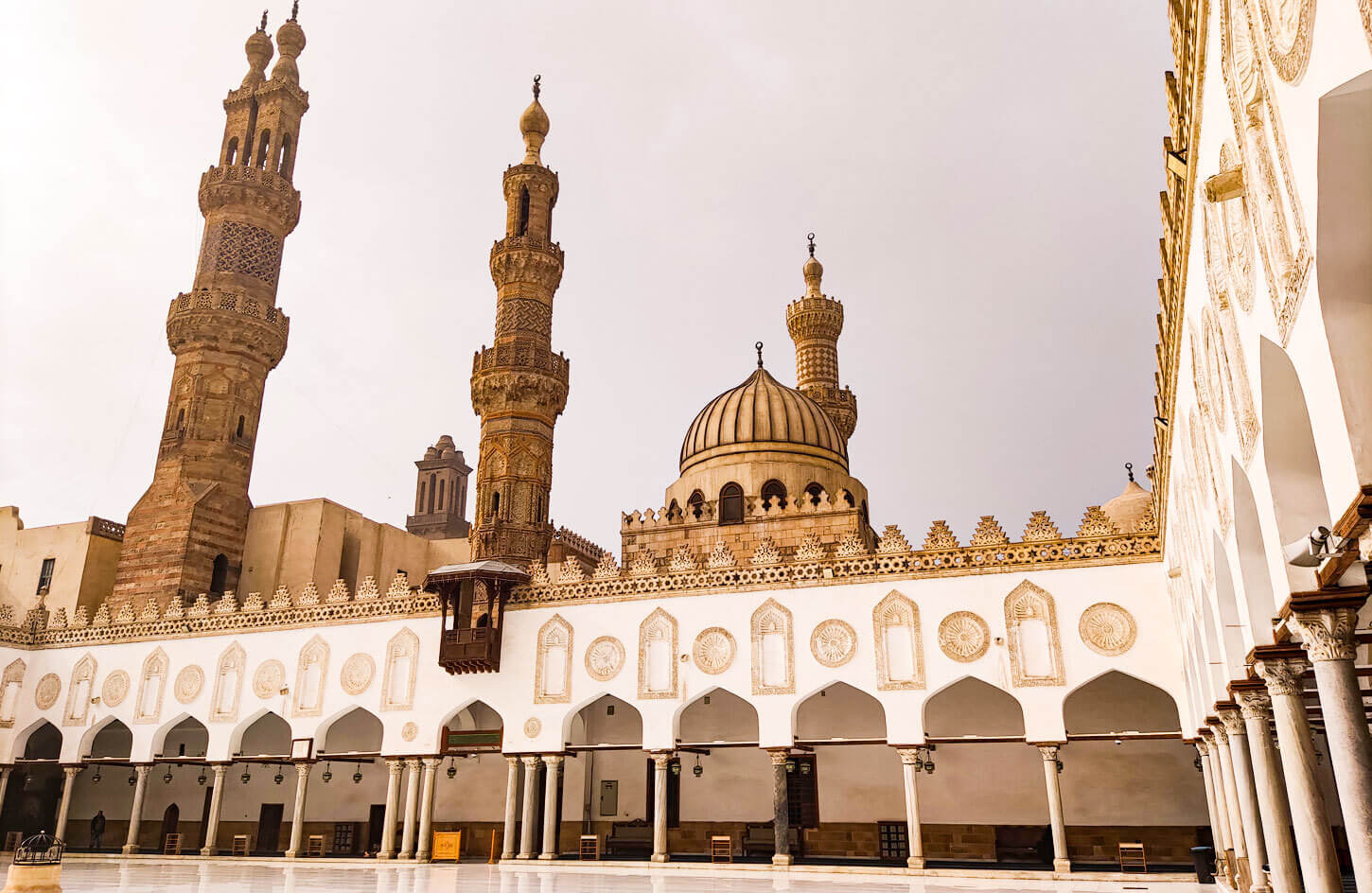
Al Azhar Mosque, also called Al-Azhar Al-Sharif, is a historic Fatimid mosque in Cairo that developed into one of the most influential centers of Islamic learning in the Muslim world.
The mosque was founded shortly after the establishment of Cairo by the Fatimid commander Jawhar al-Siqilli on behalf of Caliph Al-Mu’izz li-Din Allah. The foundation dates to 970 CE, while the mosque was inaugurated for prayer in 972 CE according to Al-Azhar’s official historical account.
Its importance is not limited to architecture. For centuries, Al Azhar has been associated with Islamic scholarship, Arabic language, religious education, jurisprudence, and intellectual life.
This makes a visit different from visiting an archaeological temple or a museum.
At the Grand Egyptian Museum, visitors primarily encounter curated archaeological collections. At Al Azhar Mosque, you are entering a living religious and educational environment.
That distinction matters when planning your visit.
Why Visit Al Azhar Mosque Cairo Egypt in 2027?
There are several reasons Al Azhar deserves a place on a Cairo itinerary.
1. It connects you with Islamic Cairo
The mosque stands in one of Cairo’s most historically important areas. A visit can easily be combined with the narrow streets, markets, mosques, madrasas, historic houses, and monuments of Historic Cairo.
The surrounding area is particularly valuable because the experience continues after you leave the mosque.
You can walk toward Khan El Khalili, explore Muizz Street, visit nearby historic mosques, stop at a traditional café, and observe daily life in one of the oldest parts of Cairo.
If Islamic heritage is one of your priorities, consider an organized Islamic Cairo Tour rather than visiting the mosque as an isolated attraction.
2. It is more than 1,000 years old
Al Azhar’s history begins in the 10th century.
The official Al-Azhar historical account states that the foundation was laid in 359 AH/970 CE and that the mosque opened for prayer in 361 AH/972 CE.
That means travelers visiting in 2027 will be walking through a religious complex whose history stretches across the Fatimid, Ayyubid, Mamluk, Ottoman, and modern periods.
3. The mosque is still alive
One of the most interesting aspects of visiting Al Azhar is that it has not become a purely historical monument.
- People still pray there.
- Students still study.
- Scholars still teach.
- Visitors pass through.
The building therefore provides a connection between Cairo’s medieval history and contemporary life.
4. The architecture reflects several periods
Although Al Azhar began as a Fatimid foundation, what you see today is the result of centuries of construction, enlargement, restoration, and architectural patronage.
The Mamluk period was particularly important for the mosque’s architectural development, while later Ottoman and modern interventions also influenced the complex.
5. It pairs naturally with Khan El Khalili
You do not need to dedicate an entire day to Al Azhar.
A much better strategy is to create an Islamic Cairo walking route.
For example:
Al Azhar Mosque → Khan El Khalili → Al-Hussein area → Muizz Street → historic monuments → traditional café
This gives you a much richer experience than simply arriving, taking photographs, and leaving.
For travelers who want to explore the bazaar as part of the same experience, consider the Khan Al Khalili Shopping Tour.
Where Is Al Azhar Mosque in Cairo?
Al Azhar Mosque is located in Historic Islamic Cairo, in the Al-Darb Al-Ahmar/Al-Gamaliya area, close to Khan El Khalili and Al-Hussein Square.
The listed business location is:
El-Darb El-Ahmar, El Gamaliya, Cairo Governorate, Egypt.
Al-Azhar Al-Sharif
Its central location makes it one of the easier historic Cairo attractions to combine with other landmarks.
Nearby attractions include:
- Khan El Khalili
- Al-Hussein Mosque
- Muizz Street
- Wekalet El Ghouri
- Al-Hakim Mosque
- Sultan Qalawun Complex
- Bayt Al-Suhaymi
- Bab Zuweila
- Al-Azhar Park
- Historic Mamluk monuments
The location is one of Al Azhar’s biggest advantages for tourists.
You can spend the morning exploring the mosque and historic streets, then continue toward other attractions without crossing the city.
How to Get to Al Azhar Mosque
The best transportation option depends on where you are staying in Cairo.
By private car
For visitors staying in areas such as Downtown Cairo, Zamalek, Garden City, New Cairo, or Giza, a private car or ride-hailing service can be convenient.
Traffic can be unpredictable, especially during busy periods.
If you are following a structured sightseeing program, private transportation is particularly useful because you can visit several nearby sites without repeatedly arranging taxis.
A Cairo Sightseeing Tour can be structured around the mosque and other Cairo attractions.
By taxi or ride-hailing service
Taxi or ride-hailing services are practical for independent travelers.
Ask the driver for:
Al Azhar Mosque / Al-Azhar Al-Sharif / Al-Hussein Square area.
Because historic Cairo contains dense streets and pedestrian areas, your vehicle may not drop you directly at the entrance you expect.
Allow time for a short walk.
By metro
Cairo’s metro can be useful for reaching central parts of the city, followed by a taxi or walk depending on your exact starting point and the station you use.
For first-time visitors, however, the metro is not always the simplest solution if your goal is to visit several Historic Cairo monuments in one route.
On foot from Khan El Khalili
If you are already exploring Khan El Khalili, Al Azhar Mosque is very close to the main tourist area.
This is one of the easiest ways to combine the two.
Rather than treating them as separate excursions, consider them part of one Historic Cairo experience.
Al Azhar Mosque History
When Was Al Azhar Mosque Built?
Al Azhar Mosque was founded in the Fatimid period, with construction beginning in 970 CE and the mosque opening for prayer in 972 CE.
The official Al-Azhar account states that Jawhar al-Siqilli laid the foundation in 359 AH/970 CE after the Fatimid establishment of Cairo. The mosque was opened for prayer on Friday, 7 Ramadan 361 AH/972 CE.
This makes Al Azhar one of the earliest major surviving monuments associated with the foundation of Cairo.
Who Built Al Azhar Mosque?
Al Azhar was built under the Fatimid Caliph Al-Mu’izz li-Din Allah by his military commander Jawhar al-Siqilli.
Jawhar had a central role in the Fatimid conquest of Egypt and the establishment of Cairo.
The mosque therefore belongs directly to the formative period of Fatimid Cairo.
Why Was Al Azhar Mosque Built?
The original Fatimid institution had a religious and political purpose connected with the Ismaili Shi’a Fatimid state.
The official history of Al Azhar explains that it was initially established to promote Fatimid religious teachings. Over time, its educational role changed, and the institution eventually became associated with Sunni Islamic scholarship.
This transformation is one of the most important facts about Al Azhar.
It demonstrates that the mosque’s history cannot be understood simply as “a mosque built in 972.”
Its role changed substantially across different political and religious periods.
From Fatimid Mosque to Center of Learning
Al Azhar’s educational history developed relatively soon after its foundation.
The official Al-Azhar account states that the first educational circle was established in 365 AH, corresponding to 975 CE. Students gathered around teachers in traditional study circles, creating an educational model that became closely associated with Al Azhar.
These study circles were part of the institution’s intellectual identity.
Rather than functioning only as a place for communal prayer, Al Azhar became a place where students studied religious sciences, Arabic, jurisprudence, theology, logic, and other disciplines.
Over subsequent centuries, the institution developed into a major destination for scholars and students from across the Islamic world.
Al Azhar During the Ayyubid Period
The Ayyubid period brought major changes.
After Saladin ended Fatimid rule in Egypt, the religious orientation of the state changed toward Sunni Islam.
According to the official historical account, Friday prayer at Al Azhar was suspended during this period as part of the broader effort to replace the Fatimid religious establishment with Sunni institutions.
This is an important historical detail because it explains why Al Azhar’s later Sunni identity should not simply be projected backward onto its original Fatimid foundation.
Al Azhar During the Mamluk Period
The Mamluk period was one of the most significant eras in Al Azhar’s development.
The official Al-Azhar history states that Friday prayer was restored in 1267 CE and that the mosque became increasingly important as a center of Sunni scholarship.
Mamluk rulers also contributed substantially to the architectural development of the mosque.
This is why modern visitors should not expect the building to look like a perfectly preserved Fatimid structure.
Al Azhar is a layered monument.
Its appearance reflects the accumulation of centuries.
Al Azhar During the Ottoman Period
During Ottoman rule, Al Azhar maintained its importance as a center of religious and Arabic learning.
The mosque continued to attract scholars and students from different parts of the Islamic world.
Its influence extended beyond religious education into Egyptian social and intellectual life.
This long continuity is one reason the name Al-Azhar Al-Sharif carries such significance in Egypt and the wider Muslim world.
Al Azhar and Modern Egypt
Al Azhar also played a role in major events in modern Egyptian history.
The institution’s official history describes its role during the French occupation and later periods of political change.
In 1961, Al-Azhar University was formally reorganized under Egyptian law, with the institution developing a wider university structure and numerous colleges.
For travelers, this history helps explain why the terms Al Azhar Mosque, Al Azhar University, and Al Azhar Al Sharif can refer to related but distinct aspects of a much larger institution.
Al Azhar Mosque Facts
Here are some of the most useful Al Azhar Mosque facts for travelers.
- Al Azhar was founded during the Fatimid period.
- Construction began around 970 CE.
- The mosque opened for prayer in 972 CE.
- It was founded by Jawhar al-Siqilli under Caliph Al-Mu’izz.
- It was established shortly after the foundation of Cairo.
- Its original religious purpose was connected with Fatimid Ismaili Shi’a teachings.
- It later became a major Sunni center of learning.
- The mosque developed through multiple historical periods.
- It is still a functioning mosque.
- Al Azhar became a major destination for students and scholars from around the Islamic world.
- The mosque is located beside one of Cairo’s most famous historic markets, Khan El Khalili.
- Its current architecture contains layers from different periods.
- Al Azhar University is associated with the wider Al Azhar institution.
- The mosque has continued to play a religious, educational, cultural, and social role for more than a millennium.
Al Azhar Mosque Architecture
One of the most rewarding parts of visiting Al Azhar is understanding that the architecture is not from one period.
The mosque began as a Fatimid foundation but was repeatedly expanded and modified.
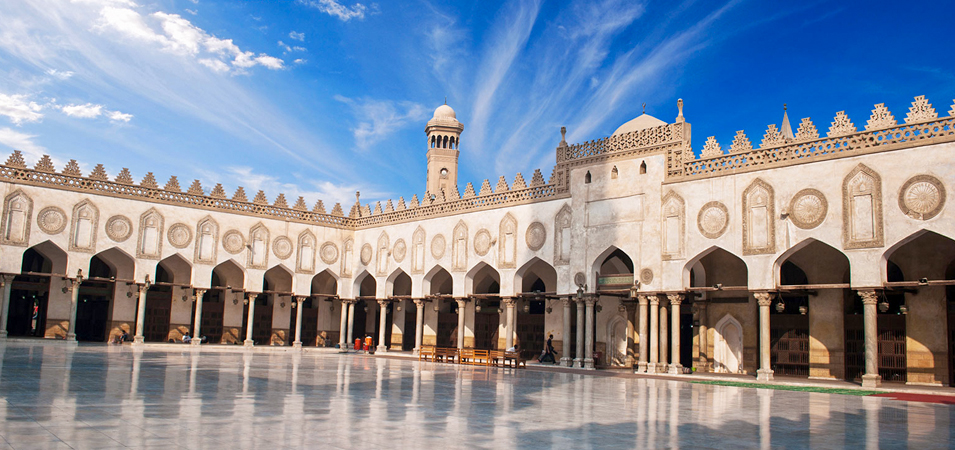
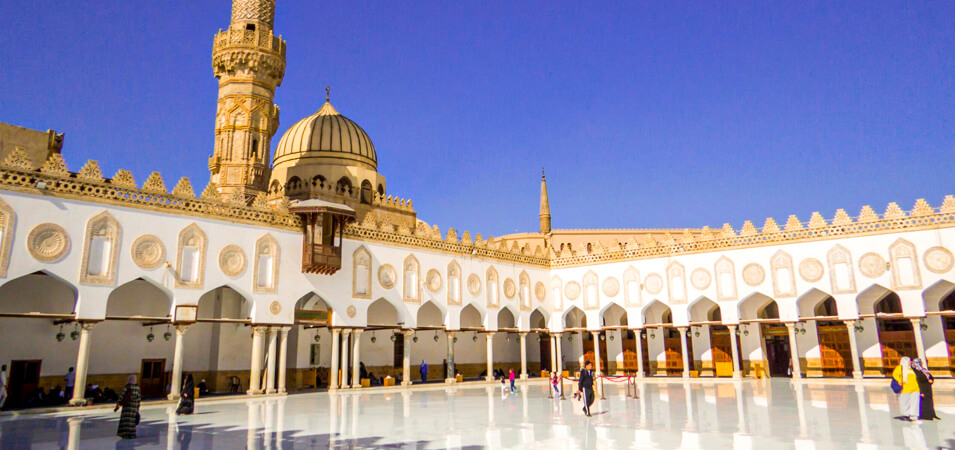
The Courtyard
The courtyard, or sahn, is one of the most recognizable spaces in the complex.
Its open layout creates a strong contrast with the dense streets outside.
The courtyard also helps visitors understand the traditional organization of Islamic religious architecture.
Look at:
- The surrounding arcades
- Columns
- Arches
- Marble surfaces
- Decorative details
- Transition between open and enclosed spaces
Do not rush through the courtyard.
Spend a few minutes simply observing how the space is used.
The Prayer Areas
The prayer spaces demonstrate how Al Azhar functions as a living mosque.
The interior should be approached differently from a museum exhibition.
People may be praying, reading, studying, or attending religious activities.
Visitors should therefore move quietly and avoid interrupting people.
The Minarets
Al Azhar’s skyline contains minarets associated with different periods of its architectural development.
Rather than thinking of the minarets as a single architectural project, consider them part of the mosque’s historical growth.
Different rulers and patrons contributed to the complex over time.
Mamluk Architectural Influence
The Mamluk period left a particularly strong architectural imprint on Al Azhar.
The Mamluks were major patrons of Islamic architecture in Cairo, and their influence can be seen across Historic Cairo.
For travelers interested in this period, Al Azhar is best understood alongside nearby Mamluk monuments rather than in isolation.
What Is Inside Al Azhar Mosque?
The interior experience can vary depending on which parts are open to visitors at the time of your visit.
You may encounter:
- The central courtyard
- Prayer halls
- Arcaded spaces
- Historic columns
- Mihrabs
- Minbar
- Educational spaces
- Architectural details from several periods
- Students and worshippers
The official Al-Azhar material describes the mosque as containing traditional riwaqs, or study areas, reflecting its long educational function.
This is one of the details that separates Al Azhar from many historic mosques that visitors see purely as architectural monuments.
At Al Azhar, architecture and education developed together.
Al Azhar Mosque Interior: What Should You Look For?
If you have only 30–45 minutes, concentrate on the following.
1. The courtyard
Look at the proportions, arches, marble, and surrounding arcades.
2. The prayer hall
Observe the columns, mihrab, wooden elements, and spatial organization.
3. The minarets
Look upward and notice the differences in architectural character.
4. The educational spaces
Remember that Al Azhar was not simply a place for prayer.
5. The relationship between old and new
The building has been repaired, restored, enlarged, and adapted over centuries.
The official Al-Azhar historical material notes major restoration work that was completed in 2018.
Al Azhar Mosque Hours in 2027
What Time Is Al Azhar Mosque Open?
This is one of the questions where travelers should be careful.
There is no single permanent tourist timetable that should be assumed for all of 2027.
Al Azhar is a working mosque, so access can change according to:
- Daily prayer times
- Friday congregational prayer
- Ramadan
- Religious occasions
- Special events
- Restoration or maintenance
- Security requirements
- Visitor-management decisions
Current online travel sources also publish different opening-hour and admission information, which is another reason not to treat a third-party timetable as guaranteed for 2027.
The safest planning rule
Plan your visit outside the five daily prayer periods and avoid Friday midday if you are visiting primarily as a tourist.
Prayer times change throughout the year because they are based on the position of the sun.
For a 2027 trip, check the latest official information close to your travel date.
The official Al-Azhar website should be treated as the primary source for institutional announcements.
Is Al Azhar Mosque Open Every Day?
Al Azhar generally operates as an active mosque rather than following the normal schedule of a museum.
Visitors may therefore encounter periods when tourist access is restricted.
Do not assume that “open today” means “tourist access is available continuously.”
A mosque can be functioning normally for worship while visitors are temporarily unable to enter certain areas.
This is particularly relevant on:
- Friday
- Ramadan
- Major Islamic holidays
- Busy prayer periods
- Special religious occasions
Al Azhar Mosque Entrance Fee in 2027
Is Al Azhar Mosque Free?
Do not plan your 2027 budget around an unverified fixed entrance fee.
Online sources currently disagree about whether foreign visitors pay an admission fee, with some recent sources reporting a modest tourist fee while other sources continue to describe entry as free.
This conflict makes one point especially important:
Check the current official visitor policy shortly before your 2027 visit.
If there is an entrance fee at the time of your trip, it may change independently from museum ticket prices.
If you are visiting as part of an organized tour, ask whether any required visitor fees are already included.
Do not assume that a tour price automatically includes every site fee unless the itinerary explicitly says so.
Can Non-Muslims Visit Al Azhar Mosque?
Yes, non-Muslim visitors can generally visit Al Azhar Mosque when visitor access is permitted, provided they follow the mosque’s rules and respect worshippers.
The key issue is not simply religion.
It is timing and conduct.
A visitor may be welcome during an appropriate period but should not expect unrestricted access during prayer or religious events.
You should also dress appropriately and follow instructions from mosque staff.
If a particular prayer area is closed to visitors, accept the restriction.
Al Azhar Mosque Dress Code
Dress appropriately because Al Azhar is an active place of worship.
For men
A practical choice is:
- Long trousers
- Shirt or T-shirt covering the shoulders
- Avoid very short shorts
- Avoid clothing with offensive graphics or wording
For women
A practical choice is:
- Long trousers or a long skirt
- Covered shoulders
- Clothing that is not transparent or very tight
- A scarf available if head covering is requested
- A lightweight outer layer can be useful
Official Al-Azhar educational material specifically advises visitors to dress properly, covering the arms and legs and avoiding tight or revealing clothing. It also instructs visitors to remove their shoes and behave respectfully toward people praying.
Do You Have to Remove Your Shoes at Al Azhar Mosque?
Yes, expect to remove your shoes before entering the relevant prayer areas.
Wear footwear that is easy to remove.
A simple pair of sandals or slip-on shoes can be more convenient than complicated footwear.
Bring a small bag if you prefer to keep your shoes with you.
Some visitors also leave shoes with an attendant or in designated storage areas.
If there is an attendant managing footwear, a small tip may be customary, but do not confuse a customary gratuity with an official entrance charge.
Al Azhar Mosque Etiquette for Visitors
The best rule is:
Behave as though you are entering someone’s active place of worship, because you are.
Do:
- Dress conservatively.
- Remove your shoes where required.
- Speak quietly.
- Walk carefully around people praying.
- Follow staff instructions.
- Ask before photographing people.
- Keep your phone silent.
- Respect restricted areas.
- Avoid sitting or standing in inappropriate places.
- Give worshippers space.
Don’t:
- Shout or speak loudly.
- Walk directly in front of someone performing prayer.
- Touch religious objects unnecessarily.
- Pose disrespectfully.
- Photograph worshippers closely without permission.
- Treat the mosque like a theatrical backdrop.
- Block entrances.
- Ignore instructions from mosque staff.
These simple rules make the experience better for both visitors and local worshippers.
Can You Take Photos Inside Al Azhar Mosque?
Photography policies can change, so follow the rules displayed or communicated at the entrance.
Even when photography is permitted, permission to photograph the building does not mean permission to photograph people closely.
The safest photography subjects are:
- Architecture
- Courtyard
- Arches
- Decorative details
- Doors
- Minarets
- General wide-angle scenes
Avoid intrusive close-ups of people praying or studying.
If someone is clearly the subject of your photograph, ask first.
Best Time to Visit Al Azhar Mosque in 2027
What Is the Best Time of Day?
For most tourists, a weekday morning outside prayer periods is a strong choice.
Morning visits have several advantages:
- Temperatures are generally more comfortable.
- The surrounding streets can feel less intense than later in the day.
- Light can be attractive for architectural photography.
- You have more flexibility to continue walking through Islamic Cairo afterward.
However, the exact best time depends on the season and prayer schedule.
Should You Visit on Friday?
Friday is a special day in the Islamic week.
The mosque can become significantly busier around the main Friday prayer.
For a sightseeing-focused visit, Friday midday is generally not the easiest period.
If you are primarily interested in observing the mosque as a functioning religious institution, however, Friday can offer a completely different atmosphere.
Just plan with respect for worshippers and expect visitor restrictions.
Visiting Al Azhar Mosque During Ramadan
Ramadan changes the rhythm of Cairo.
Mosques become especially important during this month, and Al Azhar can have increased religious activity.
That can be fascinating for travelers, but it also means that a sightseeing schedule needs to be flexible.
During Ramadan:
- Prayer activity increases.
- Evening crowds can become much larger.
- Religious events may affect access.
- Meal times change the rhythm of the surrounding streets.
- Traffic patterns can be unusual around iftar.
- Visitor access may differ from ordinary days.
If your 2027 trip overlaps with Ramadan, confirm the mosque’s current visitor arrangements before going.
Do not plan an important timed attraction immediately after an Al Azhar visit without allowing flexibility.
How Long Do You Need at Al Azhar Mosque?
For the mosque alone, 45–60 minutes is a practical amount of time for many visitors.
A quick visit can take around 30 minutes.
A slower visit can take 60–90 minutes if you are interested in architecture and history.
But the better question is:
How long should you spend in the surrounding Islamic Cairo area?
For that, allow at least 3–5 hours.
A possible route is:
- Al Azhar Mosque
- Khan El Khalili
- Al-Hussein area
- Muizz Street
- Historic Islamic monuments
- Traditional café
- Wekalet El Ghouri or Tanoura performance
For an evening cultural experience, the Wekalet El Ghouri Tanoura Show can complement an Islamic Cairo itinerary.
Al Azhar Mosque and Khan El Khalili
The two attractions are natural companions.
Khan El Khalili provides the commercial and street-life side of Historic Cairo.
Al Azhar provides the religious and scholarly side.
Together, they give visitors a better understanding of the neighborhood.
After visiting the mosque, walk toward Khan El Khalili and explore:
- Souvenirs shops
- Spice sellers
- Jewelry stores
- Traditional cafés
- Lantern shops
- Street food
- Historic alleys
For a broader cultural experience, you can also read the Khan El Khalili Bazaar Cairo guide.
Al Azhar Mosque and Muizz Street
Muizz Street is another excellent addition.
The historic street contains some of Cairo’s most important medieval Islamic monuments.
Walking here allows you to see how religious, commercial, residential, and political architecture developed together.
Do not try to rush through every monument.
Instead, choose several important stops.
A good walking route can include:
Al Azhar → Khan El Khalili → Muizz Street → historic madrasas and mosques → Bab Zuweila
For visitors particularly interested in medieval Cairo, this can become one of the most memorable half-days of the entire trip.
You can also read about Islamic Cairo before your visit to understand the historical landscape.
Al Azhar Mosque and Al-Hussein Mosque
Al Azhar Mosque and Al-Hussein Mosque are close to each other but serve different purposes.
Al Azhar is strongly associated with Islamic scholarship and education.
Al-Hussein Mosque is a major religious site associated with devotion and the traditional history of Husayn ibn Ali.
Visitors should avoid treating the two buildings as interchangeable tourist attractions.
They have different religious meanings and different visitor experiences.
If you are planning a religious and historical Cairo route, allow time to understand both.
Al Azhar Mosque and Al Hakim Mosque
Another worthwhile comparison is with the Al-Hakim Mosque.
Al-Hakim Mosque is also associated with the Fatimid period and provides another perspective on Fatimid architecture in Cairo.
Seeing both can help you understand how Fatimid Cairo developed.
This is especially useful for travelers interested in architectural history rather than simply ticking attractions off a list.
Al Azhar Mosque and Ibn Tulun Mosque
The Mosque of Ibn Tulun provides a different architectural experience.
Ibn Tulun is associated with the 9th century and the Tulunid period, while Al Azhar belongs to the later Fatimid foundation of Cairo.
If you have enough time, comparing historic mosques is much more rewarding than seeing only one.
Al Azhar Mosque and the Muhammad Ali Mosque
The Mosque of Muhammad Ali at the Citadel is dramatically different from Al Azhar.
| Feature | Al Azhar Mosque | Muhammad Ali Mosque |
| Historical foundation | Fatimid | 19th-century Ottoman-influenced |
| Main character | Scholarly, historic, active mosque | Monumental mosque and landmark |
| Location | Historic Islamic Cairo | Cairo Citadel |
| Architecture | Multiple historical layers | Ottoman-inspired monumental design |
| Best for | Islamic history and living religious culture | Architecture and panoramic Cairo views |
| Ideal visit | Combined with Khan El Khalili | Combined with Citadel attractions |
If you have only one day for Cairo’s Islamic heritage, you can potentially include both.
What to See Near Al Azhar Mosque
One of the biggest advantages of visiting Al Azhar is the number of attractions within a relatively compact historic area.
Consider adding:
Khan El Khalili
Ideal for shopping, street photography, traditional cafés, and atmosphere.
Al-Hussein Mosque
A major religious landmark close to the bazaar.
Muizz Street
One of Cairo’s most important historic streets.
Wekalet El Ghouri
A historic caravanserai associated with the Mamluk period.
Al-Hakim Mosque
A major Fatimid monument.
Bayt Al-Suhaymi
A historic Ottoman-era house offering insight into residential Cairo.
Bab Zuweila
A monumental medieval gate and one of Historic Cairo’s best-known landmarks.
Al-Azhar Park
A useful place to relax after walking through the dense streets of Historic Cairo.
Best Al Azhar Mosque Itinerary for Half a Day
If you want a simple route, use this structure.
Morning
8:30–9:00 AM
Travel to Historic Cairo.
9:00–10:00 AM
Visit Al Azhar Mosque, subject to current visitor access and prayer times.
10:00–11:00 AM
Walk toward Khan El Khalili and explore the surrounding streets.
11:00 AM–12:30 PM
Continue along Muizz Street and visit selected monuments.
12:30–1:00 PM
Stop for tea, coffee, or a light meal.
This route works particularly well for travelers who want Islamic Cairo without spending an entire day there.
A Full Islamic Cairo Day
If you have a full day, you can expand the route.
Suggested schedule
Morning
- Al Azhar Mosque
- Khan El Khalili
- Al-Hussein area
- Muizz Street
Midday
- Lunch in Historic Cairo
- Rest or café
Afternoon
- Al-Hakim Mosque
- Historic Mamluk monuments
- Bab Zuweila
- Al-Azhar Park
Evening
- Traditional dinner
- Tanoura performance
- Cairo night walk
The Cairo Night Tour is another option for travelers who want to see how Cairo changes after sunset.
How to Include Al Azhar Mosque in a Cairo Itinerary
If You Have 2 Days in Cairo
With only two days, do not spend an entire day at Al Azhar.
Instead, combine it with Historic Cairo.
You can dedicate one part of your second day to:
- Al Azhar
- Khan El Khalili
- Muizz Street
- Islamic monuments
For a compact plan, consider a 2 Days in Cairo itinerary.
If You Have 3 Days in Cairo
Three days provide much more flexibility.
A possible structure:
Day 1
Giza Pyramids and Sphinx.
Day 2
Grand Egyptian Museum and modern Cairo.
Day 3
Islamic Cairo, Al Azhar, Khan El Khalili, and other historic districts.
A 3 Days in Cairo program can be adapted around your interests.
If You Have 4 Days
Four days allow you to include Islamic Cairo without rushing.
Consider combining:
- Pyramids
- Grand Egyptian Museum
- Historic Cairo
- Old Cairo
- Egyptian Museum
- Khan El Khalili
You can also explore 4-Day Cairo Tour options.
Al Azhar Mosque for Families
Families can visit Al Azhar, but parents should prepare children for the fact that this is a functioning mosque.
Children should understand:
- Voices need to stay low.
- Running is inappropriate.
- People may be praying.
- Shoes must be removed.
- Some areas may be restricted.
For families, the mosque itself may take less time than the surrounding area.
Children may enjoy the market streets and architecture more than a long historical explanation inside the mosque.
For a broader family itinerary, see Egypt Family Holidays and Egypt Family Tour Packages.
Is Al Azhar Mosque Suitable for Older Travelers?
Yes, but the surrounding Historic Cairo streets can be more demanding than the mosque itself.
Consider:
- Uneven pavement
- Crowded streets
- Steps in some historic buildings
- Heat during summer
- Long walking distances
- Limited seating in some areas
A private vehicle can make the overall experience easier.
If mobility is a concern, tell your tour operator in advance so the route can be adapted.
Visiting Al Azhar Mosque as a Solo Traveler
Al Azhar is suitable for solo travelers who are comfortable navigating Cairo.
A solo visitor can enter, observe the architecture, and continue through Historic Cairo.
However, a guide can add significant historical context.
Without a guide, it is easy to look at the courtyard, take a few photographs, and leave without understanding why the building is historically important.
If you prefer independent travel, read about Solo Trips to Egypt and use a detailed Cairo map before you go.
Should You Visit Al Azhar With a Guide?
There is no universal answer.
Visit independently if:
- You enjoy exploring at your own pace.
- You have already researched Islamic Cairo.
- You mainly want the atmosphere and architecture.
- You are comfortable navigating crowded historic neighborhoods.
Choose a guide if:
- You want to understand the history.
- You are interested in Islamic architecture.
- You want to visit several monuments efficiently.
- You want help navigating the historic streets.
- This is your first time in Cairo.
For many international travelers, a guide is particularly useful because the historical layers of Cairo are difficult to understand without context.
Al Azhar Mosque vs Other Cairo Mosques
Cairo has many historic mosques, so which one should you prioritize?
| Mosque | Best For | Historical Character |
| Al Azhar | Islamic scholarship and living religious history | Fatimid foundation with later additions |
| Ibn Tulun | Architecture and open space | Tulunid |
| Al-Hakim | Fatimid architecture | Fatimid |
| Muhammad Ali | Monumental architecture and views | 19th century Ottoman-influenced |
| Sultan Hassan | Mamluk architecture | Mamluk |
| Al-Hussein | Religious significance | Medieval Islamic Cairo |
If your main interest is Islamic scholarship, prioritize Al Azhar.
If your main interest is monumental architecture, add Sultan Hassan and Muhammad Ali.
If your interest is Fatimid Cairo, combine Al Azhar with Al-Hakim Mosque.
Al Azhar Mosque vs Sultan Hassan Mosque
Sultan Hassan Mosque is one of Cairo’s most spectacular Mamluk monuments.
Al Azhar, however, offers a different experience.
Sultan Hassan is primarily encountered by tourists as a monumental architectural masterpiece.
Al Azhar combines architecture with an active educational and religious identity.
For a serious Islamic Cairo itinerary, seeing both is worthwhile.
Is Al Azhar Mosque a Museum?
No. Al Azhar Mosque is not simply a museum. It is an active mosque and a major religious and educational institution.
This distinction affects almost every part of your visit.
You should not expect:
- Museum-style galleries
- Fixed visitor routes
- Continuous tourist access
- Uniform photography rules
- The same experience every day
Instead, expect a living environment.
That is precisely what makes the visit interesting.
Common Mistakes When Visiting Al Azhar Mosque
Mistake 1: Arriving during prayer
Always consider the daily prayer schedule.
Mistake 2: Wearing shorts or revealing clothing
Dress for a religious site rather than a typical sightseeing attraction.
Mistake 3: Treating the mosque like a museum
Remember that people are worshipping and studying there.
Mistake 4: Spending only five minutes
If you have an interest in architecture or history, slow down.
Mistake 5: Visiting only the mosque
The surrounding neighborhood is part of the experience.
Mistake 6: Planning too many attractions afterward
Historic Cairo is slower than a conventional museum visit.
Allow time for walking and unexpected discoveries.
Mistake 7: Assuming 2026 information will automatically apply in 2027
Hours, access rules, fees, and restoration work can change.
Check again close to your travel date.
What to Bring to Al Azhar Mosque
You do not need much.
Carry:
- Comfortable walking shoes
- Lightweight conservative clothing
- A scarf if you are a woman
- Small bag
- Water
- Phone
- Camera if photography is currently permitted
- Small amount of Egyptian cash
- Sunscreen
- Hand sanitizer or tissues
A lightweight scarf is especially useful because it can serve as an extra layer if needed.
What Not to Bring
Avoid unnecessary luggage.
You do not need:
- Large bags
- Professional photography equipment unless permitted
- Loud accessories
- Clothing that exposes shoulders and knees
- Anything that could interfere with security checks
A small day bag is usually much easier in Historic Cairo.
Is Al Azhar Mosque Safe to Visit?
For normal tourism, Al Azhar is a major established religious and historic site in central Cairo.
The most useful safety advice is practical rather than dramatic:
- Keep valuables secure.
- Be aware of your surroundings in crowded markets.
- Use reputable transportation.
- Keep your phone secure in busy streets.
- Follow security instructions.
- Stay with your guide if traveling as part of a group.
- Be particularly careful around dense crowds.
Historic Cairo can be crowded, especially around Khan El Khalili.
The biggest challenge for many visitors is not the mosque itself but navigating busy streets and traffic.
Visiting Al Azhar Mosque With Children
Children can visit, but explain mosque etiquette before entering.
A simple explanation works:
“People come here to pray and study, so we need to be quiet and respectful.”
That is usually enough.
If children have limited patience, spend around 30–45 minutes inside and devote more time to the surrounding neighborhood.
Visiting Al Azhar Mosque for Photography
Al Azhar can be particularly attractive for architectural photography.
Look for:
- Symmetry
- Arches
- Courtyard perspectives
- Minarets
- Doorways
- Marble
- Shadows
- Architectural details
- Historic streets outside
Early morning or late afternoon can provide attractive light, but always prioritize current access rules.
The best photograph is not necessarily the most dramatic one.
A respectful wide-angle image that shows the architecture and atmosphere is usually more appropriate than close-up photography of worshippers.
Al Azhar Mosque for Architecture Lovers
Architecture enthusiasts should pay attention to historical layering.
Instead of asking:
“What style is this mosque?”
Ask:
“Which parts belong to which periods?”
This approach makes the visit much more interesting.
The Fatimid foundation represents the early period.
Mamluk additions represent another major stage.
Ottoman and later interventions show how Cairo’s religious architecture continued to evolve.
The result is a building that functions almost like a timeline in stone.
Al Azhar Mosque for History Lovers
History enthusiasts should focus on four major transitions:
- Fatimid foundation
- Ayyubid transformation
- Mamluk revival and expansion
- Modern Al Azhar institution
This framework is easier to remember than trying to memorize hundreds of dates.
Al Azhar Mosque for Religious Travelers
For Muslim travelers, Al Azhar has an additional layer of meaning because of its long association with Islamic scholarship.
For non-Muslim travelers, the visit can provide an opportunity to understand how Islamic institutions function within Cairo’s cultural landscape.
The most respectful approach is the same for everyone:
Observe, learn, and avoid interrupting worship.
What Makes Al Azhar Al Sharif Different?
The term Al-Azhar Al-Sharif refers to the wider revered Al Azhar institution and its religious and scholarly identity.
The mosque is one physical part of that long institutional history.
The wider institution includes educational, scholarly, and religious functions.
This is why travelers sometimes encounter information that appears to use “Al Azhar Mosque,” “Al Azhar University,” and “Al Azhar Al Sharif” interchangeably.
They are connected, but they are not identical terms.
Is Al Azhar the Oldest University in the World?
This question requires careful wording.
Al Azhar is frequently described as one of the world’s oldest continuously operating centers of higher learning, and the Al-Azhar institution itself describes its educational history as extending back more than a thousand years.
However, rankings of the “oldest university” depend on how a university is defined.
Some institutions trace their origins to earlier educational traditions, while others emphasize continuous institutional operation in the modern sense.
For an article aimed at travelers, the safest factual description is:
Al Azhar is one of the world’s oldest continuously operating centers of Islamic learning and one of the most influential institutions of Sunni scholarship.
Al Azhar Mosque and the History of Cairo
Al Azhar is inseparable from Cairo.
The mosque was established shortly after the Fatimid foundation of the city.
Its history therefore parallels Cairo’s development.
The surrounding district grew into an important center of religious, commercial, political, and intellectual activity.
This is why visiting Al Azhar without exploring the surrounding streets leaves out a major part of the story.
For a broader historical introduction, explore the Egypt Wiki Travel and History Guide.
Al Azhar Mosque and Historic Cairo
Historic Cairo is not simply one isolated neighborhood.
It is a large cultural landscape containing centuries of Islamic architecture and urban development.
Al Azhar belongs to this larger network.
Other sites worth understanding include:
- Al-Hakim Mosque
- Ibn Tulun Mosque
- Sultan Hassan Mosque
- Al-Rifa’i Mosque
- Muizz Street
- Bab Zuweila
- Khan El Khalili
- Historic houses
- Mamluk madrasas
A visit becomes much more meaningful when you understand these connections.
How Al Azhar Fits Into a Classic Egypt Trip
If you are visiting Egypt for the first time, Al Azhar is usually part of the Cairo section of your itinerary.
A classic Egypt trip may include:
Cairo
- Giza Pyramids
- Sphinx
- Grand Egyptian Museum
- Historic Islamic Cairo
- Al Azhar
- Khan El Khalili
Luxor
Aswan
If you want to combine Cairo and the Nile Valley, explore the Best of Cairo and Luxor Tour or longer Egypt Tour Packages depending on your departure market and itinerary needs.
Al Azhar Mosque in a 7-Day Egypt Itinerary
A week in Egypt requires careful prioritization.
One possible structure:
Day 1
Arrival in Cairo.
Day 2
Giza Pyramids and Grand Egyptian Museum.
Day 3
Islamic Cairo, Al Azhar, Khan El Khalili.
Day 4
Fly or travel to Luxor.
Day 5
Luxor sightseeing.
Day 6
Nile or Aswan experience.
Day 7
Departure or additional Cairo time.
You can compare this with 7-Day Egypt Tours and 7-Day Cairo and Nile Cruise Tour.
Al Azhar Mosque in an 8-Day Egypt Itinerary
Eight days gives you additional flexibility.
You can combine:
- Cairo
- Giza
- Islamic Cairo
- Luxor
- Nile cruise
- Aswan
See the 8-Day Egypt Tour in Cairo, Luxor and Aswan with Abu Simbel for a broader framework.
Al Azhar Mosque in a 10-Day Egypt Trip
With ten days, you can slow the pace.
A possible itinerary includes:
- Cairo
- Giza
- Islamic Cairo
- Luxor
- Nile cruise
- Aswan
- Abu Simbel
- Red Sea
For planning inspiration, compare 10-Day Egypt Tours .
Al Azhar Mosque and a Nile Cruise
If your Egypt vacation includes a Nile cruise, visit Al Azhar during your Cairo stay before traveling south.
Do not try to squeeze Islamic Cairo into the same day as an early flight or train to Luxor unless your schedule has substantial flexibility.
Cairo traffic can be unpredictable.
For travelers who want a traditional river experience, explore Egypt Nile Cruise Packages or the Private Nile Cruise.
Al Azhar Mosque and the Pyramids
The Pyramids and Al Azhar represent very different chapters of Egyptian history.
The Giza Pyramids Tour focuses on ancient Egypt.
Al Azhar focuses primarily on Islamic Cairo and medieval-to-modern Egyptian history.
Putting both into one itinerary is one of the best ways to experience Cairo’s historical depth.
You move from:
Ancient Egypt → Roman/Christian Cairo → Islamic Cairo → Modern Cairo
That chronological contrast is one of the strongest reasons to spend several days in the city.
Al Azhar Mosque and the Grand Egyptian Museum
The Grand Egyptian Museum and Al Azhar also complement each other.
The museum focuses on ancient Egyptian heritage.
Al Azhar demonstrates a much later period of Egyptian civilization.
A two-day cultural plan might therefore include:
Day 1: Giza Pyramids + Grand Egyptian Museum
Day 2: Al Azhar + Khan El Khalili + Islamic Cairo
The Grand Egyptian Museum Tour can be combined with other Cairo experiences.
Should You Visit Al Azhar in the Morning or Evening?
For the mosque itself, daytime is generally the practical choice because visitor access depends on religious activity and current operating arrangements.
For the surrounding neighborhood, evening can be excellent.
Khan El Khalili becomes especially atmospheric later in the day, while traditional cafés and restaurants become busier.
Therefore:
Visit the mosque during an appropriate daytime period, then enjoy Historic Cairo after sunset.
This gives you two different experiences in the same neighborhood.
What to Eat Near Al Azhar Mosque
The surrounding Historic Cairo area has many opportunities to try Egyptian food.
Depending on your route, look for:
- Koshari
- Ful medames
- Taameya
- Shawarma
- Grilled meats
- Egyptian bread
- Tea
- Turkish-style or Arabic coffee
- Traditional desserts
If food is a major part of your Cairo experience, consider a dedicated Cairo Food Tour.
A food tour can complement a Historic Cairo walking day particularly well.
How Much Time Should You Allow for Khan El Khalili After Al Azhar?
At minimum, allow 60–90 minutes.
If you enjoy shopping, photography, cafés, and street exploration, allow several hours.
Do not underestimate walking time.
Historic Cairo’s narrow streets can make a short distance take much longer than it appears on a map.
Shopping After Visiting Al Azhar
Khan El Khalili is one of the most famous shopping areas in Cairo.
Common souvenirs include:
- Brass lamps
- Jewelry
- Scarves
- Spices
- Traditional crafts
- Papyrus-style artwork
- Perfume bottles
- Egyptian-themed decorations
Compare prices before buying.
For expensive items, ask about materials, origin, and workmanship rather than buying solely because something is presented as “antique.”
For additional ideas, see Best Souvenirs from Egypt.
Al Azhar Mosque in Summer 2027
Cairo summers can be extremely hot.
If your trip takes place in June, July, or August:
- Visit earlier in the day.
- Drink water.
- Wear lightweight clothing.
- Use sun protection.
- Avoid scheduling long outdoor walks during the hottest hours.
- Leave flexibility between attractions.
Historic Cairo has many shaded areas, but walking between monuments can still be tiring.
The Egypt Weather by Month guide can help with broader seasonal planning.
Al Azhar Mosque in Winter 2027
Winter is generally more comfortable for extensive sightseeing.
This is a particularly good season for combining:
- Al Azhar
- Khan El Khalili
- Muizz Street
- Historic mosques
- Walking tours
Evenings can be cool, so carry a light layer.
Al Azhar Mosque During Egyptian Holidays
Religious holidays can affect access.
Expect potentially larger crowds around:
- Eid al-Fitr
- Eid al-Adha
- Ramadan nights
- Other major Islamic occasions
If your trip coincides with a major holiday, check current arrangements rather than relying on a normal tourist schedule.
Is Visiting Al Azhar Mosque Free for Children?
Do not assume a universal 2027 child-ticket policy.
If an admission fee is introduced or applies to foreign visitors, the rules for children may differ.
Check the current policy when planning your trip.
Can You Visit Al Azhar Mosque Without a Tour?
Yes.
You can visit independently if access is open and you follow the mosque’s rules.
However, independent visitors should research:
- Opening/access periods
- Prayer times
- Dress
- Photography
- Nearby attractions
A guide becomes particularly useful if you want to understand the history rather than simply see the architecture.
Is Al Azhar Mosque Tourist-Friendly?
Yes, but “tourist-friendly” does not mean “tourist-only.”
That is an important distinction.
Visitors are welcome in appropriate circumstances, but the primary purpose of the mosque remains religious and educational.
You should adapt to the environment rather than expect the environment to adapt completely to tourists.
That mindset usually leads to a much better experience.
Expert Tips for Visiting Al Azhar Mosque in 2027
Tip 1: Check access on the day
Prayer schedules and religious events can affect entry.
Tip 2: Carry a scarf
It is a simple precaution.
Tip 3: Wear easy-to-remove shoes
You will appreciate this when entering and leaving.
Tip 4: Do not rush
The architectural details are easy to miss.
Tip 5: Combine the mosque with nearby sites
Al Azhar is much more valuable as part of Historic Cairo.
Tip 6: Avoid Friday midday if sightseeing is your priority
The main congregational prayer can create major restrictions and crowds.
Tip 7: Carry small cash
Useful for small purchases and customary gratuities.
Tip 8: Protect your phone
Historic markets can be crowded.
Tip 9: Ask before photographing people
Especially worshippers and students.
Tip 10: Check 2027 information close to your trip
Do not rely blindly on a 2024, 2025, or even 2026 timetable.
A Practical 60-Minute Visit Plan
If you have only one hour:
First 10 minutes
Enter, remove shoes where required, and orient yourself.
Next 15 minutes
Explore the courtyard.
Next 15 minutes
Observe the prayer areas and architectural details that are accessible.
Next 10 minutes
Look at minarets, arches, columns, and decorative features.
Final 10 minutes
Exit and continue toward Khan El Khalili.
This is enough for a useful first visit.
A Practical 3-Hour Historic Cairo Route
If you have three hours:
Hour 1: Al Azhar Mosque
Hour 2: Khan El Khalili and Al-Hussein area
Hour 3: Muizz Street and selected historic monuments
This is probably the best balance for travelers who have limited time.
A Practical 5-Hour Route
For five hours:
- Al Azhar Mosque
- Khan El Khalili
- Al-Hussein Mosque area
- Muizz Street
- Al-Hakim Mosque
- Historic Mamluk monuments
- Café or lunch
- Optional Wekalet El Ghouri
This provides a much deeper experience.
Al Azhar Mosque for First-Time Visitors to Egypt
If this is your first trip to Egypt, prioritize Al Azhar if you want to understand more than ancient Egyptian history.
Many first-time itineraries focus heavily on:
- Pyramids
- Sphinx
- Museums
- Temples
- Nile cruises
Those are essential for many travelers, but Islamic Cairo shows another side of Egypt.
Al Azhar demonstrates how Cairo developed as a major Islamic intellectual and cultural center.
That makes it especially valuable for travelers interested in modern Egyptian identity and history.
Al Azhar Mosque for Returning Visitors
If you have already visited the Pyramids, museums, and major temples, Al Azhar can be an even better choice.
Returning visitors often benefit from slowing down and exploring neighborhoods rather than adding another major ticketed attraction.
Historic Cairo is ideal for that style of travel.
Is Al Azhar Mosque Better Than Khan El Khalili?
This is not really an either-or decision.
They provide different experiences.
Al Azhar: history, religion, architecture, scholarship, spirituality.
Khan El Khalili: shopping, cafés, street life, crafts, atmosphere.
The best itinerary includes both.
Is Al Azhar Mosque Better Than the Citadel?
Again, they serve different interests.
Choose Al Azhar if you want:
- Islamic scholarship
- Historic Cairo
- Fatimid history
- Active religious life
- Walking through medieval Cairo
Choose the Citadel and Muhammad Ali Mosque if you want:
- Panoramic views
- Monumental 19th-century architecture
- Military and political history
- A larger sightseeing complex
Ideally, include both if you have enough time.
Al Azhar Mosque and Coptic Cairo
A complete Cairo cultural itinerary should not focus on only one religious tradition.
You can combine Islamic Cairo with Coptic Cairo.
Coptic Cairo includes important Christian heritage sites such as the Hanging Church and other historic churches.
See the Coptic Cairo guide and Hanging Church in Cairo for background.
A religious heritage day can therefore show:
Islamic Cairo → Coptic Cairo → Modern Cairo
This creates a more complete understanding of the city.
Al Azhar Mosque and the National Museum of Egyptian Civilization
Another useful combination is Al Azhar with the National Museum of Egyptian Civilization.
The museum presents Egyptian civilization across different periods, while Al Azhar provides an opportunity to experience one specific living cultural and religious tradition.
Read more about the National Museum of Egyptian Civilization.
Al Azhar Mosque and Egyptian History
One of the greatest strengths of Cairo is that different historical periods coexist.
In a single day you can encounter:
- Ancient Egyptian history
- Greco-Roman heritage
- Coptic Christianity
- Fatimid Cairo
- Mamluk architecture
- Ottoman architecture
- Modern Egyptian culture
Al Azhar belongs to the Islamic chapter of this larger story.
Frequently Asked Questions About Visiting Al Azhar Mosque Cairo Egypt in 2027
1. Can tourists visit Al Azhar Mosque in Cairo in 2027?
Yes, tourists can generally visit Al Azhar Mosque when visitor access is permitted. The mosque is an active place of worship, so access can be restricted during prayer periods, religious events, or other circumstances. Check the current visitor arrangements shortly before your 2027 visit.
2. Can non-Muslims visit Al Azhar Mosque?
Yes. Non-Muslim visitors can generally visit when access is open, provided they dress appropriately and respect the mosque’s religious function. Certain areas or periods may be restricted.
3. What are the Al Azhar Mosque hours in 2027?
There should not be one fixed tourist timetable assumed for the entire year. Access can change around the five daily prayers, Friday prayer, Ramadan, religious holidays, and special events. Check the latest official information close to your travel date.
4. Is Al Azhar Mosque free to enter?
Current online sources disagree about visitor admission arrangements, with some reporting free access and others reporting a modest fee for foreign visitors. Because the user is planning for 2027, the safest approach is to verify the current official policy immediately before visiting.
5. What should women wear to Al Azhar Mosque?
Women should wear modest clothing that covers the shoulders and legs. Carrying a lightweight scarf is recommended in case head covering is requested for the area you are entering.
6. What should men wear to Al Azhar Mosque?
Men should wear long trousers and a shirt that covers the shoulders. Shorts and very casual clothing are best avoided.
7. Do you have to remove your shoes at Al Azhar Mosque?
Yes. Visitors should expect to remove their shoes before entering the appropriate prayer areas. Wear footwear that is easy to take off and put back on.
8. How long does it take to visit Al Azhar Mosque?
Allow approximately 45–60 minutes for the mosque itself. If you combine it with Khan El Khalili, Muizz Street, Al-Hussein, and other Islamic Cairo monuments, allow at least three hours.
9. What is the best time to visit Al Azhar Mosque?
A weekday morning outside prayer periods is generally a practical choice for sightseeing. Avoid Friday midday if you want a quieter tourist experience because of the main congregational prayer.
10. Can you take photos inside Al Azhar Mosque?
Photography policies can change. Follow the current instructions at the mosque and avoid photographing worshippers closely without permission. Architectural photography is generally more appropriate than intrusive people photography.
11. What is Al Azhar Mosque famous for?
Al Azhar is famous for its Fatimid origins, more than a thousand years of Islamic scholarship, its role in Sunni religious education, its historic architecture, and its continuing importance as a working mosque and educational institution.
12. What attractions are near Al Azhar Mosque?
Khan El Khalili, Al-Hussein Mosque, Muizz Street, Al-Hakim Mosque, Wekalet El Ghouri, historic Mamluk monuments, and Al-Azhar Park are among the nearby attractions that can be combined with a visit.
Final Verdict: Visiting Al Azhar Mosque Cairo Egypt in 2027
Visiting Al Azhar Mosque Cairo Egypt in 2027 is one of the best ways to experience the Islamic and intellectual history of Cairo.
The mosque’s importance comes from more than its age.
It was founded during the Fatimid establishment of Cairo, developed into a major center of Islamic learning, underwent significant architectural changes during later dynasties, and continues to function as an active religious institution today.
For the best experience, plan your visit around prayer times, dress conservatively, remove your shoes when required, respect worshippers, and avoid treating the building like an ordinary tourist attraction.
Most importantly, do not visit Al Azhar in isolation.
Combine it with Khan El Khalili, Al-Hussein, Muizz Street, and the wider Historic Islamic Cairo area. That is where the visit becomes more than a one-hour stop and turns into an understanding of how Cairo’s religious, commercial, educational, and architectural life developed over centuries.
If you are planning a wider Egypt vacation, Al Azhar works particularly well within a Cairo Sightseeing Tour, a Cairo and Alexandria Tour, a 12-Day Egypt Tour, or a customized private itinerary.
For a personalized itinerary, you can also use the Egypt All Inclusive contact .