Quick Answer: What Should You Know Before Visiting Al Hakim Mosque in 2027?
Al Hakim Mosque is a historic Fatimid mosque at the northern end of Al-Muizz Street in Islamic Cairo, beside Bab Al-Futuh. It was begun around 990 AD and completed in 1013 AD. The mosque is known for its large open courtyard, four surrounding arcades, monumental western entrance, and two distinctive minarets. According to Egypt’s Ministry of Tourism and Antiquities, entry is currently free, although visitors should verify arrangements before traveling in 2027.
Key facts at a glance
Information Al Hakim Mosque Common name Al Hakim Mosque Full name Mosque of Al-Hakim bi-Amr Allah Location Al-Muizz Street, Al-Gamaliya, Cairo Nearby landmark Bab Al-Futuh Architectural period Fatimid Construction began Around 990 AD Completed 1013 AD Plan Central courtyard surrounded by four arcades Minarets Two Current entry information Free according to the Ministry’s monument page Best combined attractions Al-Muizz Street, Bab Al-Futuh, Khan El-Khalili, Al-Azhar Recommended visit About 30–60 minutes Opening arrangements, access rules, restoration work, and visitor policies can change, so check official information closer to your 2027 travel date.
Visiting Al Hakim Mosque in 2027 is an excellent choice for travelers who want to explore the architectural and religious heritage of Islamic Cairo beyond the city’s better-known landmarks. Located at the northern end of Al-Muizz Street beside Bab Al-Futuh, the Al Hakim Mosque in Cairo, Egypt is one of the most important surviving Fatimid monuments in the city.
The mosque was begun during the reign of the Fatimid caliph Al-Aziz bi Allah around 990 AD and completed by his son Al-Hakim bi-Amr Allah in 1013 AD. Egypt’s Ministry of Tourism and Antiquities describes it as the fourth-oldest surviving congregational mosque in Egypt and the second-largest mosque in Cairo after the Mosque of Ibn Tulun.
For visitors, the mosque is especially interesting because of its enormous courtyard, Fatimid architectural details, monumental western entrance, distinctive minarets, and location within the historic urban fabric of Islamic Cairo.
If you are planning a Cairo itinerary for 2027, Al Hakim Mosque can easily be combined with Bab Al-Futuh, Al-Muizz Street, Khan El-Khalili, Al-Azhar Mosque, and other historic monuments in the same area.
This guide explains what to know before visiting, including the mosque’s history, architecture, Al Hakim Mosque plan, minarets, interior, photography opportunities, location, suggested visiting time, dress etiquette, nearby attractions, and practical planning advice.
What Is Al Hakim Mosque?
Al Hakim Mosque, also called the Mosque of Al-Hakim bi-Amr Allah, is a major Fatimid-era mosque in historic Cairo. It stands at the northern end of Al-Muizz Street beside Bab Al-Futuh and represents an important stage in the development of Fatimid architecture in Egypt.
The mosque takes its name from the Fatimid ruler Al-Hakim bi-Amr Allah, although construction began under his father, Al-Aziz bi Allah.
The monument is particularly significant because it was built during the early Fatimid period, when Cairo was developing into the political and religious center of the Fatimid state in Egypt.
The Ministry of Tourism and Antiquities identifies the mosque as the fourth oldest surviving congregational mosque in Egypt and the second-largest in Cairo after Ibn Tulun Mosque.
For travelers, however, its importance is not limited to its age. The mosque is valuable because it helps explain how Cairo developed as an Islamic city and how Fatimid architecture shaped the historic northern section of the city.
Where Is Al Hakim Mosque in Cairo?
Al Hakim Mosque is located at the northern end of Al-Muizz Street in Al-Gamaliya district, immediately beside Bab Al-Futuh.
This location makes it particularly convenient for travelers exploring Islamic Cairo on foot.
The mosque is within the historic area generally associated with Cairo’s medieval Islamic monuments, where mosques, gates, markets, religious schools, houses, and other historic structures developed around the old city.
The Ministry of Tourism and Antiquities confirms that the mosque stands near Bab Al-Futuh at the end of Al-Muizz Street.
Why the location matters
One of the biggest advantages of visiting Al Hakim Mosque is that you do not need to make a separate trip across Cairo just to see it.
You can organize a walking route around several nearby landmarks.
A practical route can include:
- Bab Al-Futuh
- Al Hakim Mosque
- Al-Muizz Street
- Historic Fatimid and Mamluk monuments
- Khan El-Khalili
- Al-Azhar Mosque
For travelers who want to understand the historic character of Cairo, this is more useful than visiting each attraction independently.
For a broader introduction to the area, see the Islamic Cairo guide.
How Old Is Al Hakim Mosque?
Al Hakim Mosque dates to the Fatimid period and is more than a thousand years old.
Construction began during the reign of Caliph Al-Aziz bi Allah around 990 AD. He died before the mosque was completed, and his son Al-Hakim bi-Amr Allah completed the building in 1013 AD.
This makes the mosque one of the earliest major surviving monuments associated with Fatimid Cairo.
The dates are sometimes presented slightly differently in historical references because Islamic and Gregorian calendars do not correspond exactly year-for-year. The official Egyptian monument source gives the construction as 380 AH/990 AD and completion as 403 AH/1013 AD.
Who Built Al Hakim Mosque?
The mosque was started by Al-Aziz bi Allah, the fifth Fatimid caliph, and completed by his son Al-Hakim bi-Amr Allah.
This distinction is important because the mosque is commonly called Al Hakim Mosque even though Al-Hakim was not the ruler who initiated its construction.
The Ministry of Tourism and Antiquities states that Al-Aziz began the mosque and that Al-Hakim completed it after his father’s death.
The mosque therefore belongs to the early period of Fatimid rule in Egypt, when Cairo was still developing from a newly established Fatimid capital into the historic city visitors recognize today.
Why Was Al Hakim Mosque Built?
Al Hakim Mosque was constructed as a major congregational mosque during the Fatimid period.
At the time, Cairo was becoming an important center of Fatimid political and religious life. The mosque also had an educational and religious role.
The Egyptian State Information Service notes that Al Hakim Mosque played a role comparable to Al-Azhar Mosque during the Fatimid period as a center associated with teaching the Shiite tradition.
This gives the monument significance beyond its architecture. It was part of the religious and intellectual landscape of Fatimid Cairo.
What Makes Al Hakim Mosque Special?
Several features distinguish the mosque from other historic mosques in Cairo.
1. Its Fatimid history
The mosque belongs to the early Fatimid period, making it particularly important for understanding the development of Islamic architecture in Cairo.
2. Its enormous courtyard
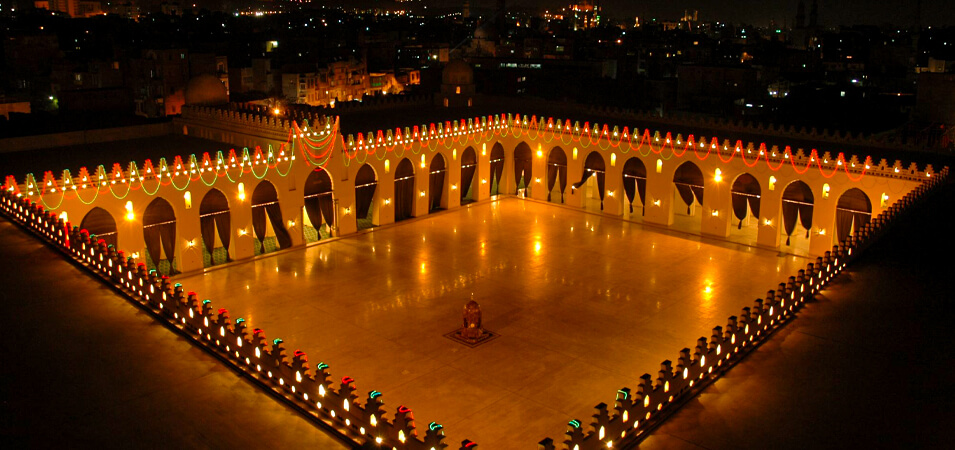
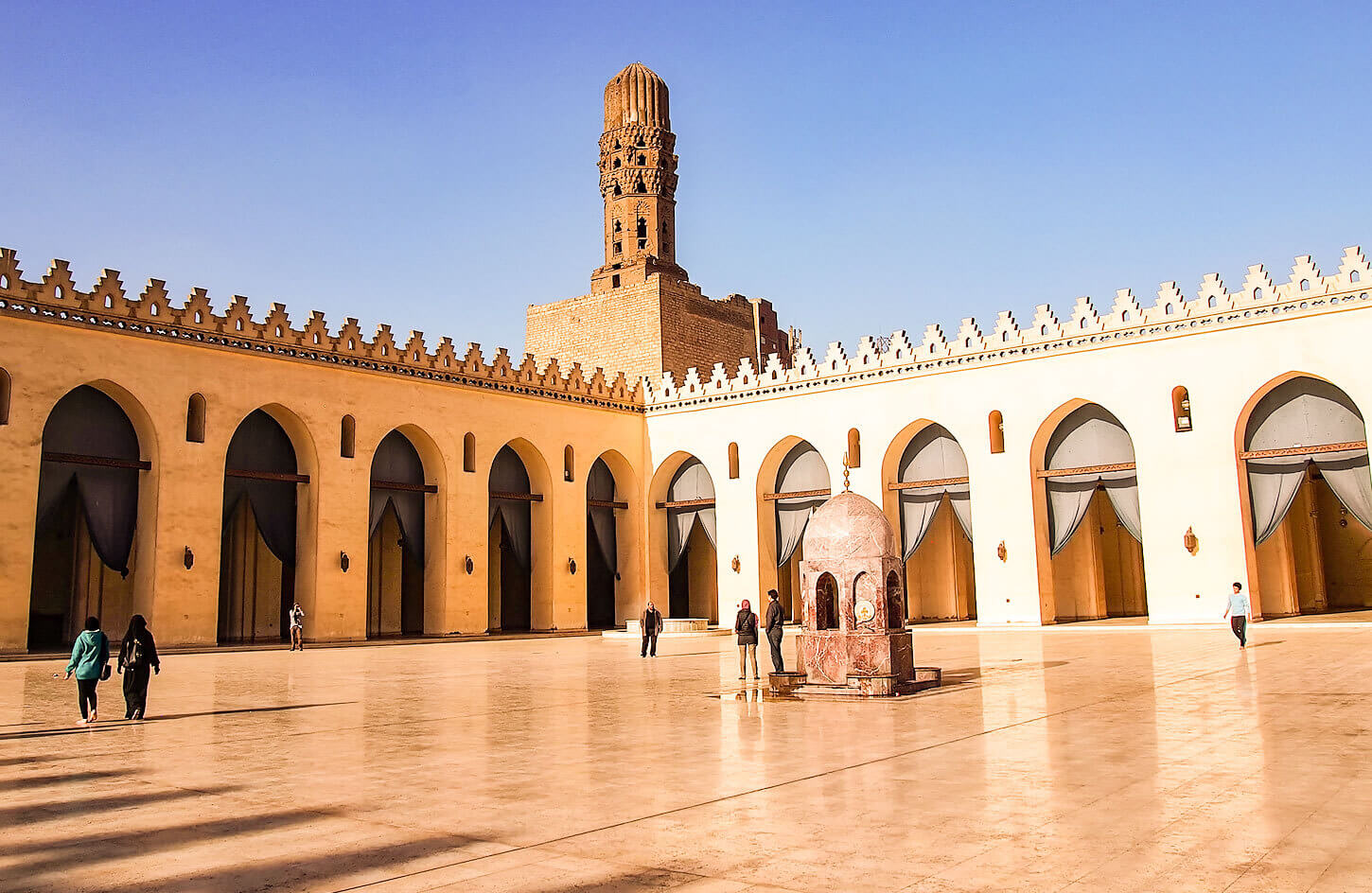
The central open courtyard is one of the most immediately noticeable features when entering the mosque.
3. Its two minarets
The two minarets frame the exterior and are among the mosque’s most recognizable features.
4. Its monumental entrance
The western entrance projects prominently from the façade. The Ministry describes it as one of the earliest examples of a projecting entrance in Egyptian architecture and connects its design to the Great Mosque of Mahdiya in Tunisia.
5. Its location beside Bab Al-Futuh
The mosque forms part of one of the most historically important sections of Cairo.
6. Its complicated later history
The building has experienced different uses, restorations, and changes over the centuries.
Al Hakim Mosque Architecture
What Architectural Style Is Al Hakim Mosque?
Al Hakim Mosque is primarily a Fatimid architectural monument.
Its architecture reflects the early development of Fatimid religious buildings in Egypt and contains features that are especially useful for visitors interested in Islamic architectural history.
The building’s basic organization revolves around a central courtyard surrounded by arcades.
The official monument description explains that the mosque’s plan includes four arcades arranged around a courtyard, with two minarets flanking the façade.
This organization allows visitors to understand the mosque almost immediately after entering: the open central space provides the visual center, while the surrounding covered areas create the main prayer arcades.
Al Hakim Mosque Plan Explained
The Al Hakim Mosque plan is organized around a large open central courtyard surrounded by four arcades, with the prayer spaces arranged around the courtyard. Two minarets stand on either side of the main façade.
This is one of the most useful things to understand before visiting because the mosque can look deceptively simple from photographs.
The courtyard is not merely an empty space. It creates the organizational center of the mosque.
Simplified layout
| Area | Function |
|---|---|
| Central courtyard | Open central space |
| Four arcades | Covered prayer areas |
| Western façade | Main monumental entrance |
| Two minarets | Vertical architectural landmarks |
| Qibla side | Main prayer orientation |
| Exterior walls | Define the large rectangular complex |
The Ministry’s English description refers to the plan as a triangle, while the Arabic official description describes it as rectangular. For practical visitor purposes, the important architectural feature is the central courtyard surrounded by four arcades.
Al Hakim Mosque Minarets
The Al Hakim Mosque minarets are among the most distinctive elements of the building.
Two minarets stand on either side of the mosque’s main façade. Their position makes them particularly visible from the surrounding streets and helps create the recognizable exterior profile of the monument.
They are also historically interesting because the mosque had uses far beyond its original religious function.
According to the Egyptian government and Ministry of Tourism and Antiquities, during the French campaign the mosque was used as a military headquarters and its minarets served as watchtowers.
This is an excellent example of why visitors should look beyond the construction date when exploring historic Cairo. A monument can have several different lives over hundreds of years.
What Should You Look for in the Al Hakim Mosque Minarets?
When visiting, look at:
- Their position at the edges of the façade.
- The contrast between the vertical minarets and the broad horizontal mosque.
- The architectural details around their bases and upper sections.
- How the minarets relate visually to Bab Al-Futuh.
- Their position when viewed from Al-Muizz Street.
If you are interested in Islamic architecture, spend a few minutes examining the exterior before entering rather than immediately walking through the main entrance.
Al Hakim Mosque Interior
What Is Inside Al Hakim Mosque?
The Al-Hakim Mosque interior is centered around its open courtyard and surrounding prayer arcades.
The interior is less about a single spectacular object and more about understanding the scale, symmetry, space, and relationship between the courtyard and covered areas.
Visitors should pay attention to:
- The proportions of the courtyard.
- The surrounding arcades.
- Columns and architectural details.
- The prayer orientation.
- The relationship between open and covered spaces.
- Restoration details.
- The overall simplicity of the architectural composition.
The mosque has undergone several restoration phases over its long history.
That means some parts of what you see today should be understood as part of a restored historic monument rather than assuming every visible surface has remained unchanged since the Fatimid period.
Can You Take Al-Hakim Mosque Photos?
Visitors interested in Al-Hakim Mosque photos should find plenty of photographic opportunities, particularly around the courtyard, façade, minarets, entrance, and surrounding historic streets.
However, photography inside a functioning religious space should always be respectful.
Good photography subjects include:
- The western entrance.
- The two minarets.
- The courtyard.
- Geometric architectural details.
- The relationship between the mosque and Bab Al-Futuh.
- Exterior views from Al-Muizz Street.
- Architectural details that do not disturb worshippers.
Photography etiquette
Avoid:
- Photographing people praying without permission.
- Using flash when prohibited.
- Blocking entrances.
- Standing in prayer areas during worship.
- Treating the mosque like a photography studio.
- Using a tripod where it obstructs visitors.
Photography rules can change, so follow instructions from mosque staff during your 2027 visit.
Is Al Hakim Mosque Free to Enter?
The Ministry of Tourism and Antiquities currently lists entry to Al Hakim Mosque as free of charge.
However, because your trip will be in 2027, do not assume that today’s access arrangements will remain unchanged.
Historic monuments can occasionally have temporary closures, restoration work, controlled access, or changes in visitor procedures.
Best approach for 2027
Before visiting:
- Check the official monument information.
- Confirm whether restoration work affects access.
- Check local opening arrangements.
- Follow any security or photography instructions.
- If visiting as part of a guided tour, ask your guide to confirm access that morning.
For planning purposes, it is reasonable to treat the mosque as a low-cost or free attraction based on the current official information, rather than building your itinerary around a guaranteed 2027 ticket policy.
How Long Do You Need at Al Hakim Mosque?
For most travelers, 30 to 60 minutes is enough to see Al Hakim Mosque properly.
20–30 minutes
Suitable if:
- You are visiting many Cairo attractions.
- You mainly want to see the architecture.
- You are combining it with a walking tour of Al-Muizz Street.
45–60 minutes
Better if:
- You enjoy Islamic architecture.
- You want to photograph the courtyard.
- You want time to examine the minarets and entrance.
- You are traveling with a knowledgeable guide.
60+ minutes
Worth considering if:
- You are studying architecture.
- You are photographing details.
- You want a slower cultural experience.
- The mosque is part of a dedicated Islamic Cairo tour.
You do not need several hours unless the visit is specifically focused on architectural study or photography.
What Is the Best Time to Visit Al Hakim Mosque?
The best time depends on your priorities.
For comfortable sightseeing and photography, earlier in the day is generally preferable, especially if you are planning to walk through Al-Muizz Street afterward.
Morning
Advantages:
- Better for combining multiple historic sites.
- Usually more comfortable during hotter periods.
- Gives you plenty of time for Al-Muizz Street and Khan El-Khalili.
- Useful for travelers on a full-day Cairo sightseeing itinerary.
Afternoon
Advantages:
- Works well with a broader Islamic Cairo itinerary.
- Can be combined with Khan El-Khalili later in the day.
Evening
The surrounding historic area can have a very different atmosphere after sunset, but access to individual monuments can differ from daytime sightseeing.
Do not assume that because Al-Muizz Street remains active in the evening, every monument will be open to visitors at the same time.
How Much Time Should You Allow for the Whole Area?
If you are visiting only Al Hakim Mosque, allow around one hour.
If you are exploring the wider northern section of Islamic Cairo, allow half a day.
A practical route could look like:
| Stop | Suggested Time |
|---|---|
| Bab Al-Futuh | 20–30 minutes |
| Al Hakim Mosque | 30–60 minutes |
| Al-Muizz Street | 60–120 minutes |
| Nearby historic monuments | 60–90 minutes |
| Khan El-Khalili | 60–120 minutes |
| Meal or coffee break | 45–60 minutes |
The exact timing depends on your pace and which monuments are accessible on the day.
Al Hakim Mosque and Bab Al-Futuh
One of the best reasons to visit Al Hakim Mosque is its relationship with Bab Al-Futuh, one of the historic gates of Cairo.
The mosque was originally outside the walls of the earlier Fatimid city. It later became incorporated into the expanded city when Badr Al-Jamali expanded Cairo’s fortifications.
This means the location is not accidental.
The mosque and city walls belong to the same broader story of Cairo’s transformation from a Fatimid royal settlement into a larger fortified urban center.
For visitors, the combination makes the area far more interesting than viewing the mosque as an isolated building.
Al Hakim Mosque and Al-Muizz Street
Al Hakim Mosque is one of the most useful starting or finishing points for exploring Al-Muizz Street.
Al-Muizz Street runs through the historic core of Islamic Cairo and contains a remarkable concentration of medieval monuments.
If you enjoy historic architecture, consider spending an entire morning or afternoon walking the area instead of visiting the mosque alone.
You can combine the visit with:
- Bab Al-Futuh
- Al-Muizz Street
- Khan El-Khalili
- Al-Azhar Mosque
- Historic Fatimid and Mamluk monuments
See the Khan El-Khalili Bazaar guide before planning your route.
You can also learn more about Al-Muizz Street and the historic district.
Al Hakim Mosque vs Al-Azhar Mosque
Both mosques are important Fatimid monuments, but they provide different experiences.
| Feature | Al Hakim Mosque | Al-Azhar Mosque |
|---|---|---|
| Period | Fatimid | Fatimid |
| Main character | Historic architectural monument | Mosque and major Islamic learning center |
| Location | Northern Al-Muizz Street | Al-Azhar area |
| Courtyard | Major feature | Major feature |
| Visitor experience | More focused on architecture and history | Strong religious and educational significance |
| Best combined with | Bab Al-Futuh and Al-Muizz Street | Khan El-Khalili and central Islamic Cairo |
Al-Azhar was established very early in Fatimid Cairo, with the first Friday prayer held there in Ramadan of 361 AH/972 AD.
If you have time, visiting both gives you a better understanding of Fatimid Cairo.
Read the Al-Azhar Mosque guide for more background.
Al Hakim Mosque vs Ibn Tulun Mosque
The comparison is particularly useful for architecture enthusiasts.
| Feature | Al Hakim Mosque | Ibn Tulun Mosque |
|---|---|---|
| Main period | Fatimid | Tulunid |
| Location | Islamic Cairo | Sayyida Zeinab area |
| Courtyard | Central courtyard | Large central courtyard |
| Architecture | Fatimid | Distinctive Tulunid style |
| Famous feature | Twin minarets and monumental façade | Spiral minaret and expansive courtyard |
| Recommended for | Fatimid Cairo | Early Islamic architecture |
The two mosques should not be treated as interchangeable.
If your interest is specifically the development of Cairo’s architecture, seeing both can be extremely rewarding.
Read more about the Mosque of Ibn Tulun.
Al Hakim Mosque vs Muhammad Ali Mosque
These are two very different experiences.
The Mosque of Muhammad Ali is located inside the Citadel of Saladin and dates to the 19th century, while Al Hakim Mosque belongs to the Fatimid period. The Ministry of Tourism and Antiquities describes Muhammad Ali Mosque as a Turkish-style mosque with a monumental central dome and twin minarets reaching 84 meters.
| Feature | Al Hakim Mosque | Muhammad Ali Mosque |
|---|---|---|
| Period | Fatimid | 19th-century |
| Location | Al-Muizz Street | Cairo Citadel |
| Style | Fatimid | Ottoman/Turkish-inspired |
| Main visual feature | Courtyard and twin minarets | Large central dome and minarets |
| Experience | Medieval Islamic Cairo | Citadel and panoramic Cairo |
See the Muhammad Ali Mosque if you plan to visit the Citadel.
Is Al Hakim Mosque Worth Visiting in 2027?
Yes, especially if you are interested in Islamic history, architecture, photography, or historic Cairo.
It may not be the first monument that comes to mind for a first-time visitor to Egypt, but that is part of its appeal.
Travelers who only visit the Pyramids, Egyptian Museum, and major modern Cairo attractions can miss the architectural story of medieval Cairo.
Al Hakim Mosque gives you a different perspective.
It is particularly suitable for:
- Architecture enthusiasts
- History travelers
- Cultural travelers
- Photographers
- Repeat visitors to Cairo
- Travelers exploring Islamic Cairo
- Visitors interested in Fatimid history
- Travelers taking a guided walking tour
It may be less important if:
- You have only a few hours in Cairo.
- Your priority is Ancient Egyptian archaeology.
- You are visiting Cairo for the first time and have not yet seen the Pyramids or major museums.
In a short itinerary, prioritize according to your interests.
For a first Cairo visit, consider combining the mosque with a broader Cairo sightseeing tour.
How to Visit Al Hakim Mosque Respectfully
Al Hakim Mosque is a religious building as well as a historic monument.
Visitors should treat it accordingly.
Dress appropriately
Wear clothing that covers the shoulders and knees.
Women may wish to carry a lightweight scarf, particularly if local staff request additional covering.
Keep noise low
Avoid loud conversations, especially around people praying.
Ask before photographing people
Architectural photography is one thing; photographing worshippers is different.
Follow local instructions
Staff may restrict access to particular areas during prayers or religious activities.
Remove footwear when required
If you are asked to remove your shoes before entering a prayer area, follow the mosque’s instructions.
The goal is simple: treat the mosque as a functioning religious place rather than only as an archaeological attraction.
What Should You Bring?
You do not need special equipment to visit Al Hakim Mosque.
Useful items include:
- Comfortable walking shoes
- Modest clothing
- Water
- Sunglasses for outdoor walking
- Phone or camera
- Portable power bank
- Small amount of local currency
- Lightweight scarf if needed
- Hand sanitizer
The most important item is comfortable footwear because the mosque is best experienced as part of a walking route through historic Cairo.
Is Al Hakim Mosque Suitable for Families?
Yes.
Children who enjoy history and architecture can find the mosque interesting, especially because the courtyard provides a sense of scale that photographs cannot fully communicate.
However, families should remember that this is a religious site.
Encourage children to:
- Speak quietly.
- Avoid running.
- Respect worshippers.
- Stay with the family.
- Follow staff instructions.
If your children are more interested in Ancient Egypt, consider combining the mosque with a more varied Cairo day rather than spending a full day exclusively on Islamic monuments.
Is Al Hakim Mosque Accessible for Older Travelers?
The answer depends on the visitor’s mobility and the conditions on the day.
The broader Islamic Cairo area includes historic streets and surfaces that may be uneven or crowded.
For older travelers, the best strategy is to:
- Wear supportive shoes.
- Avoid the hottest part of the day.
- Take regular breaks.
- Use a private vehicle between major areas where practical.
- Avoid packing too many monuments into one walking route.
If you are planning a customized Egypt trip for older travelers, consider building a slower Cairo itinerary rather than following a fast-paced sightseeing schedule.
Can You Visit Al Hakim Mosque Without a Guide?
Yes, you can explore the mosque independently, but a guide can add significant historical context.
Without a guide, you can appreciate:
- The courtyard.
- The minarets.
- The façade.
- The overall scale.
- The architectural details.
With a knowledgeable guide, you can better understand:
- Fatimid Cairo.
- The mosque’s relationship with the city walls.
- The architectural plan.
- Later historical uses.
- The relationship between Al Hakim Mosque and other Fatimid monuments.
For travelers interested in Islamic Cairo, a dedicated Islamic Cairo tour can be more efficient than trying to navigate every monument independently.
What Historical Events Are Connected to Al Hakim Mosque?
The mosque has experienced several different phases throughout its history.
One particularly unusual chapter occurred during the French campaign in Egypt, when the mosque was used as a military headquarters and its minarets were used as watchtowers.
Another notable chapter concerns the building’s relationship with Islamic archaeology.
The qibla arcade was used as a museum known as the House of Arab Antiquities, described by Egyptian official sources as the first Islamic museum in Cairo.
These later uses show why the mosque should be viewed as a living historical structure rather than a monument frozen at the moment of its construction.
Al Hakim Mosque Restoration
The mosque has undergone restoration over the centuries.
The Ministry of Tourism and Antiquities specifically notes that the monument has experienced several restoration phases.
This is important when looking at photographs online.
A photograph labeled “Al Hakim Mosque interior” may show a particular restored condition, while the building’s appearance can change following conservation work.
For a 2027 visit, rely on current official information for access and conservation status rather than assuming that every photograph online represents exactly what you will see.
Common Mistakes When Visiting Al Hakim Mosque
1. Treating it as a standalone attraction
The mosque makes more sense when combined with the surrounding historic district.
2. Visiting without understanding the plan
Knowing that the courtyard is the central organizing feature makes the architecture much easier to appreciate.
3. Ignoring the minarets
The minarets are among the monument’s most recognizable architectural elements.
4. Photographing without considering worshippers
Always prioritize respect.
5. Wearing uncomfortable shoes
The surrounding area is designed for exploration on foot.
6. Trying to see everything in one hour
Islamic Cairo contains enough monuments to fill several visits.
7. Assuming current opening arrangements will apply in 2027
Check closer to your travel date.
How to Add Al Hakim Mosque to a Cairo Itinerary
If You Have 1 Day in Cairo
A full Cairo day could combine major Ancient Egyptian attractions with Islamic Cairo.
For example:
- Morning: Giza Pyramids
- Midday: Lunch and transfer
- Afternoon: Al Hakim Mosque and Al-Muizz Street
- Late afternoon: Khan El-Khalili
- Evening: Dinner or Cairo night experience
This gives you two completely different sides of Cairo.
See the Giza Pyramids tour if you want to combine the mosque with Cairo’s most famous archaeological landmark.
If You Have 2 Days in Cairo
With two days, you have considerably more flexibility.
Day 1
- Giza Pyramids
- Sphinx
- Grand Egyptian Museum
- Cairo dinner
Day 2
- Al Hakim Mosque
- Bab Al-Futuh
- Al-Muizz Street
- Khan El-Khalili
- Al-Azhar Mosque
- Historic Cairo
For travelers with limited time, a 2-day Cairo tour can help organize the major attractions efficiently.
If You Have 3 Days in Cairo
Three days allow you to slow down.
A possible structure:
Day 1
Giza and the Sphinx.
Day 2
Grand Egyptian Museum and modern Cairo.
Day 3
Islamic Cairo, including Al Hakim Mosque, Al-Muizz Street, Khan El-Khalili, and Al-Azhar.
See the 3 Days in Cairo itinerary for a broader structure.
Can Al Hakim Mosque Be Combined With Khan El-Khalili?
Yes. This is one of the easiest combinations in Cairo.
Al Hakim Mosque is in the historic northern section of the Islamic Cairo district, while Khan El-Khalili is nearby.
A walking itinerary can connect:
Bab Al-Futuh → Al Hakim Mosque → Al-Muizz Street → Khan El-Khalili
The exact order can be adjusted depending on opening arrangements and your guide.
Read the Egypt Khan El-Khalili guide before visiting the market.
Can You Combine Al Hakim Mosque With Al-Azhar Mosque?
Yes.
Al-Azhar and Al Hakim Mosque both belong to the story of Fatimid Cairo, but they represent different parts of that history.
If religious architecture is one of your main interests, visiting both is worthwhile.
A broader Coptic and Islamic Cairo tour can also provide a useful comparison between Cairo’s Islamic and Christian heritage.
Is Al Hakim Mosque Good for Photography?
Yes. The mosque is particularly interesting for architectural photography.
The strongest subjects are:
- Twin minarets
- Western façade
- Projecting entrance
- Courtyard
- Repeating arcades
- Architectural details
- Historic surroundings
Morning or late afternoon can provide attractive natural light, but the best photography time depends on the season, weather, and access.
Avoid allowing photography to interfere with prayer or other visitors.
What Should Architecture Lovers Notice?
Architecture enthusiasts should look beyond decorative details.
Ask yourself:
How does the courtyard organize the building?
The open central space establishes the visual center.
How do the arcades frame the courtyard?
They create repeated architectural rhythms around the open space.
How does the entrance project from the façade?
The monumental western entrance is one of the mosque’s important architectural characteristics.
How do the minarets affect the façade?
Their placement creates a strong vertical frame for the mosque.
How does the mosque relate to the city?
Its relationship with Bab Al-Futuh and Al-Muizz Street is essential to understanding its historical setting.
Al Hakim Mosque and the Development of Cairo
To understand the mosque, it helps to understand the development of Cairo itself.
The Fatimids established Cairo after their conquest of Egypt in 969 AD. The city became a new political center northeast of earlier settlements such as Fustat.
The Ministry of Tourism and Antiquities describes Cairo’s establishment under Jawhar al-Siqilli and the development of its early urban plan, including Al-Muizz Street and the city’s original gates.
Al Hakim Mosque belongs to this early history.
That is why walking through the surrounding district is so valuable. You are not simply moving between separate attractions. You are moving through the historical urban landscape that developed around them.
Al Hakim Mosque for First-Time Visitors to Egypt
If this is your first trip to Egypt, should you visit Al Hakim Mosque?
If you have enough time, yes—but it should normally complement, rather than replace, Cairo’s major first-time attractions.
For a first trip, consider prioritizing:
- Giza Pyramids
- Sphinx
- Grand Egyptian Museum
- Historic Cairo
- Khan El-Khalili
- Al Hakim Mosque
- Al-Azhar Mosque
The exact order depends on your interests.
Travelers passionate about Islamic architecture may rank Al Hakim Mosque much higher.
Al Hakim Mosque for Repeat Visitors
For repeat visitors to Cairo, Al Hakim Mosque becomes even more attractive.
If you have already seen:
- The Pyramids
- Sphinx
- Egyptian Museum
- Grand Egyptian Museum
- Cairo Citadel
- Khan El-Khalili
then exploring Fatimid Cairo in greater depth can provide a completely different experience.
You can spend more time studying architectural details rather than rushing between famous landmarks.
Is Al Hakim Mosque Suitable for a Private Cairo Tour?
Yes.
A private tour is especially useful if you want to combine the mosque with several nearby monuments while controlling the pace.
For example, a private itinerary could include:
Bab Al-Futuh → Al Hakim Mosque → Al-Muizz Street → Khan El-Khalili → Al-Azhar → selected historic monuments
This is particularly useful for families, photographers, older travelers, and travelers with specific architectural interests.
For a shorter visit, consider a half-day Cairo tour.
How Much Does a Visit to Al Hakim Mosque Cost in 2027?
The current official Ministry of Tourism and Antiquities page lists free admission.
However, 2027 pricing should be confirmed shortly before your visit.
Your actual cost may still include:
- Transportation
- Private guide
- Full-day tour
- Food
- Other monument tickets
- Photography-related costs if any special rules apply
If you are visiting as part of a larger Cairo itinerary, the mosque itself may be only one part of your total tour cost.
Is Al Hakim Mosque Open Every Day?
Visitors should not assume a fixed 2027 schedule based on today’s information.
Historic monuments can have:
- Different opening hours
- Prayer-related access restrictions
- Restoration closures
- Special religious arrangements
- Security restrictions
The Ministry’s current monument listing confirms the location and free admission but does not provide a permanent 2027 schedule that travelers should treat as guaranteed.
For this reason, verify access shortly before your visit.
What Is the Best Month to Visit Al Hakim Mosque?
The best months for exploring Cairo’s historic districts are generally the cooler periods of the year, particularly autumn through spring.
For walking-heavy itineraries, cooler weather can make a major difference.
The most comfortable period depends on your tolerance for heat, but travelers planning extensive outdoor sightseeing should consider the seasonal conditions before choosing dates.
For more detailed planning, see the Egypt weather by month guide.
What Should You Wear to Al Hakim Mosque?
Wear modest, comfortable clothing.
A good approach is:
- Shoulders covered
- Knees covered
- Loose, comfortable clothing
- Comfortable walking shoes
- Lightweight scarf available if needed
Because the mosque is an active religious environment, conservative clothing is the safest choice.
You should also consider the heat if visiting Cairo during warmer months.
Is Al Hakim Mosque Safe to Visit?
Al Hakim Mosque is located within a well-established historic tourist area of Cairo.
As with any busy urban destination, travelers should use normal precautions:
- Keep valuables secure.
- Watch belongings in crowded markets.
- Stay aware of your surroundings.
- Follow local instructions.
- Use reputable transportation.
- Keep important documents secure.
If you are concerned about broader travel conditions, consult current government travel advice shortly before departure because security guidance can change.
What Other Historic Mosques Should You Visit in Cairo?
If you enjoy Al Hakim Mosque, consider adding:
Al-Azhar Mosque
A major Fatimid mosque and historic center of Islamic learning.
Ibn Tulun Mosque
One of Cairo’s most important early Islamic monuments.
Muhammad Ali Mosque
A dramatically different 19th-century mosque inside the Citadel.
Sultan Hassan Mosque
A major Mamluk monument known for its monumental architecture.
Al-Muayyad Sheikh Mosque
Another important historic mosque on Al-Muizz Street.
The Ministry of Tourism and Antiquities maintains official monument information for Cairo’s historic Islamic sites.
Recommended Islamic Cairo Walking Route
For travelers who want maximum value from the area, consider:
- Start at Bab Al-Futuh.
- Explore the exterior of Al Hakim Mosque.
- Enter the mosque if access is available.
- Spend time in the courtyard.
- Walk along Al-Muizz Street.
- Stop at selected historic monuments.
- Continue toward Khan El-Khalili.
- Visit Al-Azhar if time and opening arrangements allow.
- Finish with food or coffee in the surrounding area.
Do not attempt to enter every monument simply because it is nearby.
Choose a few sites and spend enough time understanding them.
Expert Tips for Visiting Al Hakim Mosque in 2027
Tip 1: Visit with context
Read a little about Fatimid Cairo before arriving.
Tip 2: Look at the exterior first
The façade and minarets are important parts of the monument.
Tip 3: Do not rush through the courtyard
The courtyard is central to understanding the building’s architecture.
Tip 4: Combine nearby attractions
Al Hakim Mosque is best experienced as part of historic Cairo.
Tip 5: Wear good shoes
You will probably walk more than expected.
Tip 6: Keep your itinerary flexible
Opening arrangements can change.
Tip 7: Respect prayer times and worshippers
The mosque is not simply an archaeological site.
Tip 8: Take fewer but better photographs
Architectural details are more interesting when you take time to frame them properly.
Tip 9: Consider a private guide
A knowledgeable guide can explain the relationship between the mosque, Fatimid Cairo, Bab Al-Futuh, and Al-Muizz Street.
Tip 10: Avoid overcrowding your day
Three or four meaningful sites are often better than ten rushed stops.
Suggested Cairo Itineraries Featuring Al Hakim Mosque
2-Day Cairo Option
Day 1: Giza Pyramids, Sphinx, Grand Egyptian Museum.
Day 2: Al Hakim Mosque, Bab Al-Futuh, Al-Muizz Street, Khan El-Khalili, Al-Azhar.
See the 2-day Egypt tour option.
3-Day Cairo Option
Day 1: Giza and Sphinx.
Day 2: Grand Egyptian Museum and selected Cairo attractions.
Day 3: Islamic Cairo, including Al Hakim Mosque.
See the 3 Days in Cairo tour.
4-Day Cairo Option
A slower four-day itinerary could include:
- Giza
- Grand Egyptian Museum
- Islamic Cairo
- Al Hakim Mosque
- Khan El-Khalili
- Old Cairo
- Coptic Cairo
- Additional museums or local experiences
A longer itinerary is particularly useful for travelers who prefer cultural experiences over rushing through a checklist.
Frequently Asked Questions About Visiting Al Hakim Mosque in 2027
Is Al Hakim Mosque worth visiting?
Yes. Al Hakim Mosque is worth visiting if you are interested in Fatimid history, Islamic architecture, photography, or historic Cairo. Its courtyard, monumental façade, minarets, and location beside Bab Al-Futuh make it particularly valuable as part of an Islamic Cairo walking route.
Is Al Hakim Mosque free to enter?
The Ministry of Tourism and Antiquities currently lists entry as free. Because your trip is in 2027, verify the latest access and ticket information before visiting.
Where is Al Hakim Mosque located?
Al Hakim Mosque is located at the northern end of Al-Muizz Street in Al-Gamaliya district, next to Bab Al-Futuh in historic Cairo.
Who built Al Hakim Mosque?
Construction was begun by Fatimid Caliph Al-Aziz bi Allah around 990 AD and completed by his son Al-Hakim bi-Amr Allah in 1013 AD.
What is Al Hakim Mosque famous for?
It is famous for its Fatimid architecture, large courtyard, monumental projecting entrance, two minarets, and its historical location beside Bab Al-Futuh and Al-Muizz Street.
How long should I spend at Al Hakim Mosque?
Most visitors can see the mosque in about 30–60 minutes. Allow more time if you are interested in architectural photography or are visiting with a guide.
Can I take photos inside Al Hakim Mosque?
Photography may be possible, but visitors should follow local rules and avoid disturbing worshippers. Check with staff before using professional equipment or a tripod.
Is Al Hakim Mosque near Khan El-Khalili?
Yes. It is located in the historic Islamic Cairo area and can be combined with Khan El-Khalili and Al-Muizz Street in the same sightseeing route.
What should I wear to Al Hakim Mosque?
Wear modest clothing that covers the shoulders and knees. Comfortable walking shoes are also strongly recommended because the surrounding historic district is best explored on foot.
Can I visit Al Hakim Mosque without a guide?
Yes. Independent visitors can appreciate the architecture, courtyard, façade, and minarets. A guide is useful if you want deeper information about Fatimid history and Islamic Cairo’s urban development.
What is the Al Hakim Mosque plan?
The mosque is organized around a central open courtyard surrounded by four arcades, with the main façade and two minarets forming its most recognizable exterior elements.
What are the Al Hakim Mosque minarets used for today?
The minarets are primarily architectural and religious features of the mosque. Historically, they were also used as watchtowers during the French campaign in Egypt.
Conclusion: Should You Visit Al Hakim Mosque in 2027?
Visiting Al Hakim Mosque in 2027 is worthwhile for travelers who want to understand the Fatimid heritage of Cairo and explore a side of the city that goes beyond the Pyramids and Ancient Egyptian monuments.
The mosque’s importance comes from several elements working together: its early Fatimid history, large central courtyard, four-arcade plan, distinctive minarets, monumental entrance, and position beside Bab Al-Futuh and Al-Muizz Street.
The best way to experience it is not as an isolated stop.
Instead, combine it with a broader exploration of historic Cairo.
A route including Bab Al-Futuh, Al Hakim Mosque, Al-Muizz Street, Khan El-Khalili, and Al-Azhar Mosque can provide a compact but rich introduction to the city’s Islamic heritage.
For most travelers, 30–60 minutes is enough for the mosque itself. Allow several hours if you want to explore the surrounding district properly.
Most importantly, confirm opening arrangements and visitor policies close to your 2027 trip, since access and conservation conditions can change.
If your Cairo itinerary allows enough time, Al Hakim Mosque is one of the historic monuments that can turn a standard Cairo sightseeing trip into a much deeper exploration of the city’s architectural history.