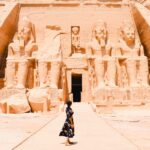
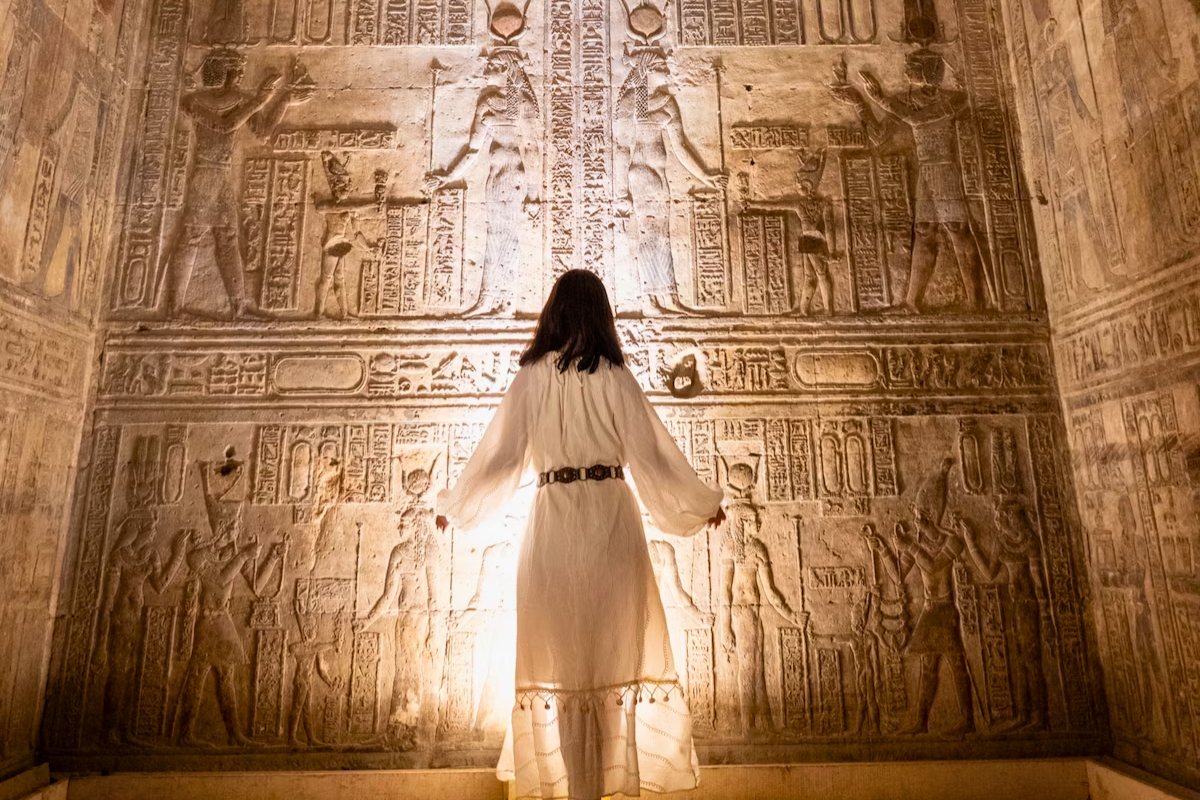
Dendera Temple Complex is one of the best-preserved sacred sites in all of Egypt, famous for two things almost nobody forgets after seeing them in person: a painted stone map of the sky known as the Dendera Zodiac, and wall colors so vivid that visitors often assume they were repainted last year rather than roughly 2,000 to 4,000 years ago.
In this guide, you will learn exactly where Dendera is, how it compares to Luxor’s temples, why the ceiling and colors have survived so well, what a visit costs and includes in 2026, and how to combine it with Abydos, a helicopter ride, or a private tour for the smoothest possible day trip. Whether you are a first-time visitor to Egypt or a returning traveler chasing the sites everyone else skips, this article was built to answer every question you might type into a search bar before, during, and after your trip.
By the end, you will know precisely how to plan your visit, what to pack, what to photograph, and how to book the experience with a trusted local partner instead of guessing your way through it.
Dendera does not get the crowds of the Pyramids of Giza or Luxor’s Karnak Temple, and that is exactly its charm. Because fewer buses stop here, the temple feels quieter, more intimate, and in many ways more magical — you can stand under the famous zodiac ceiling for as long as you like without fighting for space, and you can wander through underground crypts that most Egypt itineraries never even mention. Egypt All Inclusive has been sending travelers here for years, and this guide reflects exactly what our guests ask us before they go, and what they tell us afterward. Let’s start at the beginning: what exactly is the Dendera Temple Complex, and why has it become one of the most talked-about ancient sites heading into 2026?
What Is the Dendera Temple Complex? A Quick Overview for 2026 Travelers
The Dendera Temple Complex, known in Arabic as Iunet or Tantere in ancient Egyptian, is a sprawling sacred enclosure located on the west bank of the Nile River near the modern city of Qena in Upper Egypt. At its heart sits the Temple of Hathor, the goddess of love, beauty, music, and motherhood, but the complex is far larger than a single building. Surrounded by a massive mudbrick enclosure wall, the site includes the main Hathor temple, a smaller temple dedicated to Isis, a sanatorium where ancient pilgrims came for healing, two mammisi (birth houses) celebrating the divine birth of Horus, a sacred lake once used for ritual purification, and the remains of a Coptic Christian basilica built centuries later within the same walls. This layering of history — pharaonic, Greco-Roman, and early Christian — is part of what makes Dendera so rewarding for curious travelers who want more than a single photo opportunity.
Unlike many Egyptian temples that were built and finished under a single pharaoh, the temple of Dendera egypt visitors see today largely dates to the Ptolemaic and Roman periods, meaning Greek-descended pharaohs and later Roman emperors funded and decorated most of what stands now, even though the site itself had been sacred ground for thousands of years before that. Cartouches of Cleopatra VII, the last pharaoh of Egypt, appear on the temple’s rear exterior wall, and Roman emperors such as Augustus, Tiberius, and Nero are depicted making offerings to Hathor in full pharaonic regalia — a fascinating reminder that Egypt’s religious traditions outlived its political independence by centuries.
For 2026 travelers, Dendera temple complex ancient Egypt tourist attractions status has grown considerably. Restoration teams have continued cleaning and stabilizing the painted ceilings, tourism authorities have improved the road and rest-stop infrastructure between Luxor and Dendera, and online interest has spiked thanks to viral photos and videos of the zodiac ceiling and the so-called “Dendera light” reliefs circulating across social media. This means more travelers are adding it to their must-see list, but it also means booking through a reliable operator matters more than ever, since demand for well-organized, air-conditioned, guided day trips is rising fast.
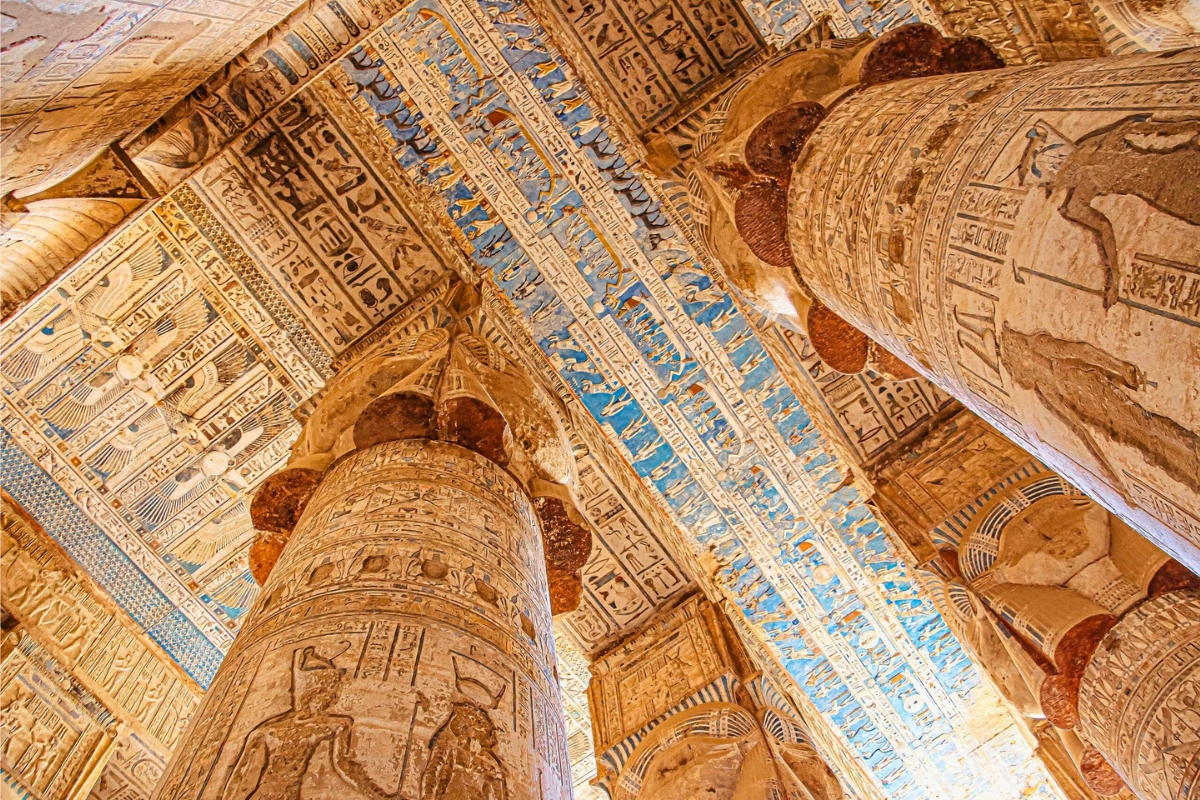
What makes the temple of Hathor at Dendera stand out from other Egyptian temples is the sheer completeness of its roof. Very few ancient Egyptian temples still have an intact ceiling, but Dendera’s hypostyle hall roof survives almost entirely, covered edge to edge in painted astronomical scenes, including the celebrated zodiac. That intact ceiling is precisely why the site draws astronomy enthusiasts, art historians, photographers, and spiritually curious travelers all at once — there is genuinely something here for every type of visitor, and that is exactly why we have built this guide to answer every angle of interest you might have.
Where Is Dendera Temple Located? Distance From Luxor and How to Get There in 2026
If you are asking “where is Dendera temple” or “where is the temple of Dendera,” the short answer is Upper Egypt, on the west bank of the Nile, roughly 60 to 77 kilometers (about 37 to 48 miles) north of Luxor, near the city of Qena. Depending on the road conditions and your starting point within Luxor, the drive typically takes between 60 and 90 minutes each way by private vehicle, making it a very manageable half-day or full-day excursion for anyone already staying in Luxor, whether on a Nile cruise, in a hotel, or passing through en route to Abydos.
For travelers based in Hurghada or along the Red Sea coast, distance from Luxor to Dendera temple is only part of the journey — you would first need to reach Luxor, then continue north, which is why most Hurghada-based visitors treat this as a full-day trip lasting around 10 to 12 hours round trip. It is still very doable, and Egypt All Inclusive routinely arranges these longer transfers with comfortable, air-conditioned vehicles, rest stops, and an English-speaking Egyptologist guide who narrates the drive so the hours pass quickly rather than dragging.
Here is a simple breakdown of typical travel times to help you plan your 2026 itinerary:
| Starting Point | Approximate Distance | Approximate Drive Time |
|---|---|---|
| Luxor City | 60–77 km | 1 to 1.5 hours |
| Luxor Nile Cruise Dock | 60–77 km | 1 to 1.5 hours |
| Hurghada | Approx. 220 km via Luxor | 3 to 3.5 hours |
| Aswan | Approx. 180 km via Luxor | 2.5 to 3 hours |
| Cairo (by domestic flight to Luxor, then road) | N/A | Flight ~1 hour + 1 to 1.5 hour drive |
Most independent travelers reach Dendera by one of three methods: a private car with driver, a shared group tour bus, or a Nile cruise shore excursion for those sailing between Luxor and Qena. Public transportation exists in theory, but it is not recommended for tourists due to inconsistent scheduling, language barriers, and security escort requirements that apply to this specific route. Egyptian authorities have historically required tourist vehicles traveling to Dendera to travel in escorted convoys or with registered tour operators, particularly for the Qena road, so booking with a licensed travel agency is not just more comfortable — it is the practical way most visitors are able to reach the site smoothly and legally.
If you are combining destinations, many travelers choose to visit dendera and abydos temples from Luxor in a single, long day, since both sites sit north of the city along a similar route. Others prefer splitting them across two separate half-day trips to avoid a long day in the vehicle, especially in the hotter months. We will explore that combined itinerary in more detail later in this guide, along with a full comparison table of tour types so you can pick exactly the pace that suits your travel style in 2026.
Whichever way you arrive, the reward is the same: a beautifully preserved temple, a genuinely different atmosphere from the busier Luxor East and West Bank sites, and one of the most photographed ceilings in the ancient world waiting at the end of the road.
When Was Dendera Temple Built? A Journey Through Its Ancient History
The question “when was Dendera temple built” does not have a single simple answer, because the site was rebuilt and expanded repeatedly across roughly 2,500 years of continuous use. Archaeological evidence shows that a temple to Hathor stood at this location as early as the Old Kingdom, during the reign of Pepi I, around 2250 BCE, and inscriptions even claim the sacred plans for the temple dated back to the time of legendary early rulers, reflecting how ancient Egyptians themselves viewed Dendera as an impossibly old and sacred place even in their own era.
However, when most people picture “the temple of Dendera” today — with its towering columns, painted ceilings, and dramatic Hathor-headed capitals — they are picturing the structure built far later, during the Ptolemaic Dynasty, beginning around 54 BCE under Ptolemy XII, and continued by his daughter Cleopatra VII. Construction and decoration continued well into the Roman period, with emperors including Augustus, Tiberius, Claudius, and Nero adding reliefs and completing sections of the temple through the first century CE. This means the surviving Temple of Hathor at Dendera egypt visitors explore today is roughly 2,000 years old, while the sacred site itself is closer to 4,000 years old when you count the earlier structures that once stood on the same ground — which is exactly why so many travelers search for “dendera temple of time,” sensing correctly that this single location compresses an extraordinary span of Egyptian history into one walkable site.
To make this timeline easier to follow, here is a simplified overview:
| Period | Approximate Date | What Happened at Dendera |
|---|---|---|
| Old Kingdom | c. 2250 BCE | Earliest known temple to Hathor built under Pepi I |
| Middle Kingdom | c. 2000–1700 BCE | Site continued as a cult center for Hathor worship |
| New Kingdom | c. 1500–1100 BCE | Additional shrines and expansions recorded |
| Ptolemaic Period | 54 BCE onward | Main surviving temple begun under Ptolemy XII and Cleopatra VII |
| Roman Period | 30 BCE–c. 100 CE | Temple decoration completed under Augustus, Tiberius, Nero |
| Coptic Period | 4th–5th century CE | Basilica built within temple enclosure |
Why does this matter for your visit? Because understanding the layered history helps explain features that otherwise look confusing on-site. For example, the enclosure wall and sacred lake are far older than the painted columns you will photograph, and the crypts hidden within the temple’s thick walls contain some of the oldest and most symbolically loaded reliefs in the entire complex, deliberately built into the structure by Ptolemaic architects to reflect much older religious traditions passed down through generations of priests.
It is also worth noting that Dendera was never “lost” in the way some Egyptian sites were buried by desert sand for centuries. Because it remained partially visible and was reused by Coptic Christians as a place of worship, and later studied intensively by the Napoleonic expedition of 1798-1801, the temple’s rediscovery by the modern world was less dramatic than sites like Abu Simbel or Tutankhamun’s tomb, but arguably just as significant. French scholars accompanying Napoleon were stunned by the intact ceiling and famously removed one section — the original round zodiac ceiling relief — which now resides in the Louvre Museum in Paris, with a plaster cast replica installed at the temple itself. We will explain exactly what this means for what you will see on-site later in this guide.
Understanding when the temple of Dendera was built also answers a related and very common question: why was the temple of Dendera built at all, and why did rulers separated by thousands of years keep investing in this same patch of land? That story is deeply tied to the goddess Hathor herself, and it is where we turn next.
Why Was the Temple of Dendera Built? The Legend of Hathor
Every great Egyptian temple was built to house a god, but Dendera holds a special place in Egyptian religion because Hathor was not simply a goddess of the sky or the underworld — she was the goddess of joy, love, music, dance, fertility, and motherhood, one of the most beloved deities in the entire pantheon. Ancient Egyptians believed the temple of Hathor at Dendera was one of the primary places on earth where Hathor’s spirit could be honored, celebrated, and reconnected with her divine husband, Horus of Edfu, during an annual festival that remains one of the most fascinating rituals in ancient Egyptian religious life.
Hathor was often depicted as a cow, or as a woman with cow horns cradling a sun disk, and sometimes as a lioness or a sycamore tree, reflecting her role as a nurturing, protective, and occasionally fierce mother-goddess figure. The temple egypt dendera temple of the goddess Hathor was designed as her earthly home, a place where her cult statue could be dressed, fed offerings, and carried in procession during major festivals, most famously during the “Sacred Marriage” festival, when Hathor’s statue traveled by boat from Dendera south to Edfu to symbolically reunite with Horus, before returning north again — an event that drew pilgrims from across Egypt for a joyous, music-filled celebration involving dancing, intoxication, and public festivity that stood in stark contrast to the somber rituals associated with other deities.
This is part of why Dendera temple facts fascinate so many travelers today: unlike temples built purely for royal cult worship or funerary purposes, Dendera was, at its core, a temple of celebration. Wall reliefs throughout the complex depict musicians playing sistrums (a sacred rattle instrument closely associated with Hathor), dancers, and offerings of wine, perfume, and flowers, rather than exclusively battle scenes or solemn funerary processions found elsewhere.
The temple’s design also reflects deep astronomical and cosmological beliefs. Hathor was linked to the sky and to the star Sirius, whose annual reappearance in the dawn sky signaled the start of the Nile flood and the Egyptian new year. This is why the temple includes a specific “New Year” chapel and a rooftop area used for rituals tied to the rising of Sirius, directly connecting the temple’s religious purpose to the astronomical themes visible in the famous zodiac ceiling we will explore in detail later in this guide.
Rulers had political reasons to build here too. For Ptolemaic pharaohs of Greek descent and later Roman emperors who never set foot in Egypt, funding major temple construction was a powerful way to present themselves as legitimate protectors of Egyptian religious tradition to a population that might otherwise view them as foreign occupiers. Depicting themselves in full pharaonic dress, offering incense to Hathor on the temple walls, was effectively a public relations strategy carved permanently in stone — one that succeeded well enough that the temple flourished for centuries under both Greek and Roman rule.
For today’s traveler, this backstory transforms a simple temple visit into something richer: you are not just looking at old stone, you are standing inside what was once one of the most joyful, music-filled religious centers in the ancient world, built and rebuilt across millennia because people never stopped believing this ground was sacred.
The Temple of Hathor at Dendera: Architecture and Design Explained
Approaching the temple of Hathor at Dendera for the first time, most travelers are struck by the scale of the facade before anything else. Six massive columns, each topped with a carved Hathor-head capital, support the entrance portico, and the facade itself is dominated by a large winged sun disk, a common protective symbol placed above temple entrances across Egypt. Walking beneath these towering Hathor faces — each one showing the goddess with cow ears and a serene, almost smiling expression — is one of the most photographed moments at the entire site, and it sets the tone for everything that follows inside.
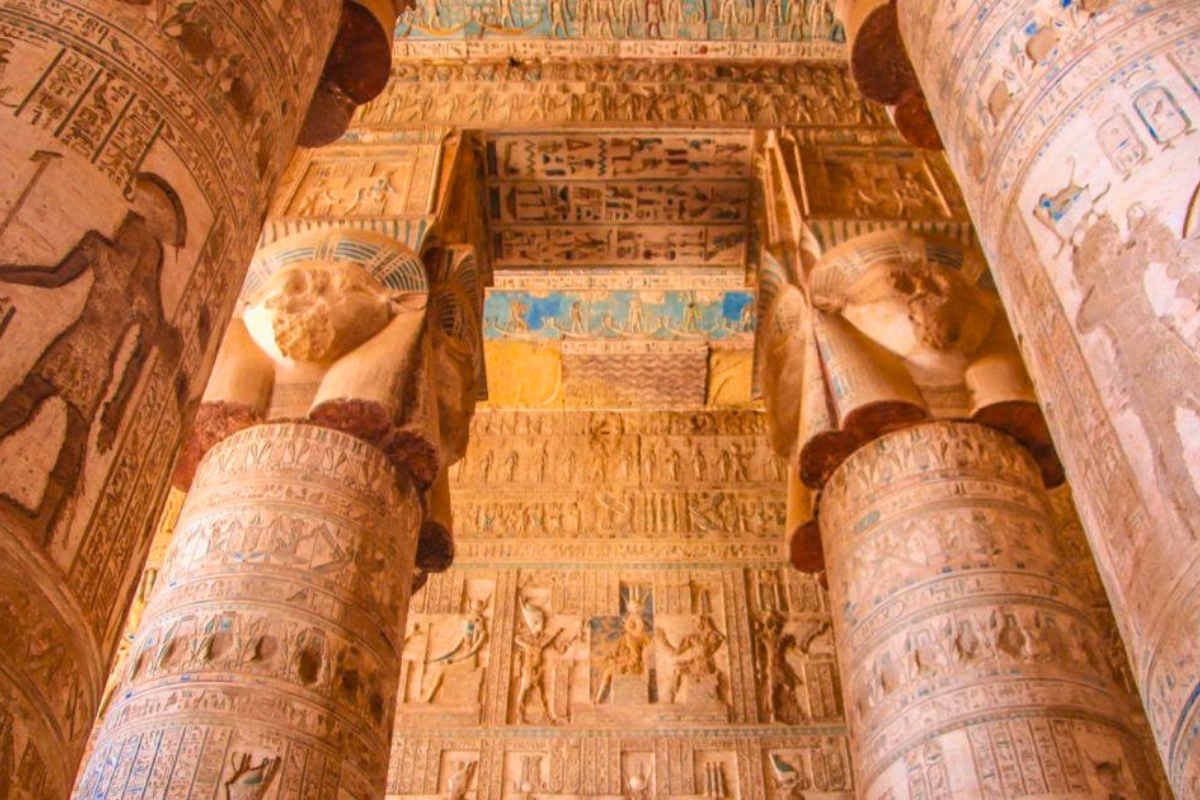
Passing through the entrance leads into the hypostyle hall, a large columned room whose ceiling is the star attraction of the entire complex. Twenty-four columns, again crowned with Hathor-head capitals, support a roof covered edge to edge in painted astronomical and religious scenes, including the world-famous zodiac. This hall was a public or semi-public space where certain rituals and offerings took place, and its scale alone — with columns rising roughly 15 meters — gives a genuine sense of how imposing this building must have felt to ancient visitors approaching the sanctuary beyond.
Beyond the hypostyle hall lies a second, smaller offering hall, followed by a series of increasingly restricted chambers leading toward the innermost sanctuary, where the sacred barque and cult statue of Hathor would have been kept, accessible only to high priests. This layout — moving from open, public spaces toward increasingly dark, narrow, and restricted inner chambers — is a design principle common across ancient Egyptian temples, symbolically representing the journey from the mundane world into the presence of the divine.
What makes Dendera especially interesting architecturally is what surrounds this central axis: a network of small crypts built directly into the thickness of the temple’s walls, accessible through narrow, almost hidden doorways, along with staircases leading to rooftop chapels. Very few surviving Egyptian temples retain this level of architectural completeness, which is exactly why Egyptologists and curious travelers alike consider the temple at Dendera one of the most instructive sites in Egypt for understanding how a full temple actually functioned, rather than viewing scattered ruins and imagining the missing pieces.
The temple also features exterior wall reliefs on its rear (south) exterior face depicting Cleopatra VII and her son by Julius Caesar, Caesarion, making offerings to the gods — one of the only surviving large-scale images widely believed to depict Cleopatra herself. We will explore this relief, along with the surrounding controversy among scholars about how idealized or realistic the image truly is, in a dedicated section later in this guide.
For architecture enthusiasts, it’s worth noting the construction technique: builders used massive sandstone blocks quarried from Gebel el-Silsila, transported along the Nile, and fitted together using a combination of post-and-lintel construction for the columns and roof slabs, alongside corbelled techniques in some of the smaller crypt spaces. The precision of the joints, especially in the ceiling slabs supporting the painted zodiac panels, has fascinated engineers and conspiracy theorists alike, feeding into some of the more sensational internet theories about the site that we will address honestly and factually later in this article.
In short, the temple of Hathor at Dendera is not simply a single building to glance at and photograph from the entrance. It is a layered architectural puzzle box, rewarding visitors who take the time to explore its side chambers, climb its stairways, and descend into its crypts — all of which we will guide you through room by room in the next section, so you know exactly what to look for and where to find it once you arrive.
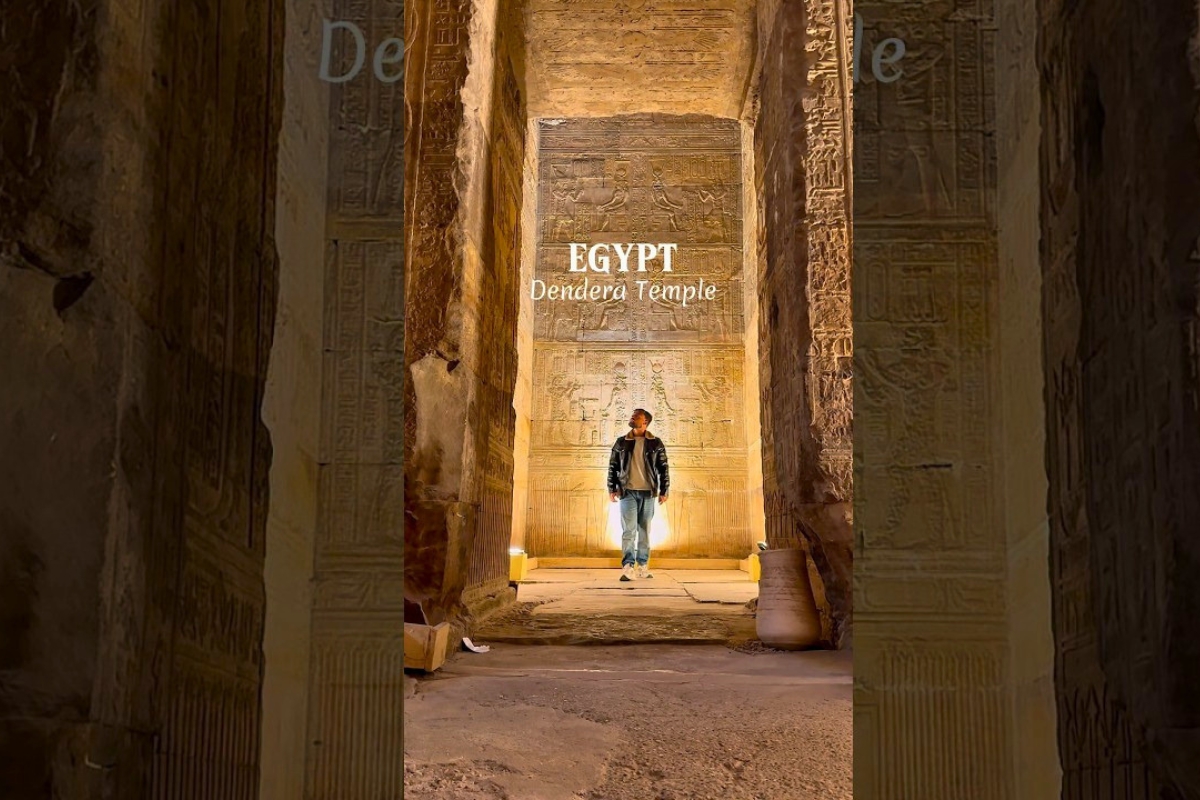
Inside Dendera Temple: A Room-by-Room Walking Tour
Knowing what to look for before you step inside dendera temple dramatically improves the experience, since many of the most fascinating details are easy to miss if you are not specifically watching for them. Here is a practical, room-by-room walkthrough based on how most guided tours move through the complex.
The Entrance Facade and Hathor Columns. Start by looking up at the six enormous Hathor-head columns supporting the entrance portico. Note the winged sun disk above the doorway and the still-visible traces of ancient blue and gold pigment clinging to the upper cornice, a small preview of the color preservation you will see much more of inside.
The Hypostyle Hall (Pronaos). This is the room most visitors associate with Dendera, and it deserves at least fifteen to twenty minutes of unhurried attention. Look straight up: the ceiling here contains multiple painted registers depicting the sky goddess Nut swallowing and rebirthing the sun, rows of decans (star groupings used for ancient timekeeping), and, in the section closest to the rear of the hall, a section related to the famous zodiac imagery, though the original circular zodiac ceiling relief was removed to the Louvre and replaced here with a faithful plaster replica.
The Offering Hall and Hall of Appearances. Moving deeper into the temple, these transitional rooms feature reliefs of priests carrying processional standards and offering incense, a good spot to slow down and notice how relief carving styles shift subtly between different construction phases.
The Sanctuary. The innermost chamber, dim and quiet, once held Hathor’s sacred barque shrine. Even without dramatic decoration at eye level, standing here gives a genuine sense of the temple’s original function as a working religious space rather than a museum piece.
The Crypts. Small, low-ceilinged chambers built into the thickness of the walls, accessible via narrow openings and short staircases, some requiring a slight stoop to enter. These crypts contain some of the temple’s most symbolically dense reliefs, including the famous “Dendera light” carving, which we cover in detail in its own section below.
The Rooftop Chapels. A staircase near the rear of the temple leads up to the roof, where two small chapels dedicated to the resurrection of Osiris are located. One contains the space where the original zodiac relief was carved into the ceiling before its removal in the 19th century.
The Sacred Lake and Sanatorium. Outside the main temple building, within the enclosure wall, look for the remains of the sacred lake, once used for ritual purification, and the sanatorium, where ancient pilgrims came seeking healing through sacred water rituals — one of the only structures of its kind surviving in Egypt.
The Temple of Isis and the Mammisi. Smaller structures near the main entrance gate honor Isis and celebrate the divine birth of Horus, both worth a brief stop if time allows, particularly for travelers interested in the birth-house architectural style unique to Ptolemaic and Roman era temples.
A knowledgeable Egyptologist guide makes an enormous difference in this walkthrough, since many reliefs require context to appreciate fully. This is exactly why Egypt All Inclusive pairs every Dendera tour with a licensed, experienced guide, ensuring you never simply wander past the details that make this temple so extraordinary.
The Famous Dendera Temple Zodiac Ceiling: Egypt’s Map of the Stars
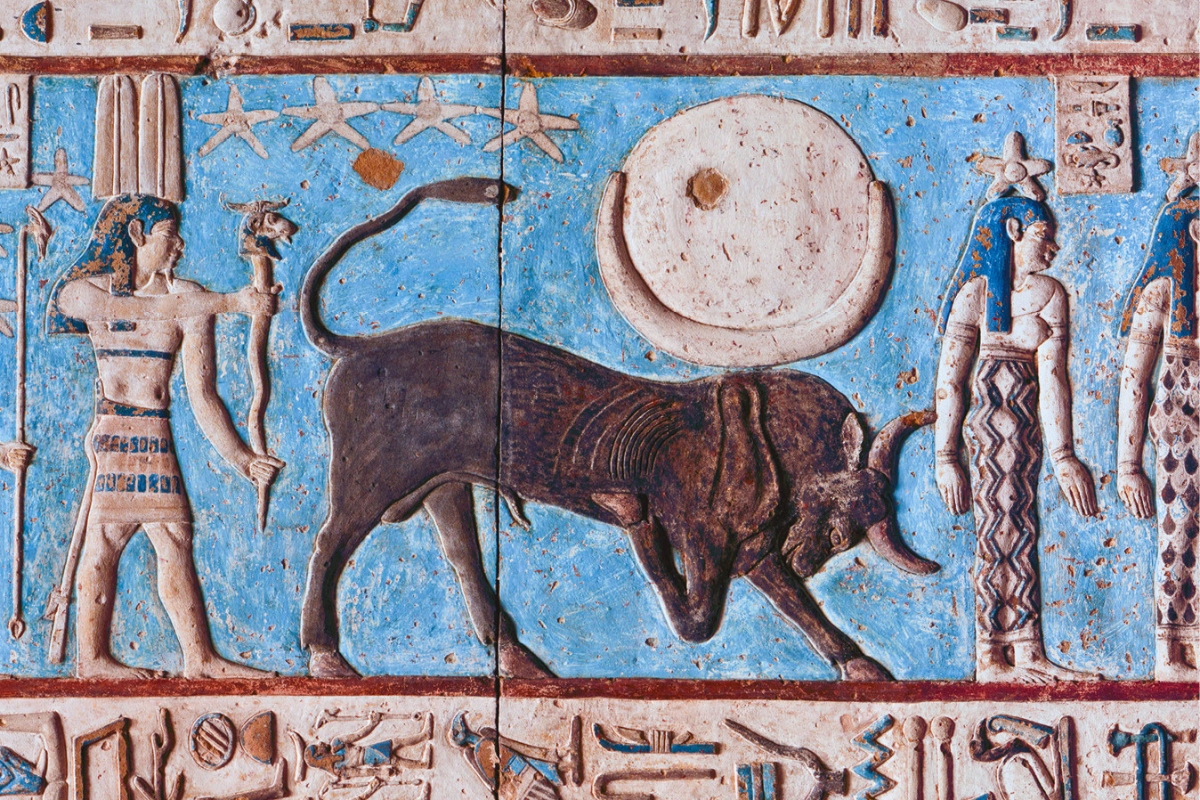
If there is one single feature that made this site famous around the world, it is the Dendera zodiac, a carved circular relief depicting the constellations, planets, and decans as understood by ancient Egyptian astronomer-priests. Located originally in a small chapel dedicated to Osiris on the temple’s roof, the temple of Dendera zodiac ceiling is widely considered one of the most important surviving pieces of ancient astronomical art anywhere in the world, combining Egyptian, Babylonian, and Greek astrological traditions into a single, beautifully composed circular design.
The zodiac depicts the twelve familiar constellations still used in Western astrology today — Aries, Taurus, Gemini, and so on — alongside Egyptian decans (36 star groupings used to divide the night sky for timekeeping purposes) and several important deities represented as celestial figures. Nut, the sky goddess, and figures representing the five visible planets known to ancient astronomers (Mercury, Venus, Mars, Jupiter, and Saturn) appear woven throughout the design, reflecting an extraordinarily sophisticated blend of religious symbolism and observational astronomy.
Scholars date the relief to around 50 BCE, based on the specific positions of the planets depicted, which correspond to a real astronomical configuration observable from Egypt around that time — a detail that has allowed modern astronomers to date the carving with remarkable precision, a rare case where ancient art can be dated almost like a snapshot of the actual night sky on a specific date.
Here is where many travelers get confused, so let’s clarify it clearly: the original circular zodiac ceiling relief was removed from the temple in 1821 by French engineer Jean-Baptiste Lelorrain, controversially cut out of the rooftop chapel ceiling and shipped to France, where it was purchased by King Louis XVIII and has remained on permanent display at the Louvre Museum in Paris ever since. What visitors see today at the temple of Dendera egypt itself is a high-quality plaster cast replica installed in the original location on the rooftop chapel ceiling, allowing you to view the composition exactly as it would have appeared, in its original architectural context, even though the genuine carved stone resides thousands of kilometers away in France.
This does not diminish the experience nearly as much as some travelers expect. Standing in the same small rooftop chapel where the original zodiac was carved, looking up at an accurate replica in its intended setting, surrounded by the temple’s other surviving rooftop reliefs, still delivers a powerful sense of connection to the ancient astronomers who designed it. Many visitors say the atmosphere of the actual chapel, with its intimate scale and rooftop views over the surrounding countryside, adds something that a museum display case in Paris simply cannot replicate.
For travelers who want to compare both, it is entirely possible to view the replica at Dendera during an Egypt tour and later see the genuine relief at the Louvre during a separate trip to France, and many of our clients enjoy doing exactly that, treating it as a two-part historical experience across two countries.
Practical tips for viewing the zodiac ceiling:
- Bring a small flashlight or use your phone’s flashlight, since the rooftop chapel can be dim, especially on cloudy mornings.
- A zoom lens or smartphone with strong low-light capability captures the detail best, since flash photography is prohibited to protect the surviving pigment elsewhere in the temple.
- Ask your guide to point out the specific constellation figures, since without guidance many first-time visitors miss the connection between the carved figures and recognizable zodiac symbols.
- Visit earlier in the day when possible, since the rooftop chapel receives natural light through small openings that shift throughout the day.
The zodiac ceiling alone justifies the trip for many travelers, but it is only one of several extraordinary features waiting inside this temple, including the equally famous preserved colors we cover in the next section.
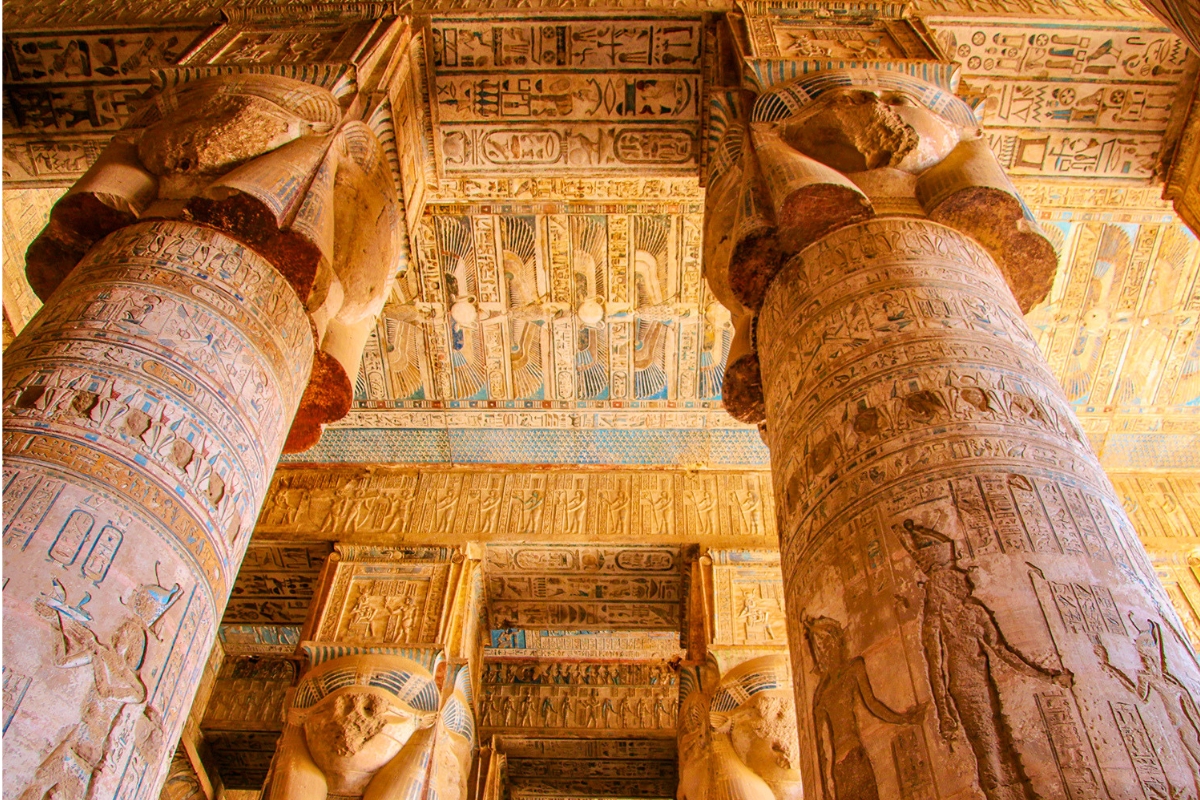
Dendera Temple Colors: The Secret Behind 4,000 Years of Vivid Pigments
Perhaps the single most common reaction from first-time visitors is genuine disbelief at how vivid the dendera temple colors remain after thousands of years. Deep blues, warm ochres, rich reds, and touches of gold-toned yellow still cling to ceiling reliefs and column capitals throughout parts of the temple, particularly in areas protected from direct sunlight and centuries of soot buildup, such as certain crypts and ceiling sections of the hypostyle hall.
So how did these colors survive so long? Several factors combine to explain this remarkable preservation. First, ancient Egyptian pigments were made primarily from mineral sources rather than organic dyes, which are far more prone to fading. Blue, one of the most strikingly preserved colors at Dendera, came from Egyptian blue, a synthetic pigment made from copper, silica, lime, and natron heated together — one of the earliest known synthetic pigments in human history, and remarkably stable across millennia because its chemical structure resists fading from light exposure far better than organic alternatives. Reds and yellows typically came from ochre (iron oxide), greens from malachite (a copper mineral), and black from carbon-based soot or charcoal, all mineral-based colorants with excellent long-term stability when protected from moisture and abrasion.
Second, the temple’s interior spaces, particularly the hypostyle hall and inner chambers, provided natural protection from direct sunlight, wind-blown sand erosion, and rainfall (which is minimal in this part of Upper Egypt in any case), allowing painted plaster and pigment layers to remain remarkably intact compared to exterior reliefs exposed to the elements for centuries.
Third, and often underappreciated, the temple spent long periods either buried under wind-blown sand and debris up to its ceiling level, or repurposed for other uses, both of which paradoxically helped preserve the paint by limiting exposure to light, tourists, and environmental damage until modern conservation efforts began.
Modern restoration has also played a significant role in what visitors see in 2026. A major cleaning and conservation project, carried out by Egyptian and international conservation teams over the past two decades, carefully removed centuries of soot, bat guano, and grime that had darkened many ceiling surfaces, revealing colors far more vivid than anyone expected to find underneath, essentially rediscovering the ancient paint layers rather than adding anything new. This is an important point worth understanding: the vivid colors you see today are the original ancient pigments, carefully uncovered and cleaned, not modern repainting, though conservation stabilizing agents have been applied to prevent further deterioration.
For photographers, this means certain sections of the temple — particularly specific crypt chambers and portions of the hypostyle hall ceiling — offer color saturation that looks almost unreal in photographs, which is exactly why dendera temple complex photos circulate so widely across travel social media. If bright, saturated ancient color is high on your must-see list in Egypt, few other sites in the country deliver quite what Dendera does.
A quick tip: bring a lens cloth and consider a small portable light source, since a combination of low ambient light and the no-flash photography rule means getting a truly sharp, color-accurate photo takes a steady hand and sometimes a brief pause to let your camera adjust exposure settings manually. Ask your guide which specific rooms currently show the best-preserved color sections, since conservation work occasionally shifts public access to different chambers.
The Dendera Temple Crypts: Hidden Chambers and the “Dendera Light” Relief
Tucked within the thick outer walls of the main sanctuary are a series of narrow crypts, low, cool chambers accessible through small openings and short flights of stairs, some tight enough that taller visitors need to duck slightly to pass through. Ancient priests used these hidden spaces to store temple treasures, sacred statues, and ritual equipment during festivals, sealing them away from public view for most of the year. Today, exploring these crypts is one of the most memorable parts of any dendera temple complex tours itinerary, offering a genuinely different atmosphere from the open, sunlit hypostyle hall above.
The most famous of these chambers contains a relief that has become a genuine internet sensation: a carved scene showing an elongated, bulb-like object connected to what looks like a snake inside it, resting atop a stem resembling a lotus flower, with a small figure appearing to support the object from below. Because of its visual resemblance to a modern incandescent light bulb, this carving has earned the nickname the “Dendera light” and has fueled decades of speculation, particularly online, suggesting that ancient Egyptians may have possessed some form of electrical lighting technology.
Mainstream Egyptology interprets this relief quite differently, and it is worth explaining that interpretation clearly and fairly. According to the accompanying hieroglyphic text and comparable imagery found elsewhere in Egyptian religious art, the scene depicts a well-documented mythological motif: a lotus flower giving birth to a serpent, symbolically representing the god Harsomtus (a form of Horus) emerging from a primordial lotus, a common creation and rebirth symbol throughout Egyptian religious art. The “wire” some viewers see is understood by scholars as a stylized serpent, and the “bulb” as a stylized lotus blossom or protective barque, a visual metaphor entirely consistent with religious symbolism found in numerous other temples, without any accompanying technical evidence, such as wiring systems, power sources, or comparable artifacts, that would support a literal electrical interpretation.
That said, we think it is only fair to present this respectfully rather than dismissively, since curiosity about the “Dendera light” is precisely why so many travelers want to see this relief in person. Whatever conclusion you personally draw, standing in front of the actual carving and forming your own impression is a genuinely fascinating experience, and it is one of the most frequently requested stops on any guided tour of the temple.
Beyond the “Dendera light” chamber, other crypts contain reliefs depicting temple treasures, ritual vessels, and processional items, along with inscriptions describing festival rites conducted at Dendera, giving historians valuable insight into how the temple actually operated on a day-to-day and annual basis. Some crypts require an additional small entrance fee beyond the general admission ticket, which we detail in the ticket pricing section further below, so it’s worth confirming with your guide or tour package what is included before you arrive.
Practical tips for visiting the crypts:
- Wear comfortable, closed-toe shoes, since the stone stairways can be uneven and the passages narrow.
- If you are prone to claustrophobia, ask your guide about the specific dimensions of the chamber before entering, since some sections are noticeably tighter than others.
- Photography is generally permitted without flash, but confirm current rules with your guide, since access and photography permissions occasionally change based on ongoing conservation work.
- Visit earlier in your temple tour rather than at the very end, since crypt access sometimes closes temporarily if staff need to manage visitor flow in narrow spaces.
Dendera Temple Stargate: Separating Myth From Archaeology
Few Egyptian sites have generated as much online buzz as Dendera when it comes to alternative history theories, and the term “dendera temple stargate” now returns a significant volume of searches from curious travelers who have come across viral videos and social media posts suggesting the temple contains some kind of ancient portal, energy device, or evidence of advanced lost technology. Given how much interest this generates, we think it is worth addressing honestly, clearly, and without either mockery or exaggeration, since informed travelers make for more satisfied travelers.
The “stargate” theory appears to combine several separate elements circulating online: the previously discussed “Dendera light” relief, a genuine fascination with the temple’s astronomical zodiac ceiling, and a broader wave of alternative history content questioning whether ancient civilizations possessed technology beyond what mainstream archaeology accepts. Some viral content has also linked Dendera loosely to a wider set of pyramid-related conspiracy theories, occasionally referencing high-profile public figures who have casually joked online about ancient aliens building Egyptian monuments — comments made in a general, joking context about the pyramids at Giza rather than any specific claim about Dendera itself, though the two have sometimes become blurred together in online discussion.
Mainstream Egyptology and archaeology do not support claims of portals, energy devices, or advanced lost technology at Dendera. The temple’s inscriptions, when translated, consistently describe religious, mythological, and astronomical concepts well understood within the broader context of ancient Egyptian belief systems, and no physical evidence — wiring, batteries, mechanical components, or comparable artifacts — has ever been found to support these more sensational claims.
We share this not to dismiss your curiosity, but to help you enjoy your visit with accurate context. The genuine, well-documented history of Dendera — its extraordinary zodiac ceiling, its beautifully preserved colors, its hidden crypts, and its layered 4,000-year history — is remarkable enough on its own merits without needing embellishment. Many travelers who arrive expecting a “stargate” leave even more impressed by the real archaeological and artistic achievement standing in front of them, and our guides are always happy to discuss both the popular theories and the scholarly consensus so you can form your own informed opinion during your visit.
Dendera Temple Stairs and the Rooftop Chapels of Osiris
One of the most rewarding parts of any visit involves climbing the dendera temple stairs leading up to the roof, where two small chapels dedicated to the resurrection of Osiris await, along with sweeping views over the surrounding Qena countryside and the temple enclosure below. These stairways are original ancient construction, worn smooth by thousands of years of priestly footsteps during annual New Year festival processions, when statues and ritual objects were carried up to the roof to be exposed to the rays of the rising sun.
There are actually two separate staircases connecting the temple’s ground floor to the roof, positioned symmetrically on either side of the building, and ancient temple ritual involved priests ascending via one staircase and descending via the other, forming a continuous ceremonial loop during festival processions rather than simply walking up and back down the same steps. This detail, often missed by visitors without a knowledgeable guide, reflects the careful ritual choreography built into the temple’s very architecture.
At the top, the two Osiris chapels are modest in size but rich in symbolism, containing reliefs depicting the resurrection myth of Osiris, god of the afterlife, alongside the rooftop chapel that once housed the original zodiac ceiling relief before its removal to the Louvre. Standing in this elevated, open-air space after moving through the temple’s darker, more enclosed interior chambers creates a genuinely moving contrast, often cited by visitors as one of the most memorable moments of their entire Egypt itinerary.
The rooftop also offers some of the best photography opportunities at the entire complex, with panoramic views over the temple’s mudbrick enclosure wall, the surrounding agricultural land, and, on clear days, distant glimpses of the Nile Valley’s characteristic green fields stretching toward the horizon.
Practical tips for the rooftop visit:
- Wear supportive footwear, since the ancient stone steps are uneven and can be slippery, particularly if worn smooth by centuries of foot traffic.
- Visit in the morning if possible, both for better light and cooler temperatures, since the rooftop offers no shade.
- Bring water, especially between April and October, when Upper Egypt’s heat becomes intense even in the morning hours.
- Allow at least fifteen minutes at the top, since many tour groups rush this section, but the chapels and views genuinely reward a slower pace.
The Melted Steps Mystery at Dendera Temple
Among the more curious details visitors notice are the dendera temple melted steps, certain stone stairways within the temple, particularly near specific crypt entrances and rooftop access points, that appear unusually smooth, rounded, and almost liquid in texture, as though the stone itself had softened and reformed rather than simply worn down through use. This distinctive appearance has fueled online speculation ranging from ancient advanced stone-working technology to more exotic theories involving heat or energy exposure.
The more grounded, widely accepted explanation among archaeologists and geologists involves a combination of factors common to heavily trafficked ancient limestone and sandstone structures. Centuries, and in some cases millennia, of foot traffic by bare or sandaled feet gradually polished and rounded stone edges, particularly on narrow stairways where every visitor’s foot lands in roughly the same spot repeatedly over generations. Combined with natural sandstone erosion patterns, occasional water exposure from rare rainfall or humidity within enclosed crypt spaces, and the specific mineral composition of the sandstone used in construction, this produces the smoothed, rounded appearance many visitors describe as looking “melted.”
It’s a similar phenomenon seen at other ancient sites worldwide where stone stairways have survived heavy use over very long timescales, and while the visual effect is undeniably striking and worth seeking out during your visit, mainstream archaeology does not attribute it to any exotic cause beyond simple, cumulative physical wear combined with the specific properties of the stone itself.
That said, we understand why this detail captures imaginations, and we encourage you to see it for yourself and ask your guide to point out the most dramatically worn sections during your visit, since photographing this texture up close makes for a genuinely unique and conversation-starting travel photo that most visitors to Egypt never think to capture.
Cleopatra at Dendera Temple: The Queen’s Own Relief
Among the most historically significant features at Dendera is the cleopatra dendera temple relief, carved into the temple’s rear exterior wall, depicting Cleopatra VII, the last active pharaoh of ancient Egypt, alongside her son Caesarion (fathered by Julius Caesar), both shown making offerings to the gods in traditional pharaonic style. This relief is considered one of only a small number of surviving large-scale images widely associated with the historical Cleopatra, making it a genuinely significant stop for anyone interested in her remarkable life and reign.
It’s important to set expectations accurately here, since many visitors arrive expecting a lifelike portrait. Like virtually all ancient Egyptian royal reliefs, the dendera temple cleopatra image follows the highly stylized, idealized artistic conventions used for pharaonic depictions for thousands of years, rather than attempting individual, realistic portraiture in the way a modern viewer might expect. Scholars continue to debate exactly how much, if any, individual likeness these conventionalized royal images were intended to capture, and some argue the figures may represent Cleopatra symbolically as pharaoh rather than as a personal portrait in the way we would understand one today.
Regardless of the ongoing scholarly debate, standing before this relief carries genuine historical weight: Cleopatra herself likely visited Dendera during her reign, given her documented interest in reviving and supporting traditional Egyptian religious practices as part of her political strategy, and she personally funded portions of the temple’s construction, making this one of the more direct physical connections to her historical reign that survives anywhere in Egypt today.
The relief is located on the exterior rear wall of the temple, meaning it’s easily missed by visitors who only explore the interior chambers, so be sure to ask your guide specifically to bring you to this section during your visit, ideally allowing a few extra minutes to appreciate both the historical significance and the surrounding hieroglyphic inscriptions describing the temple’s dedication.
The Dendera Temple Cat and Sacred Animals of Hathor
A recurring and delightful question from travelers researching this site is about the so-called dendera temple cat, and it’s worth clarifying exactly what this refers to, since it surprises many first-time visitors. While Hathor herself is most commonly depicted as a cow or as a woman with cow horns, ancient Egyptian religion closely associated several goddesses, including Bastet and Sekhmet, with feline imagery, and small carved feline figures do appear among the temple’s extensive relief decoration, particularly in scenes depicting divine processions and offerings involving multiple deities honored alongside Hathor.
Visitors often photograph these carved feline figures without realizing their broader religious context, assuming they represent simply decorative animal imagery, when in fact they typically reflect specific, symbolically loaded connections between different goddesses within the interconnected Egyptian pantheon. Cats held genuine religious significance throughout ancient Egypt, associated with protection, fertility, and the sun’s daily journey, and their appearance within Dendera’s decorative program reflects this broader cultural reverence rather than random decoration.
Beyond feline imagery, the temple’s reliefs feature an extensive menagerie of sacred and symbolic animals: cobras representing protective goddesses, falcons representing Horus, cows representing Hathor herself in her primary sacred form, and various birds and creatures woven throughout offering scenes and mythological narratives carved across nearly every surface of the temple. For animal-loving travelers or anyone interested in ancient Egyptian religious symbolism, spending time studying these smaller carved details, rather than only the large dramatic scenes, reveals an entirely different, wonderfully detailed layer of the temple’s storytelling.
Our guides are always happy to point out these smaller details during your visit, since they are easy to walk past without noticing, but genuinely reward closer attention, especially for travelers who enjoy photography focused on fine detail rather than only wide architectural shots.
Dendera Temple Complex Photos: Best Spots for Photography in 2026
Given how frequently travelers search for dendera temple complex photos before booking a visit, it’s worth dedicating a section specifically to helping you plan the best photography experience possible, whether you’re a casual smartphone photographer or traveling with professional equipment.
Best photo spots inside the temple:
- The entrance facade, capturing all six Hathor-head columns in a single wide shot, ideally taken slightly off-center to include the winged sun disk above the doorway.
- The hypostyle hall ceiling, best photographed using a wide-angle lens pointed straight up, capturing the full painted astronomical scene in vivid detail.
- The rooftop Osiris chapels, offering both architectural detail shots and panoramic countryside views in the same location.
- The crypt chambers, particularly for close-up, detail-focused photography of well-preserved color and the famous “Dendera light” relief.
- The rear exterior wall, featuring the Cleopatra and Caesarion relief alongside dramatic large-scale carved figures of Roman emperors in pharaonic dress.
Photography tips specific to Dendera:
- Flash photography is prohibited throughout the temple’s painted interior sections to protect the surviving pigment, so plan for handheld low-light shooting or bring a small tripod for interior shots.
- Morning visits generally offer better natural light through the temple’s small window openings, particularly in the hypostyle hall.
- A wide-angle lens (or your phone’s wide/ultra-wide camera setting) captures ceiling details far more effectively than a standard lens, given the relatively low ceiling height in some sections.
- Consider bringing a polarizing filter for exterior shots, particularly around midday, to reduce harsh reflections off the sandstone surfaces.
- Ask your guide about current photography permissions before entering the crypts, since access occasionally shifts during conservation work.
For travelers building a broader Egypt photography portfolio, Dendera offers a genuinely different visual palette compared to Luxor’s Karnak or Luxor Temple — richer surviving color, more intimate architectural scale, and considerably fewer crowds in most photographs, making it easier to capture clean, uncluttered shots without dozens of other tourists in frame, a genuine advantage over some of Egypt’s more heavily visited sites.
Dendera Temple Ticket Prices and Opening Hours in 2026
Understanding dendera temple ticket costs and opening hours in advance helps you plan your day accurately and avoid surprises on-site. Ticket structures at Egyptian archaeological sites are periodically adjusted, so while the figures below reflect the most recent widely reported pricing structure heading into 2026, we always recommend confirming exact current rates with your tour operator or at the ticket office on the day of your visit, since official pricing can shift with little advance public notice.
| Ticket / Access Type | Approximate Price (EGP) | Notes |
|---|---|---|
| General Temple Complex Entry | Approx. 260–300 EGP | Covers the main Temple of Hathor and complex grounds |
| Crypt / “Light Relief” Access | Approx. 100 EGP | Separate add-on fee, not always included in general admission |
| Rooftop / Zodiac Chapel Access | Approx. 100 EGP | Separate add-on fee for rooftop chapel access |
| Student Discount | Typically 50% of adult rate | Valid student ID required |
| Egyptologist Guide Fee | Varies by tour operator | Usually bundled into organized tour packages |
Opening hours at the Dendera Temple Complex generally run daily from approximately 6:00 or 7:00 AM until 5:00 PM, with last entry typically around 4:30 PM, though hours can shift slightly during religious holidays, national events, or seasonal adjustments, so always confirm current hours before finalizing your day’s schedule, particularly if you plan to combine Dendera with another site on the same day.
A few practical notes worth knowing:
- Tickets are typically priced in Egyptian pounds (EGP), and payment in local currency is standard, though many organized tours include all entrance fees within the total package price, removing the need to handle ticket purchases yourself.
- Flash photography restrictions and specific crypt access rules are enforced by on-site staff and may change based on ongoing conservation work, so always check current guidance with your guide upon arrival.
- Booking through an established tour operator like Egypt All Inclusive means your entrance fees, guide costs, and transportation are typically bundled into a single upfront price, removing any guesswork or on-site payment logistics from your day.
Given how frequently ticket prices and site regulations are updated at major Egyptian attractions, we strongly encourage travelers to book through a licensed operator who stays current with official pricing, rather than relying solely on older online listings that may no longer reflect 2026 rates.
Best Dendera Temple Complex Tours in 2026
Choosing the right dendera temple complex tours option depends heavily on your starting location, available time, and travel style. Below is a comparison of the most popular tour formats we arrange for travelers heading into 2026, designed to help you quickly identify which option fits your itinerary.
| Tour Type | Typical Duration | Best For | What’s Usually Included |
|---|---|---|---|
| Half-Day Private Tour from Luxor | 4–5 hours | Travelers based in Luxor with limited time | Private vehicle, driver, Egyptologist guide, entrance fees |
| Full-Day Combined Dendera & Abydos Tour | 10–12 hours | Travelers wanting two major sites in one day | Private vehicle, guide, entrance fees, lunch stop |
| Day Trip from Hurghada | 10–12 hours | Red Sea resort travelers wanting an inland excursion | Private vehicle, guide, entrance fees, hotel pickup |
| Nile Cruise Shore Excursion | 3–4 hours | Travelers already sailing between Luxor and Qena | Guided walking tour, entrance fees, transport from dock |
| Small Group Tour | 5–8 hours | Budget-conscious travelers comfortable sharing a vehicle | Shared vehicle, guide, entrance fees |
| Helicopter Tour Add-On | Varies | Luxury travelers seeking a unique aerial experience | Aerial transfer, ground tour, guide, entrance fees |
Each format has genuine advantages. Private tours offer maximum flexibility, allowing you to linger in the crypts or rooftop chapels as long as you like without a group schedule dictating your pace, while small group tours offer a more budget-friendly price point for solo travelers or couples happy to share transportation with a handful of fellow travelers. Nile cruise shore excursions are ideal for travelers already sailing this stretch of the Nile, since Dendera is a natural, convenient stop requiring minimal additional logistics.
For travelers asking specifically about the temple of dendera tours available directly from Luxor hotels or cruise docks, same-day booking is often possible, though we generally recommend booking at least one to two days in advance during Egypt’s peak travel season (October through April), since vehicle and guide availability can fill up quickly, particularly around major holidays.
When comparing tour operators, look for a few key quality indicators: licensed Egyptologist guides (rather than general drivers doubling as guides), air-conditioned vehicles in good condition, clear, all-inclusive pricing without hidden add-on fees for entrance tickets, and flexibility to combine Dendera with nearby sites like Abydos if your schedule allows. Egypt All Inclusive builds every Dendera itinerary around these exact standards, ensuring your day runs smoothly from hotel pickup to final drop-off, without the common pitfalls of poorly organized budget tours that leave travelers waiting, rushed, or paying unexpected on-site fees.
Combining Dendera and Abydos Temples From Luxor: The Ultimate Day Trip
For travelers with a full day to spare, combining dendera and abydos temples from Luxor into a single itinerary is one of the most rewarding full-day excursions available anywhere in Upper Egypt. Both sites sit north of Luxor along a similar route, making it logistically efficient to visit both without an excessive amount of additional driving compared to visiting either site alone.
Abydos, home to the magnificent Temple of Seti I, offers a completely different atmosphere and artistic style compared to Dendera. While Dendera dazzles with its intact painted ceiling and Ptolemaic-Roman architecture, Abydos is famous for some of the finest, most delicately carved raised relief work anywhere in ancient Egypt, dating to the New Kingdom, roughly a thousand years earlier than most of what you’ll see at Dendera. Visiting both in the same day gives travelers a genuinely rare opportunity to compare two distinct eras and artistic traditions within a single, well-organized excursion.
A typical combined itinerary looks like this: early morning hotel pickup from Luxor, arrival at Abydos first (generally recommended, since it sits slightly farther north and benefits from cooler morning temperatures for its more exposed courtyard areas), followed by a scenic countryside drive south to Dendera for the afternoon portion of the tour, before returning to Luxor by early evening.
This combined day does require genuine stamina — expect a full day of ten to twelve hours including driving time, so it suits travelers comfortable with a longer excursion in exchange for covering significantly more historical ground in a single day. For travelers who prefer a more relaxed pace, splitting these two sites across separate half-day trips on different days remains a perfectly reasonable alternative, particularly for those staying in Luxor for three or more nights.
Either way, we strongly recommend arranging this combined trip through an experienced local operator familiar with both sites’ specific logistics, opening hours, and any required travel permissions for this particular route, since attempting to independently coordinate transportation, entrance timing, and guiding for two separate major sites in a single day is considerably more complicated without local expertise and established relationships with both site authorities.
Dendera Temple by Helicopter: A Luxury Alternative
For travelers seeking something genuinely different in 2026, a dendera temple helicopter tour offers a spectacular alternative to the standard road journey from Luxor. Rather than spending over an hour each way on a highway drive, helicopter transfers cover the same distance in a fraction of the time, while offering sweeping aerial views over the Nile Valley, the temple’s mudbrick enclosure walls, and the surrounding agricultural patchwork of Upper Egypt that road travelers never get to experience.
Helicopter tours to Dendera are typically arranged as premium, small-group or private experiences, often combined with aerial views of Luxor’s West Bank sites, the Valley of the Kings, or the Nile itself as part of the same flight package, making this a natural fit for travelers celebrating a special occasion, honeymooners, or anyone with a generous travel budget looking to maximize a short Egypt itinerary without sacrificing depth of experience.
Beyond the obvious time savings and novelty factor, helicopter access offers a genuinely unique photographic perspective, capturing the temple’s full enclosure layout, sacred lake remains, and surrounding structures from above in a way that is simply impossible from ground level, giving photography enthusiasts an entirely different portfolio of images compared to a standard ground tour.
It’s worth noting that helicopter tours generally require advance booking, favorable weather conditions, and typically operate through a small number of licensed aviation partners in the Luxor area, so availability can be limited, particularly during peak season. Pricing sits considerably above standard ground transportation, reflecting the specialized nature of the experience, but for travelers with the flexibility and interest, it remains one of the most memorable ways to experience this region of Egypt.
Egypt All Inclusive can arrange helicopter add-ons for qualifying itineraries upon request, coordinating directly with licensed aviation partners to ensure a seamless combination of aerial transfer and ground-based guided temple exploration, giving discerning travelers the best of both worlds in a single, expertly organized day.
Best Time to Visit Dendera Temple Complex in 2026
Timing your visit well significantly affects your comfort and overall enjoyment, particularly given Upper Egypt’s intense summer heat. Generally speaking, the period from October through April offers the most comfortable conditions, with daytime temperatures typically ranging from the mid-20s to low 30s Celsius (roughly high 70s to high 80s Fahrenheit), making outdoor exploration, including the exposed rooftop chapels, considerably more pleasant.
Summer months, particularly June through August, bring intense heat to Upper Egypt, with daytime temperatures frequently exceeding 40 degrees Celsius (104 Fahrenheit). Visiting during these months is still entirely possible, and the temple’s interior chambers offer welcome relief from direct sun exposure, but we recommend scheduling summer visits for early morning, ideally starting your day trip before 8 AM, to minimize time spent outdoors during peak heat hours, and ensuring you carry ample water throughout the day.
Within each day, morning visits generally offer the best combination of cooler temperatures, better natural light for photography, and smaller crowds, since many organized tours from Luxor depart early to beat both the heat and the midday tour bus rush. Arriving as close to opening time as your schedule allows consistently delivers the most comfortable and photographically rewarding experience.
Seasonally, late autumn through early spring (November through March) also aligns with Egypt’s peak international tourism season, meaning you’ll encounter more fellow travelers during this window, though Dendera remains considerably less crowded than Luxor’s more famous sites even during peak season. Shoulder season months (April, May, September, and October) often provide an excellent balance of comfortable temperatures and lighter crowds, particularly appealing for travelers with flexible scheduling who want to avoid both extreme heat and peak-season congestion.
Whichever season you choose, we recommend booking your transportation and guide in advance rather than arranging things last-minute on the ground, since availability for quality guides and comfortable vehicles can tighten considerably during Egypt’s busiest tourism months heading into 2026.
Insider Tips for Visiting Dendera Temple Complex
After years of arranging trips to this remarkable site, our team at Egypt All Inclusive has gathered a collection of practical tips that go beyond what most standard travel guides mention, designed to help you get more out of your visit than the average tourist.
- Arrive with a working flashlight app or small flashlight. Several of the temple’s most fascinating features, including sections of the crypts, are dimly lit, and a personal light source lets you appreciate carved detail that overhead lighting alone doesn’t fully reveal.
- Ask specifically to see the “Dendera light” relief and the Cleopatra relief. These two specific features are sometimes skipped on rushed group tours, so if they matter to you, mention them directly to your guide at the start of your visit.
- Bring small EGP denominations. Restroom facilities, optional site guides offering additional local commentary, and small souvenir vendors near the entrance typically prefer small bills.
- Wear layers. Interior chambers can feel notably cooler than the exposed courtyard and rooftop areas, especially in winter months, so a light layer you can remove or add makes the temperature shifts more comfortable.
- Budget more time than you initially expect. Many visitors plan for a quick one-hour stop and end up staying two to three hours once they discover the crypts, rooftop chapels, and exterior reliefs, so build flexibility into your day’s schedule.
- Combine with a local Qena market stop if time allows. Some tour itineraries include a brief stop in the nearby town, offering an authentic glimpse of everyday Upper Egyptian life rarely seen by travelers focused solely on major tourist sites.
- Download offline maps and confirm your pickup time in writing. Mobile signal can be inconsistent in this rural stretch of Upper Egypt, so having your itinerary confirmed in advance avoids any last-minute confusion about pickup logistics.
These small details separate an average visit from a genuinely memorable one, and they’re exactly the kind of guidance our team builds into every Dendera itinerary we arrange, ensuring nothing important gets missed during your time at this extraordinary site.
Frequently Asked Questions About Dendera Temple Complex
Where is Dendera temple located?
Dendera Temple Complex sits on the west bank of the Nile River near the city of Qena in Upper Egypt, roughly 60 to 77 kilometers north of Luxor, making it an easy half-day or full-day trip for most travelers based in the Luxor area.
When was Dendera temple built?
The main surviving structure, the Temple of Hathor, was built primarily during the Ptolemaic and Roman periods, beginning around 54 BCE, though earlier temples stood on the same sacred site dating back to at least 2250 BCE during the Old Kingdom.
Why was the temple of Dendera built?
It was built to honor Hathor, the goddess of love, joy, music, and motherhood, serving as her primary cult center and the site of major annual festivals, including her symbolic reunion with Horus of Edfu.
What is the Dendera zodiac, and is the original still at the temple?
The Dendera zodiac is a carved circular relief mapping the constellations, planets, and decans as understood by ancient Egyptian astronomers. The original was removed to the Louvre Museum in Paris in 1821; a plaster cast replica now occupies its original location in the temple’s rooftop chapel.
Is the “Dendera light” relief really evidence of ancient electricity?
Mainstream Egyptology interprets this carving as a mythological scene depicting a lotus flower giving birth to a serpent, a well-documented religious motif, rather than literal evidence of electrical technology, though it remains a popular and fascinating stop for curious travelers.
How much does it cost to visit Dendera temple?
General admission typically runs approximately 260 to 300 Egyptian pounds, with separate optional fees of around 100 EGP each for crypt and rooftop chapel access, though prices can change, so confirming current rates with your tour operator is always recommended.
Can I combine Dendera with Abydos in one day?
Yes, many travelers combine dendera and abydos temples from Luxor into a single full-day itinerary, typically visiting Abydos first in the morning before continuing to Dendera in the afternoon, returning to Luxor by early evening.
What are the opening hours?
The temple typically operates daily from approximately 6:00 or 7:00 AM until 5:00 PM, with last entry around 4:30 PM, though hours can shift slightly, particularly around holidays.
Is Dendera worth visiting compared to Luxor’s other temples?
Absolutely, particularly for travelers interested in preserved color, astronomical art, and a quieter, less crowded atmosphere compared to Karnak or Luxor Temple, both of which see considerably heavier tourist traffic.
Do I need a guide to visit Dendera temple?
While not strictly mandatory, a knowledgeable Egyptologist guide dramatically improves the experience, helping you locate key features like the Cleopatra relief, the “Dendera light” carving, and the rooftop zodiac chapel that are easy to miss without guidance.
Why Book Your Dendera Temple Tour With Egypt All Inclusive in 2026
Planning a trip to a site as rich in detail as Dendera deserves a travel partner who understands every layer of what you’re about to see, and that is exactly what Egypt All Inclusive brings to every itinerary we arrange. As we head into 2026, we have refined our Dendera and combined Dendera-Abydos itineraries based on years of direct traveler feedback, ensuring every guest sees the details that matter most, from the Cleopatra relief to the rooftop zodiac chapel, without the rushed pacing common on generic group tours.
Every Egypt All Inclusive Dendera tour includes a licensed, knowledgeable Egyptologist guide, comfortable air-conditioned transportation, all entrance fees bundled transparently into your upfront price, and the flexibility to combine your visit with Abydos, a Nile cruise, or a helicopter add-on based on your personal travel style and schedule. We handle every logistical detail, including the specific travel permissions sometimes required for this route, so your only job is to enjoy one of Egypt’s most visually stunning and historically layered temples.
We genuinely believe Egypt All Inclusive stands as the best travel agency in Egypt for 2026, built on transparent pricing, deeply knowledgeable local guides, and a level of personalized itinerary planning that larger, impersonal operators simply cannot match. Whether you want a quick half-day stop from your Luxor hotel, a full combined day with Abydos, or a luxury helicopter experience, our team designs the exact trip that fits your goals, your budget, and your curiosity.
Also Known As: Different Ways Travelers Refer to This Site
One detail that sometimes confuses first-time researchers is how many different names and phrasings point to the exact same destination. Whether you’ve seen it written as the temple of dendera egypt, temple dendera, temple at dendera, the temple of dendera, or simply dendera, you’re always talking about the same remarkable complex on the Nile’s west bank near Qena. Similarly, egypt dendera temple, dendera temple egypt, and egyptian temple of dendera all describe this identical site, and international travelers often search using egypt dendera temple gods, temple dendera egypte in French phrasing, or el templo de dendera and templo hathor dendera among Spanish-speaking visitors planning the exact same trip.
The main structure itself goes by several interchangeable names too: the temple of hathor, temple of hathor dendera egypt, hathor temple dendera, temple hathor dendera, dendera hathor temple, and hathor dendera temple all refer to the very same building at the heart of the complex, dedicated to the goddess Hathor and famous for its intact ceiling. If you’ve come across temple painting dendera egypt, dendera egypt temple of the goddess hathor, or temple of dendera ceiling in your research, these all point toward the same painted astronomical artwork and preserved pigment we’ve covered extensively throughout this guide.
The famous star map itself is referenced under a similarly wide range of phrasings: zodiac ceiling temple of dendera, temple of dendera zodiac, dendera temple zodiac, and the temple of dendera zodiac all describe the same carved circular relief, whose original sits in the Louvre while a faithful replica occupies the original rooftop chapel at the temple itself. Likewise, dendera temple of time is simply another way travelers describe the site’s extraordinary layered timeline, spanning roughly 4,000 years from the earliest Old Kingdom shrine to the Ptolemaic-Roman structure standing today.
For the more debated and viral aspects of the site, you may have encountered pictures of stargates dendera temple, elon musk dendera temple, or dendera temple stargate while browsing social media, all referring to the same online conversation around the “Dendera light” crypt relief and broader alternative-history speculation we addressed honestly earlier in this guide. Whatever term brought you here, the underlying destination, history, and practical travel information remain exactly the same.
Finally, if you’ve been researching logistics using terms like dendera temple opening hours, dendera temple complex tickets, dendera temple photos, or dendera temple plan, or if you’ve simply been comparing the temple of dendera tours available from Luxor, rest assured that every one of these questions has been answered in detail throughout this guide, from ticket pricing tables to room-by-room walking directions to photography tips tailored specifically to this site.
Understanding that all these variations describe one single, extraordinary destination should simplify your planning considerably. Whether you found this guide by searching “temple of hathor in dendera,” “hathor temple in dendera,” “when was the temple of dendera built,” “why was the temple of dendera built,” or simply “dendera temple complex ancient egypt tourist attractions,” you’re now equipped with everything needed to plan a confident, well-informed visit heading into 2026.
Dendera Temple Map and Plan: Understanding the Site Layout
Before you arrive, it helps to have a mental dendera temple map in mind, since the complex is considerably larger than the main Hathor temple alone, and knowing the overall plan helps you prioritize your time, especially if your tour schedule is limited.
The entire complex sits within a massive rectangular mudbrick enclosure wall, a boundary that historically separated sacred temple grounds from the surrounding town and agricultural land. Entering through the main gate on the northern side, visitors first pass the smaller Temple of Isis and the mammisi (birth house) structures before reaching the imposing facade of the main Temple of Hathor, which dominates the center of the enclosure.
Here is a simplified breakdown of the temple dendera plan, moving roughly from entrance to the furthest points of the complex:
| Zone | What You’ll Find There | Typical Time to Allow |
|---|---|---|
| Main Entrance Gate | Enclosure wall, ticket checkpoint, first views of the complex | 5 minutes |
| Temple of Isis & Mammisi | Smaller birth-house structures near the entrance | 10–15 minutes |
| Hathor Temple Facade | Six Hathor-head columns, winged sun disk entrance | 10 minutes |
| Hypostyle Hall | Zodiac-related ceiling art, 24 Hathor-head columns | 20–30 minutes |
| Inner Sanctuary & Offering Halls | Restricted inner chambers, priestly reliefs | 15 minutes |
| Crypts | “Dendera light” relief, hidden storage chambers | 15–20 minutes |
| Rooftop Chapels | Zodiac ceiling replica, Osiris resurrection scenes | 15–20 minutes |
| Rear Exterior Wall | Cleopatra and Caesarion relief, Roman emperor scenes | 10 minutes |
| Sacred Lake & Sanatorium | Ritual purification lake, ancient healing center remains | 10–15 minutes |
Following this general flow, a thorough visit typically takes between two and three hours for travelers who want to see everything the complex offers, though a faster-paced version covering only the main highlights can be completed in about ninety minutes if your schedule is tighter. Knowing this layout in advance also helps you communicate priorities clearly to your guide, ensuring the sections that matter most to you — whether that’s the zodiac chapel, the crypts, or the Cleopatra relief — receive adequate time rather than being rushed at the end of a busy day.
The Gods and Goddesses of Dendera Beyond Hathor
While Hathor rightfully dominates the temple’s decoration and religious purpose, the broader egypt dendera temple gods represented throughout the complex reveal a richer, more interconnected religious world than a single-deity focus might suggest. Understanding these additional figures adds meaningful depth to what you’re looking at throughout your visit.
Horus, depicted as a falcon or falcon-headed man, appears throughout the temple as Hathor’s divine husband, and the annual festival celebrating their symbolic reunion was one of the most important religious events associated with this site, drawing pilgrims from Edfu and beyond for a multi-day celebration involving music, dance, and ritual boat processions along the Nile.
Ihy, the son of Hathor and Horus, appears frequently in temple reliefs as a youthful god associated with music, particularly the sistrum rattle so closely tied to Hathor’s worship. His depictions, often shown as a nude child figure holding a sistrum, appear throughout offering scenes, symbolizing the joyful, musical character of Hathor’s cult.
Isis, goddess of magic and motherhood, receives her own dedicated smaller temple within the complex, reflecting her close mythological association with Hathor, whom ancient Egyptians sometimes viewed as closely linked or even overlapping deities depending on the specific religious tradition and time period in question.
Osiris, god of the afterlife and resurrection, features prominently in the rooftop chapels, where his mythological death and resurrection story is depicted alongside the astronomical zodiac imagery, tying together themes of cosmic renewal, the yearly Nile flood cycle, and personal resurrection in a unified religious message that would have resonated deeply with ancient worshippers.
Nut, the sky goddess, appears dramatically stretched across sections of the hypostyle hall ceiling, her body forming the vault of the sky and swallowing the sun each evening before giving birth to it again each dawn, a powerful visual metaphor for daily cosmic renewal that directly relates to the temple’s broader astronomical themes.
Understanding these additional deities transforms a visit to Dendera from simply “the temple with the cool ceiling” into a genuinely rich exploration of ancient Egyptian religious thought, where astronomy, mythology, music, healing, and royal politics all intersect within a single sacred complex.
Dendera Temple Facts: Quick Reference for Curious Travelers
For travelers who want a fast, scannable summary of key dendera temple facts before their visit, here is a quick reference list covering the essentials:
- The temple is dedicated primarily to Hathor, goddess of love, joy, music, and motherhood.
- The main surviving structure dates largely to the Ptolemaic and Roman periods, roughly 54 BCE to 100 CE, though earlier temples on the same site date back to at least 2250 BCE.
- The complex sits approximately 60 to 77 kilometers north of Luxor, near the city of Qena.
- The famous zodiac ceiling relief, originally carved around 50 BCE, was removed to the Louvre Museum in Paris in 1821; a replica now sits in its original rooftop chapel location.
- The temple’s hypostyle hall ceiling remains one of the most architecturally complete ancient Egyptian roofs still in existence.
- Preserved wall colors derive primarily from mineral pigments, including Egyptian blue, ochre, and malachite, which remain chemically stable over long periods.
- Cleopatra VII and her son Caesarion appear in a relief on the temple’s rear exterior wall.
- The complex includes a sacred lake, a sanatorium for ancient healing rituals, a temple dedicated to Isis, and two mammisi (birth house) structures.
- Hidden crypts built into the temple’s walls contain the famous “Dendera light” relief, widely interpreted by scholars as a mythological lotus-and-serpent creation scene.
- The site is easily combined with a visit to the Temple of Seti I at Abydos for a full-day historical itinerary from Luxor.
What to Pack for Your Dendera Temple Visit in 2026
A little preparation goes a long way toward making your visit comfortable and enjoyable, particularly given Upper Egypt’s climate and the temple’s mix of sun-exposed and enclosed interior spaces. Consider packing the following:
- Comfortable, closed-toe walking shoes suitable for uneven ancient stone stairways and stone flooring throughout the crypts and rooftop chapels.
- A lightweight hat and sunglasses for the exposed outdoor courtyard and rooftop sections.
- Reef-safe sunscreen, applied before arrival, since shade is limited in the open-air portions of the complex.
- A refillable water bottle, ideally filled before departure, as temperatures can climb quickly even during cooler months.
- A small flashlight or fully charged phone for exploring the dimmer crypt chambers.
- A light jacket or layer, particularly for winter morning visits, since interior stone chambers can feel notably cool.
- Small EGP bills for optional facilities, informal site guides, or small souvenir purchases near the entrance.
- A camera or smartphone with a wide-angle setting, given the ceiling photography opportunities throughout the hypostyle hall.
- Comfortable, modest clothing, respecting general cultural norms at religious and historical sites throughout Egypt.
Packing thoughtfully for this specific site, rather than relying on a generic Egypt packing list, makes a noticeable difference in comfort, especially for travelers planning to spend two or more hours exploring every corner of the complex.
How Dendera Compares to Other Egyptian Temples
Travelers building a broader Egypt itinerary often ask how Dendera stacks up against better-known sites like Karnak, Luxor Temple, or Edfu. Each offers a genuinely different experience, and understanding these differences helps you decide how to allocate limited vacation time.
| Feature | Dendera Temple | Karnak Temple | Edfu Temple |
|---|---|---|---|
| Primary Deity | Hathor | Amun-Ra | Horus |
| Construction Period | Mostly Ptolemaic-Roman | New Kingdom, multiple phases | Ptolemaic |
| Ceiling Preservation | Exceptional, largely intact | Mostly open-air, columns only | Good, partial |
| Crowd Levels | Low to moderate | High, especially peak season | Moderate |
| Color Preservation | Excellent in several chambers | Limited | Good |
| Distance from Luxor | 60–77 km north | Within Luxor | Further south, near Aswan route |
This comparison highlights exactly why Dendera earns such enthusiastic reviews from travelers who make the trip: while Karnak offers unmatched scale and grandeur, and Edfu offers one of the best-preserved temple pylons in Egypt, Dendera uniquely combines an intact painted ceiling, exceptional color preservation, and a noticeably quieter atmosphere, making it feel like a more personal, intimate discovery rather than a heavily trafficked tourist checkpoint.
Planning Your Trip From Abroad: International Travelers Welcome
Interest in this remarkable site extends well beyond English-speaking travelers, and our team regularly assists visitors searching in other languages, whether they’re looking for information on the temple de dendera as French-speaking travelers often phrase it, or el templo de dendera and templo de dendera among Spanish-speaking guests planning their own Egyptian adventure. Wherever you’re traveling from, Egypt All Inclusive arranges multilingual guides upon request, ensuring language is never a barrier to fully appreciating this site’s remarkable history.
For international travelers arriving via Cairo, the most common route involves a short domestic flight to Luxor, followed by the road transfer to Dendera described earlier in this guide. Cruise passengers sailing the Nile between Luxor and Aswan, or on select itineraries extending toward Qena, may also find Dendera included as a scheduled shore excursion, offering a convenient way to experience the site without arranging separate ground transportation.
Whether you’re arriving from Europe, the Americas, Asia, or elsewhere, our booking team communicates clearly in multiple languages throughout the planning process, ensuring your itinerary, pricing, and logistics are fully understood well before you arrive in Egypt, removing any uncertainty from what should be an exciting, well-organized part of your 2026 travel plans.
The Sanatorium of Dendera: Ancient Egypt’s Healing Center
Within the temple enclosure, near the sacred lake, lie the remains of a sanatorium, a structure historians consider one of the only surviving examples of its kind in ancient Egypt, built specifically to receive pilgrims seeking physical and spiritual healing. Understanding this feature adds an entirely different dimension to your visit, one focused on ancient wellness practices rather than purely royal or mythological themes.
Ancient visitors to the sanatorium would undergo ritual purification using water believed to be blessed through contact with sacred temple statues, channeled through specially carved basins found within the structure. Pilgrims suffering from various ailments came seeking Hathor’s healing power, often staying overnight within designated chambers to receive dreams believed to carry divine guidance or diagnosis, a practice with intriguing parallels to healing traditions found in ancient Greece and other Mediterranean cultures of the same broader era.
The sanatorium’s basins, some still visible today, were carved with figures of protective deities, and water poured over these carved surfaces was believed to absorb healing properties before being collected for pilgrims to drink or bathe in, reflecting a fascinating intersection of religious ritual and ancient medical practice that predates modern medicine by thousands of years, yet shares a recognizable human desire to combine physical treatment with spiritual comfort.
For travelers interested in the history of medicine, ancient wellness culture, or simply the more human, personal side of Egyptian religious practice, the sanatorium offers a quieter, less-visited corner of the complex well worth the short additional walk from the main temple building. Ask your guide to point out the specific healing basins and explain the ritual process in detail, since this section of the temple is easy to walk past without realizing its significance if you’re not specifically looking for it.
Combined with the sacred lake nearby, once used for ritual purification bathing before entering the main temple for worship, this entire section of the complex illustrates a side of ancient Egyptian religious life focused on healing, comfort, and personal wellbeing, rather than solely royal power or cosmic mythology, rounding out a genuinely well-balanced picture of what this sacred site meant to the ordinary people who once traveled here seeking help.
Booking Your Dendera Temple Tour: A Simple Step-by-Step Guide
Ready to add Dendera to your 2026 Egypt itinerary? Here’s exactly how the booking process works when you plan your visit through Egypt All Inclusive, designed to be as simple and transparent as possible from start to finish.
Step 1: Tell us your travel dates and starting location. Whether you’re departing from a Luxor hotel, a Nile cruise dock, or a Hurghada resort, we tailor your itinerary and transportation plan to your specific starting point.
Step 2: Choose your preferred tour format. Select from a half-day private Dendera-only tour, a full-day combined Dendera and Abydos itinerary, a small group budget-friendly option, or a premium helicopter add-on, based on your available time, budget, and travel style.
Step 3: Receive a clear, all-inclusive price quote. Our quotes bundle transportation, entrance fees, and your Egyptologist guide into a single upfront figure, with no hidden add-on costs sprung on you at the ticket counter.
Step 4: Confirm your booking and receive detailed logistics. Once confirmed, you’ll receive your exact pickup time, driver and guide contact information, and a clear overview of what to expect throughout the day, including recommended packing tips specific to your chosen tour date and season.
Step 5: Enjoy your guided visit. On the day itself, your driver and guide handle every logistical detail, from navigating any required travel permissions for the Qena road to ensuring you see every highlight covered in this guide, from the zodiac ceiling to the Cleopatra relief, without feeling rushed.
Step 6: Share your experience. Many of our guests return home and recommend Egypt All Inclusive to friends and family planning their own Egypt trips, which remains one of the highest compliments our team can receive, and we always welcome feedback to keep refining our itineraries for future travelers.
This straightforward process reflects our broader philosophy: travel planning for a site as rich and layered as Dendera shouldn’t feel complicated or uncertain. With clear communication, transparent pricing, and genuinely knowledgeable local guides, booking your visit should feel just as smooth as the day itself.
Dendera Temple at a Glance: Quick-Answer Summary
For travelers who want the essential facts in one place before diving deeper into this guide, here is a condensed, quick-reference summary answering the most common questions people ask about this site.
| Question | Quick Answer |
|---|---|
| Where is Dendera temple? | West bank of the Nile, near Qena, roughly 60–77 km north of Luxor |
| When was it built? | Main structure c. 54 BCE–100 CE; earlier temples on-site date to c. 2250 BCE |
| Who was it built for? | Hathor, goddess of love, music, joy, and motherhood |
| What is the zodiac ceiling? | A carved star map dated to c. 50 BCE; original in the Louvre, replica on-site |
| What is the “Dendera light”? | A crypt relief popularly nicknamed for its bulb-like appearance; interpreted by scholars as a lotus-and-serpent creation myth |
| How much does entry cost? | Approximately 260–300 EGP, plus optional crypt and rooftop fees |
| What are the hours? | Roughly 6:00/7:00 AM to 5:00 PM daily |
| Best way to visit? | Guided private or small-group tour from Luxor, often combined with Abydos |
| Best time of year? | October through April for cooler temperatures |
| Who is the last pharaoh depicted here? | Cleopatra VII, shown with her son Caesarion on the rear exterior wall |
This kind of clear, structured summary is exactly the sort of information modern search tools and AI assistants look for when answering quick factual questions, and it’s exactly why we’ve built this guide to work equally well whether you’re reading it directly, skimming for a fast answer, or being guided here through a search engine or AI-powered travel assistant while researching your 2026 Egypt trip.
Sustainable and Respectful Tourism at Dendera in 2026
As visitor numbers to lesser-crowded sites like Dendera continue rising heading into 2026, responsible tourism practices matter more than ever in helping preserve this remarkable site for future generations. A few simple habits make a meaningful difference.
Respecting photography restrictions, particularly the no-flash policy protecting fragile ancient pigment, helps ensure the vivid colors that make Dendera so special remain visible for decades to come rather than fading prematurely due to repeated light exposure. Similarly, staying on designated walkways, avoiding touching painted surfaces directly, and following your guide’s instructions within the crypts and rooftop chapels all contribute directly to the site’s long-term conservation.
Supporting licensed, established tour operators also plays a role in sustainable tourism, since reputable companies typically employ fairly compensated local guides, drivers, and support staff, contribute appropriately to local economies through official channels, and maintain vehicles and practices that minimize environmental impact compared to informal, unregulated alternatives.
Egypt All Inclusive takes these responsibilities seriously, working exclusively with licensed guides, properly permitted vehicles, and established local partnerships throughout the Luxor and Qena region, ensuring your visit supports the local community and contributes to the ongoing preservation of this extraordinary site, rather than placing unnecessary strain on fragile ancient structures or local resources.
Choosing to travel this way in 2026 means your visit to Dendera becomes part of a positive, sustainable cycle: your entrance fees help fund ongoing conservation work, your respectful behavior on-site helps preserve the temple’s fragile colors and reliefs for future visitors, and your support for licensed local operators helps sustain the communities who have safeguarded this remarkable temple for generations. It’s a small mindset shift that costs nothing extra, yet makes a genuine difference for a site that has already survived over four thousand years and deserves careful stewardship for thousands more to come.
Common Mistakes Travelers Make When Visiting Dendera (and How to Avoid Them)
After guiding countless travelers through this site, our team has noticed a handful of recurring mistakes that quietly diminish an otherwise excellent visit. Knowing them in advance means you can sidestep them entirely.
Mistake 1: Treating Dendera as a rushed 30-minute photo stop. Because it’s sometimes bundled as an add-on to a longer itinerary, some visitors rush through in half an hour, missing the crypts, rooftop chapels, and rear exterior wall entirely. Budget at least ninety minutes, ideally two hours, to see the full site properly.
Mistake 2: Skipping the crypts because they require extra effort. The narrow stairways and low ceilings can feel like a deterrent, but the “Dendera light” relief and several of the best-preserved color sections are found precisely in these less-visited chambers. Don’t let a little extra ducking and stair-climbing keep you from one of the temple’s true highlights.
Mistake 3: Forgetting to check current crypt and rooftop access fees before arrival. Some travelers assume general admission covers everything, then feel caught off guard by optional add-on fees at the entrance. Confirm exactly what’s included in your tour package, or budget an extra 100–200 EGP for full access.
Mistake 4: Arriving without water or sun protection. Given the site’s exposed courtyard and rooftop sections, particularly during warmer months, arriving unprepared for sun and heat is one of the most common (and easily avoidable) visitor complaints.
Mistake 5: Not asking the guide to point out specific highlights. Features like the Cleopatra relief on the rear exterior wall are easy to walk past without a guide specifically directing you there. Speak up about what matters most to you at the start of your tour, rather than assuming everything will be automatically shown.
Mistake 6: Attempting independent transportation without confirming current travel requirements. Given occasional convoy or permission requirements for this specific route, arranging transportation through an experienced, licensed local operator avoids logistical headaches that independent travelers sometimes encounter.
Mistake 7: Skipping Abydos due to unfamiliarity, when time actually allows for both. Many travelers don’t realize how well Dendera and Abydos pair together until after their trip, when it’s too late to add it. If your schedule allows even one full day, seriously consider the combined itinerary discussed earlier in this guide.
Avoiding these seven common pitfalls transforms a good visit into a genuinely excellent one, and it’s exactly the kind of practical, experience-based guidance our team builds into every itinerary we arrange for travelers heading to this remarkable site in 2026.
Where to Stay Near Dendera: Luxor as Your Home Base
Since most travelers visit Dendera as a day trip rather than staying overnight near the temple itself, choosing the right home base matters for a comfortable, well-organized 2026 Egypt itinerary. Luxor remains, by far, the most practical and popular choice, offering a wide range of accommodation options from budget-friendly guesthouses to luxury five-star Nile-view resorts, all within easy reach of Dendera via the road routes discussed earlier in this guide.
Staying in Luxor also means easy access to the city’s other major attractions — Karnak Temple, Luxor Temple, the Valley of the Kings, and the Valley of the Queens — allowing you to build a well-rounded multi-day itinerary with Dendera as one component of a broader Upper Egypt exploration, rather than requiring separate, inconvenient travel arrangements.
For travelers arriving via Nile cruise, many itineraries between Luxor and Aswan (or extended routes toward Qena) include Dendera as a scheduled shore excursion, meaning your cruise cabin effectively serves as your home base, with the temple visit built directly into your sailing itinerary without any additional overnight arrangements required.
Travelers based in Hurghada along the Red Sea coast can also visit Dendera as a longer day trip, though given the additional driving time involved, many choose to combine this with an overnight stay in Luxor if their schedule allows, breaking up what would otherwise be a very long single-day round trip and allowing time to properly enjoy Luxor’s other major sites as well.
Whichever home base you choose, Egypt All Inclusive coordinates pickup and drop-off logistics directly with your hotel or cruise ship, ensuring a smooth, well-timed start to your Dendera excursion regardless of exactly where in the Luxor or Red Sea region you happen to be staying during your 2026 Egypt adventure.
Conclusion
The Dendera Temple Complex offers one of the most visually striking and historically rich experiences available anywhere in Egypt, combining an intact zodiac ceiling, remarkably preserved 4,000-year-old colors, hidden crypts, rooftop chapels, and a direct physical connection to Cleopatra herself, all within a single, manageable day trip from Luxor. Whether you’re drawn by the astronomical zodiac, the vivid ancient pigments, or the ongoing fascination surrounding the “Dendera light” relief, this temple consistently exceeds the expectations of travelers who take the time to visit it properly, with an experienced guide who knows exactly where to look.
As you plan your 2026 Egypt itinerary, don’t let Dendera become an afterthought squeezed into a rushed schedule; give it the attention it deserves, ideally paired with Abydos or a relaxed Nile cruise stop, for one of the most rewarding days of your entire trip. Egypt All Inclusive has built its reputation as the best travel agency in Egypt for 2026 by handling exactly this kind of detail-rich itinerary with care, transparency, and genuine local expertise, ensuring every guest sees the temple’s full story rather than a rushed highlight reel.
From private half-day tours to full combined Dendera-Abydos adventures and luxury helicopter add-ons, our team is ready to design the exact Egypt experience you’ve been picturing. Book your Dendera Temple tour with Egypt All Inclusive today, and let us turn this remarkable ancient site into one of the true highlights of your 2026 journey through Egypt.