
Quick Answer (2026)
Eye of Horus vs Eye of Ra
The Eye of Horus symbolizes healing, restoration, and personal protection, while the Eye of Ra symbolizes the power, authority, and protective force of the sun god Ra. The Eye of Horus comes from the myth of Horus losing and regaining his eye, while the Eye of Ra represents Ra’s divine power defending creation.
Eye of Ra vs Eye of Horus is one of the most common comparisons people make when exploring ancient Egyptian symbols. Although these two famous eyes may appear similar at first glance, they represent different deities, different powers, and different meanings in Egyptian mythology. Understanding the distinction helps travelers, history enthusiasts, and anyone interested in Egyptian culture appreciate the stories carved into temple walls, painted inside tombs, and displayed in museums across Egypt.
In this 2026 guide, you will discover the eye of horus vs eye of ra symbolism, learn the historical origins of each emblem, understand their meanings in ancient Egyptian religion, and see how they continue to influence art, jewelry, tattoos, and modern culture. You’ll also learn where these symbols can be found during a trip to Egypt and why they remain among the country’s most recognizable ancient icons.
Many people search for eye of horus vs ra, eye of ra vs horus, or eyes of horus vs eye of ra because the symbols share a nearly identical appearance. However, the similarities are mostly visual. Their mythology, purpose, and symbolic significance are quite different, making each one unique within the beliefs of Ancient Egypt.
The Egyptian Eye of Horus vs Ra comparison begins with the gods themselves. Horus was the falcon-headed god associated with kingship, protection, healing, and the sky. Ra was the supreme sun god whose daily journey across the heavens symbolized creation, light, and divine authority. Because each eye belonged to a different deity, the symbols naturally developed distinct meanings throughout Egyptian history.
When discussing the eye of horus vs eye of ra meaning, historians generally explain that the Eye of Horus represents restoration, health, protection, and completeness. According to Egyptian mythology, Horus lost his eye during his battle with Seth, and the eye was later restored. That story transformed the symbol into one of healing, recovery, and wholeness, making it one of the most frequently used protective amulets in ancient Egypt.
By comparison, the eye of ra vs eye of horus symbolism centers on power rather than healing. The Eye of Ra represents the sun’s destructive and protective force. Ancient Egyptians believed this eye acted as an extension of Ra’s divine authority, defending cosmic order against chaos. In many myths, the Eye of Ra even appears as an independent goddess capable of punishing those who threatened the balance of the world.
Understanding the eye of ra vs horus distinction is especially useful when visiting Egypt’s archaeological sites. Visitors often notice these symbols decorating temple entrances, carved into stone reliefs, painted inside royal tombs, or displayed among museum collections. Knowing whether a carving represents Horus or Ra adds a deeper level of appreciation to monuments that are more than three thousand years old.
Another common topic is the eye of horus vs eye of ra tattoo. Modern tattoo designs often feature one of these symbols because of their powerful meanings. People choosing the Eye of Horus typically associate it with protection, healing, guidance, and resilience. Those selecting the Eye of Ra are usually drawn to its symbolism of strength, courage, leadership, authority, and inner power. While both designs originate in Ancient Egypt, their intended messages remain different.
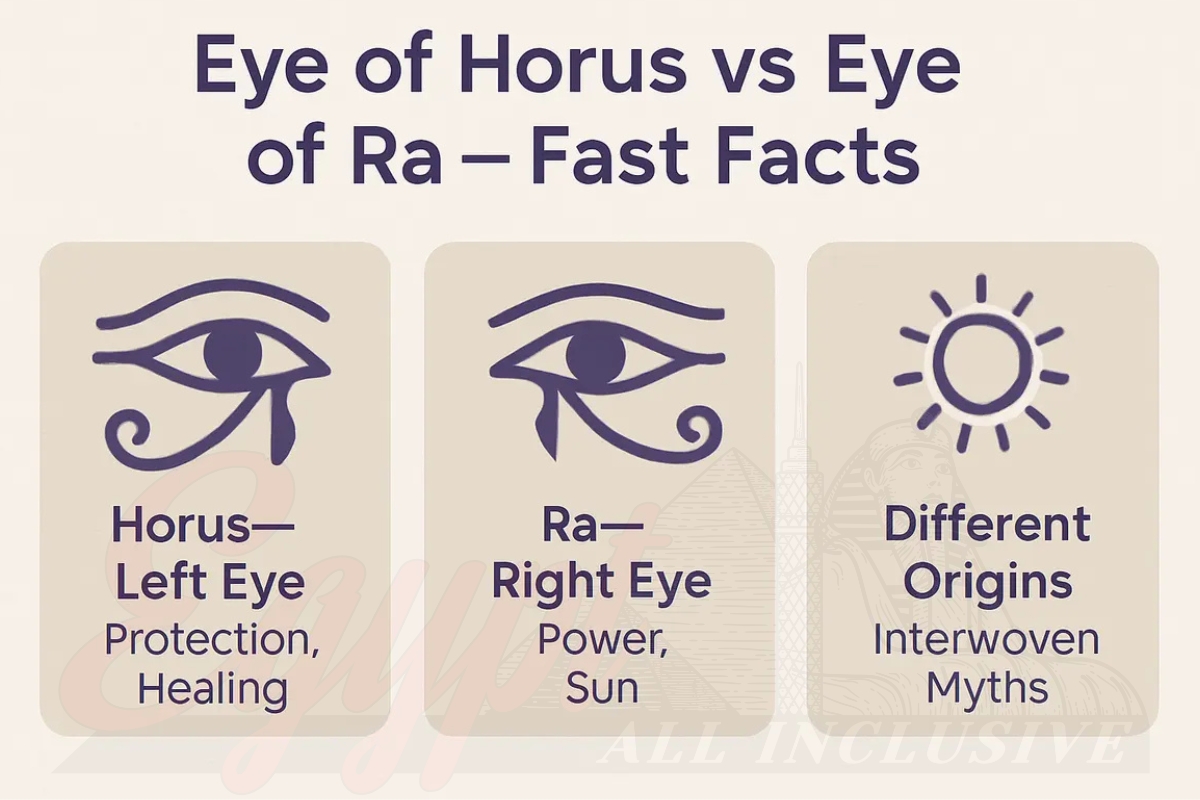
A closer look at the eye of horus vs ra comparison also reveals differences in artistic representation. Although both symbols resemble stylized human eyes inspired by the markings of a falcon, artists sometimes distinguish them by their association with either the left or right eye. In most traditional interpretations, the Eye of Horus represents the left eye connected to the moon, while the Eye of Ra represents the right eye connected to the sun. These associations reinforce the balance between healing and power, restoration and authority, lunar calm and solar energy.
The eyes of horus vs eye of ra discussion has become increasingly popular as travelers prepare for cultural tours across Egypt in 2026. Visitors exploring the temples of Luxor, Karnak, Edfu, Kom Ombo, Philae, and the Grand Egyptian Museum frequently encounter these symbols in reliefs, statues, jewelry, and ceremonial objects. Learning their meanings before visiting allows travelers to better understand the religious beliefs that shaped one of history’s greatest civilizations.
One of the most searched questions today concerns the eye of horus vs eye of ra difference. In simple terms, the Eye of Horus symbolizes healing, protection, health, restoration, and completeness, while the Eye of Ra symbolizes royal authority, solar power, divine justice, and protective strength. Neither symbol is considered more important than the other; instead, they represent complementary aspects of Egyptian belief that worked together to maintain harmony throughout the universe.
The eye of ra vs eye of horus meaning also reflects the broader Egyptian understanding of balance. Ancient Egyptians believed that life depended upon harmony between opposing forces. Just as day follows night and the Nile floods before retreating, the protective healing represented by Horus and the powerful justice represented by Ra formed two essential parts of maintaining cosmic order.
When comparing the Egyptian Eye of Horus vs Ra, historians rely on archaeological discoveries, temple inscriptions, funerary texts, and surviving amulets found across Egypt. These discoveries show that both symbols were deeply respected and widely used by kings, priests, soldiers, merchants, and ordinary Egyptians seeking divine protection or spiritual guidance.
Ultimately, the eye of horus vs eye of ra meaning goes far beyond two similar-looking ancient symbols. Together they tell the story of Egyptian religion, mythology, kingship, protection, and the eternal struggle between order and chaos. Whether you are planning a trip to Egypt, exploring ancient mythology, choosing meaningful artwork, or simply satisfying your curiosity, understanding the Eye of Ra vs Eye of Horus provides valuable insight into one of the world’s oldest and most fascinating civilizations.
Eye of Ra
Eye of Ra Meaning
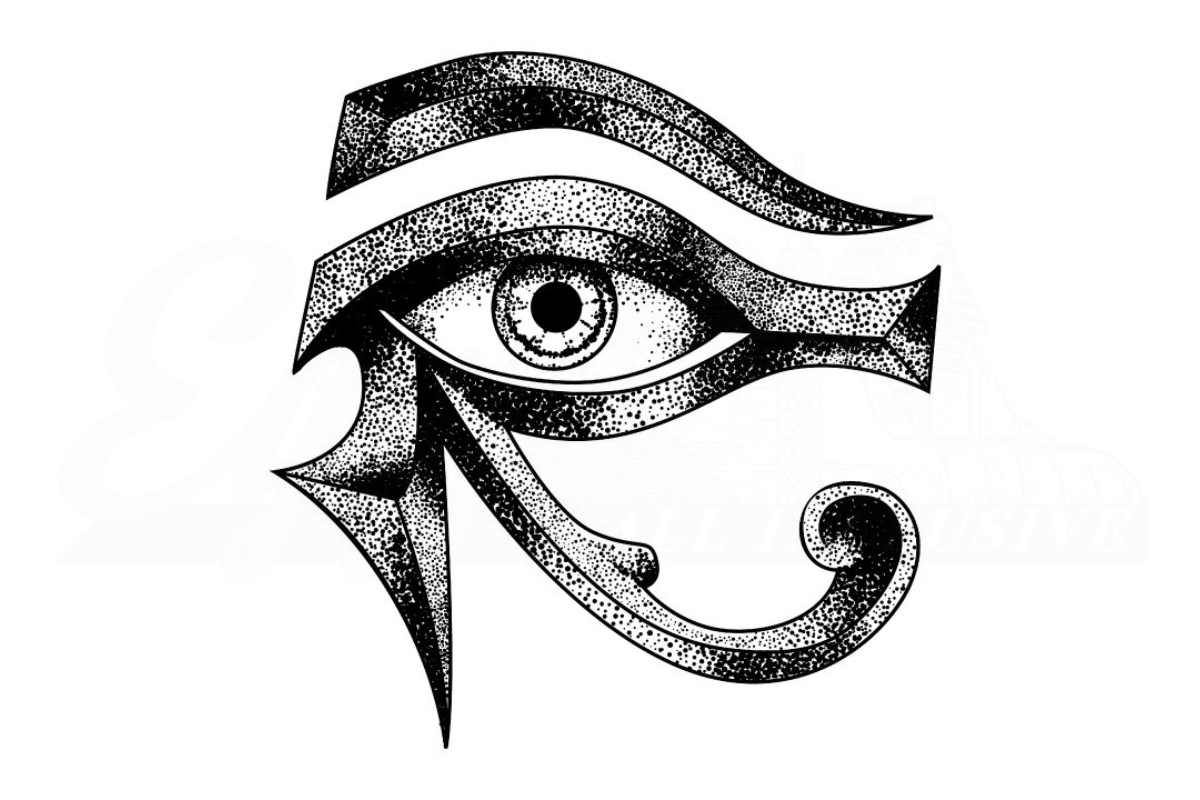
The Eye of Ra is one of the most powerful symbols in ancient Egyptian mythology. It represents the protective and sometimes destructive force of Ra, the sun god, who was believed to be the creator of the world and the ruler of the heavens. More than a simple artistic design, the Eye of Ra symbolized divine authority, royal power, justice, and the ability to maintain order over chaos. Throughout ancient Egypt, it appeared on temple walls, statues, jewelry, royal regalia, and protective amulets, reminding people that the gods were constantly watching over the world.
When discussing Eye of Ra meaning, historians explain that the symbol represents Ra’s active power rather than the god himself. According to Egyptian mythology, the Eye could leave Ra and act independently to defend him, punish his enemies, or restore balance when disorder threatened creation. In several myths, the Eye takes the form of powerful goddesses such as Sekhmet, Hathor, Bastet, or Wadjet, each carrying different aspects of protection, vengeance, motherhood, or divine strength.
The story behind the Eye of Ra begins with the daily journey of the sun across the sky. Ancient Egyptians believed Ra sailed through the heavens during the day before traveling through the underworld each night. During this journey, dangerous forces attempted to stop the sun from rising again. The Eye of Ra served as Ra’s ultimate weapon, protecting him against these threats and ensuring that light, life, and order returned every morning. This connection made the symbol a representation of survival, renewal, and the continuous cycle of life.
Unlike many ancient symbols that carried only religious significance, the Eye of Ra also became a political emblem. Egyptian pharaohs associated themselves with Ra to reinforce their divine right to rule. Displaying the Eye of Ra on crowns, temples, monuments, and ceremonial objects demonstrated that the king ruled under the protection and authority of the sun god. As a result, the symbol came to represent leadership, sovereignty, courage, and the responsibility to preserve harmony throughout the kingdom.
One reason travelers often confuse the symbol is the frequent comparison between the Eye of Horus vs Eye of Ra. At first glance, both designs resemble a stylized human eye inspired by the markings of a falcon, but their meanings differ significantly. While the Eye of Horus is associated with healing, restoration, protection, and recovery after Horus regained his injured eye, the Eye of Ra symbolizes strength, divine justice, solar energy, and the ability to defeat evil. Together, these symbols illustrate two complementary aspects of ancient Egyptian belief: healing and protection on one side, and power and authority on the other.
Understanding the Eye of Horus vs Eye of Ra comparison also helps visitors recognize the symbolism found throughout Egypt’s temples and museums. In places such as Karnak Temple, Edfu Temple, Philae Temple, and the Grand Egyptian Museum, these symbols appear in carvings, reliefs, jewelry, and ceremonial artifacts. Knowing whether an object represents Horus or Ra provides deeper insight into the religious messages that ancient artists intended to communicate.
Another common comparison is Eye of Ra vs Eye of Horus, especially among travelers researching Egyptian mythology before visiting the country’s historic sites. In most traditional interpretations, the Eye of Ra is linked to the right eye and the sun, while the Eye of Horus represents the left eye and the moon. Although this distinction is widely accepted today, scholars also note that ancient Egyptian mythology evolved over thousands of years, and some regional traditions interpreted these symbols differently.
People searching for Eye of Ra vs Horus are often interested in which symbol offers greater protection or carries stronger spiritual meaning. From a historical perspective, neither symbol was considered superior. Instead, each fulfilled a unique role within Egyptian religion. The Eye of Horus protected individuals by promoting health, healing, and safe journeys, while the Eye of Ra protected the entire cosmos by defending divine order against the forces of chaos.
The popularity of Egyptian-inspired body art has also increased searches for Eye of Horus vs Eye of Ra tattoo. Although both designs are visually striking, their meanings differ. Individuals who choose the Eye of Ra often wish to symbolize confidence, leadership, personal strength, resilience, or determination. In contrast, people selecting the Eye of Horus usually connect with themes of healing, spiritual protection, wisdom, and recovery. Understanding the historical background behind each symbol allows tattoo enthusiasts to choose a design that reflects its authentic meaning rather than simply its appearance.
Another frequently searched phrase is Eye of Horus vs Ra, especially among readers looking for a quick explanation. The simplest distinction is that Ra represents the supreme sun god whose eye became a symbol of divine power, while Horus was the falcon god whose restored eye became a symbol of healing and protection. Despite their differences, both symbols remain among the most recognizable icons of Ancient Egypt and continue to inspire artists, historians, travelers, and collectors around the world.
Today, the Eye of Ra remains an enduring symbol of ancient Egyptian civilization. Whether seen in museum collections, temple carvings, jewelry, souvenirs, or historical texts, it reminds us of a culture that viewed the universe as a delicate balance between creation and destruction, protection and justice, light and darkness. For anyone exploring Egypt in 2026, understanding the meaning of the Eye of Ra adds valuable context to the remarkable monuments and artifacts that have survived for thousands of years.
Who Is Ra?
Ra was the supreme sun god of ancient Egypt and one of the most important deities in Egyptian religion. Worshipped for thousands of years, Ra was believed to be the creator of the universe, the source of life, and the ruler of both the heavens and the earth. Every sunrise represented his victory over darkness, while every sunset marked the beginning of his nightly journey through the underworld before bringing light back to the world again. Understanding Ra is essential to understanding the Eye of the Ra, as the famous symbol represents his divine power, protection, and authority.
Ancient Egyptians often depicted Ra as a man with the head of a falcon wearing a solar disk surrounded by a sacred cobra. This image reflected his connection with the sun and his role as the protector of cosmic order. Pharaohs considered themselves the earthly representatives of Ra, believing that their right to rule came directly from the sun god. As a result, many temples, monuments, and royal inscriptions across Egypt honor Ra as the king of the gods.
To fully understand the Eye of Ra meaning, it is important to recognize that the Eye was not simply one of Ra’s physical eyes. Instead, it symbolized his active power and divine will. According to Egyptian mythology, the Eye of Ra could leave the god and act independently to defend him, punish his enemies, and restore order whenever chaos threatened creation. In several myths, the Eye appears as powerful goddesses such as Sekhmet, Hathor, Bastet, or Wadjet, each representing different aspects of Ra’s protective strength.
Another famous Egyptian symbol frequently associated with Ra is the Eye of Ra Ankh combination. The ankh, often called the “Key of Life,” represents life, immortality, and eternal existence. When artists combined the Eye of Ra with the ankh, the image symbolized divine protection together with the gift of life. Today, this pairing remains one of the most recognizable motifs in Egyptian-inspired jewelry, artwork, and historical reproductions.
The relationship between the ankh and Eye of Ra reflects a central belief of ancient Egyptian religion: life could only continue through the balance maintained by the gods. While the ankh represented everlasting life, the Eye of Ra represented the divine force that protected that life from disorder and destruction. Together, these symbols expressed the Egyptians’ hope for both physical safety and eternal existence.
Many visitors exploring Egypt notice that discussions about Ra naturally lead to comparisons between the Eyes of Horus vs Eye of Ra. Although both symbols appear similar, they represent different religious concepts. The Eye of Ra symbolizes solar power, divine authority, justice, and protection on a universal scale. The Eye of Horus, by contrast, represents healing, restoration, health, and personal protection following Horus’s legendary battle with Seth.
Understanding the Eye of Horus vs Eye of Ra difference helps explain why both symbols appear throughout Egyptian temples, tombs, and museum collections. The Eye of Horus was commonly worn as an amulet for protection and recovery, while the Eye of Ra often appeared in royal and religious settings to demonstrate the authority of the gods and the pharaoh. Rather than competing symbols, they complemented one another within Egyptian belief by representing different forms of divine protection.
The Eye of Ra vs Eye of Horus meaning also reflects the Egyptians’ broader understanding of balance. Ra embodied the life-giving power of the sun but also possessed the ability to punish those who disrupted cosmic order. Horus, meanwhile, represented legitimate kingship, justice, and restoration after conflict. Together, these two symbols illustrate how ancient Egyptians viewed strength and healing as equally necessary for maintaining harmony.
When comparing the Egyptian Eye of Horus vs Ra, historians emphasize that each symbol developed from a separate mythological tradition. Ra’s eye became associated with solar energy, leadership, and divine justice, while Horus’s restored eye became a lasting emblem of protection, health, and completeness. These meanings remained influential throughout Egypt’s long history and continue to fascinate travelers, archaeologists, and historians today.
The Eye of Horus vs Eye of Ra meaning is especially valuable for anyone planning to visit Egypt in 2026. Travelers will encounter both symbols carved into temple walls, painted inside tombs, displayed in museum exhibits, and crafted into jewelry sold throughout the country. Recognizing their connection to Ra and Horus transforms these beautiful designs from decorative artwork into meaningful representations of one of the world’s oldest civilizations.
Today, Ra remains one of the defining figures of ancient Egyptian mythology. His influence can still be seen in the magnificent temples dedicated to the sun, the artwork preserved in museums, and the enduring symbolism of the Eye of Ra. Learning about Ra provides the foundation for understanding not only Egyptian religion but also the beliefs, traditions, and cultural achievements that shaped one of history’s greatest civilizations.
How Did the Eye of Ra Come About?
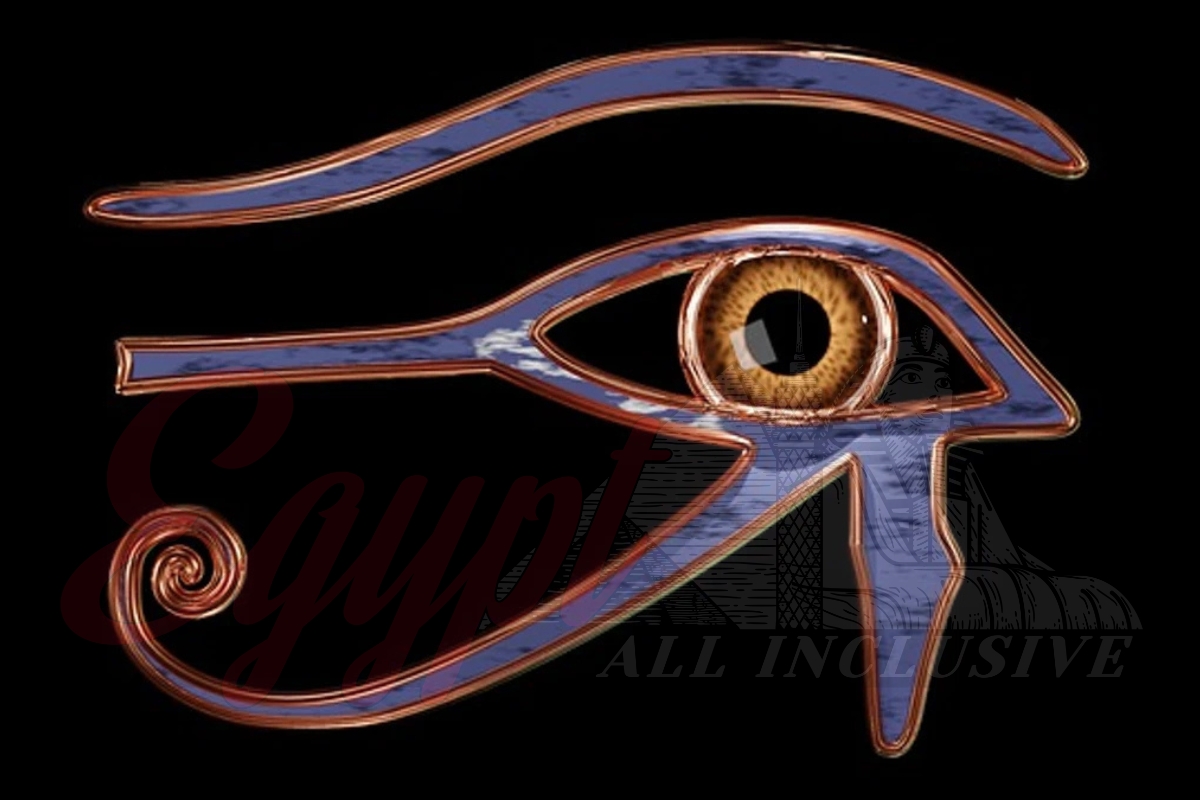
The story of the Eye of Ra begins with one of the oldest and most important myths in ancient Egyptian religion. Rather than being simply the physical eye of the sun god, the Eye of Ra was believed to be a powerful extension of Ra’s divine authority. Ancient Egyptians described it as an independent force that could leave the god, protect creation, punish evil, and restore balance whenever chaos threatened the world. This belief transformed the Eye of Ra into one of the most respected religious symbols in Egyptian civilization.
To understand what is the Eye of Ra, it helps to look at the ancient Egyptian view of the universe. Egyptians believed that the world survived because the gods maintained order, known as Ma’at. Every day, Ra sailed across the sky in his solar boat, bringing daylight to humanity. Every night, he traveled through the underworld, where he battled dangerous forces that sought to stop the sun from rising again. During these struggles, the Eye of Ra acted as his greatest weapon, defending both the creator god and the cosmic order upon which all life depended.
According to several ancient myths, Ra once sent his Eye to search for his children after they became lost. The Eye carried out its mission successfully, but upon returning, it discovered that Ra had already created a replacement eye. Feeling betrayed, the original Eye became furious. To calm it, Ra placed it on his forehead, where it became a symbol of supreme power and eternal protection. This story explains why the Eye of Ra is frequently shown above the brow of gods and pharaohs, often accompanied by the sacred cobra known as the uraeus.
The meaning Eye of Ra evolved over thousands of years as Egyptian religion developed. While the symbol always represented divine power, it also came to embody justice, protection, royal authority, courage, and the ability to overcome disorder. Unlike many ancient symbols that served only ceremonial purposes, the Eye of Ra carried deep spiritual significance for both rulers and ordinary Egyptians. It reminded them that the forces of order were constantly protecting the world against chaos.
Many people today are interested in the Eye of Ra spiritual meaning because the symbol continues to appear in jewelry, artwork, meditation practices, and cultural designs. Historically, however, its spiritual significance was rooted in ancient Egyptian beliefs rather than modern interpretations. The Eye represented divine awareness, inner strength, wisdom, protection from harmful influences, and the triumph of light over darkness. It encouraged people to trust in the balance of the universe and the enduring power of truth and justice.
Another important symbol often connected to the Eye is the Ankh Eye of Ra combination. The ankh symbolizes life, eternal existence, and rebirth, while the Eye of Ra represents divine protection and the power of the sun god. Together, these two symbols conveyed the idea that life flourishes under the protection of the gods. Ancient artists frequently combined them in temple reliefs, religious objects, and ceremonial decorations to express both physical life and spiritual security.
The origins of the Eye also explain why modern readers often compare the Eye of Horus vs Eye of Ra. Although the two symbols look remarkably similar, they emerged from different mythological traditions. The Eye of Ra belongs to the creator and sun god Ra and emphasizes authority, strength, justice, and protection. The Eye of Horus belongs to Horus, the falcon god of kingship, and symbolizes healing, restoration, health, and wholeness after his eye was restored following his battle with Seth.
Likewise, the comparison of the Eye of Ra vs Eye of Horus highlights two complementary aspects of ancient Egyptian belief. The Eye of Ra protected the universe by preserving cosmic order, while the Eye of Horus protected individuals through healing and recovery. Together, these symbols represented the balance that Egyptians believed was necessary for both society and nature to flourish.
Some travelers also encounter references to the Eye of Rah, an alternative spelling occasionally used in modern writing. Although less common in academic publications, it refers to the same ancient Egyptian symbol associated with the sun god Ra. Regardless of spelling, the historical meaning remains unchanged and continues to represent divine power and protection.
Because of their close visual resemblance, many people refer collectively to the Eye of Ra and Horus or the Eye of Horus and Eye of Ra when discussing Egyptian symbolism. While this is understandable, historians recommend recognizing each symbol individually because they communicate different religious messages. Knowing which eye appears in a temple relief, museum artifact, or piece of jewelry allows visitors to better appreciate the beliefs of ancient Egyptian civilization.
The Eye of Ra meaning becomes even clearer when viewed alongside the Eye of Ra and Eye of Horus. Rather than competing symbols, they complement one another by expressing two essential principles of Egyptian mythology: the strength required to defend order and the healing needed to restore harmony after conflict. This balance between power and restoration was central to Egyptian religion and can still be seen in countless monuments that survive across Egypt today.
For travelers visiting Egypt in 2026, understanding how the Eye of Ra came about adds valuable depth to every temple, tomb, and museum experience. Whether carved above monumental gateways, engraved on royal artifacts, or displayed in ancient jewelry, the Eye of Ra tells the story of a civilization that believed the universe depended on the constant victory of light, justice, and divine protection over the forces of chaos.
Eye of Ra Myths
The Eye of Ra is at the center of several fascinating myths that shaped ancient Egyptian religion for thousands of years. These stories explain not only what does the Eye of Ra mean, but also why it became one of the most powerful symbols of protection, justice, and divine authority. Unlike many religious symbols that simply represented a god, the Eye of Ra was believed to have its own identity and the ability to act independently on behalf of the sun god.
One of the best-known myths tells how Ra sent his Eye into the world to search for his lost children, Shu and Tefnut. After successfully finding them, the Eye returned expecting gratitude. Instead, it discovered that Ra had already created another eye to replace it. Feeling rejected and angry, the Eye became a dangerous force. To honor its loyalty and calm its fury, Ra placed the original Eye upon his forehead, where it became a permanent symbol of his supreme authority. This myth explains why the Eye of Ra is often shown above the brow of gods and pharaohs as a sign of divine protection and royal power.
Another famous legend describes how humanity rebelled against the aging sun god. In response, Ra sent his Eye to punish those who threatened the natural order. The Eye transformed into the fierce lioness goddess Sekhmet, whose strength was so overwhelming that she nearly destroyed humanity. According to the story, Ra eventually stopped her by covering the land with beer dyed red to resemble blood. Believing it was blood, Sekhmet drank it, became intoxicated, and her destructive rage subsided. This myth illustrates that the Eye of Ra could represent both protection and destruction, depending on how divine justice was required.
Many people searching what does Eye of Ra mean are surprised to learn that its symbolism extends beyond warfare and punishment. Ancient Egyptians believed the Eye also watched over creation, defended the gods during Ra’s nightly journey through the underworld, and ensured that the sun rose each morning. Because of these responsibilities, the Eye came to symbolize vigilance, order, courage, renewal, and the triumph of light over darkness.
A common question concerns the Eye of Ra left eye. In traditional Egyptian symbolism, the Eye of Ra is generally associated with the right eye, representing the sun and its life-giving yet powerful energy. The left eye is more commonly linked to the Eye of Horus and the moon, symbolizing healing and restoration. Although some artistic variations exist throughout Egypt’s long history, this right-eye and left-eye distinction remains the most widely accepted interpretation among historians today.
Ancient texts also refer to multiple Eyes of Ra because the Eye could appear in different divine forms. Rather than being limited to one goddess, the Eye was manifested through powerful female deities such as Sekhmet, Hathor, Bastet, Wadjet, and Mut. Each goddess reflected a different aspect of Ra’s power, including protection, motherhood, justice, vengeance, wisdom, or compassion. This explains why Egyptian mythology sometimes speaks of the Eye as both a symbol and a living divine force.
These myths naturally lead to comparisons between the Eye of Horus and Ra. While both symbols share similar artistic features, they belong to different mythological traditions. The Eye of Ra emphasizes solar power, divine authority, and the protection of cosmic order. The Eye of Horus represents healing, restoration, protection, and completeness following Horus’s legendary battle with Seth. Together, they illustrate two essential principles that ancient Egyptians believed were necessary for maintaining balance in the universe.
Understanding the difference between Eye of Ra and Eye of Horus is important when exploring Egypt’s temples, museums, and archaeological sites. The Eye of Ra often appears in royal contexts, reinforcing the authority of pharaohs and the strength of the sun god. The Eye of Horus is more commonly associated with protective amulets, funerary objects, and personal symbols of health and safety. Although they served different purposes, both were among the most respected symbols in Egyptian civilization.
The Eye of Ra vs Eye of Horus meaning can be summarized through their roles in mythology. The Eye of Ra represents active divine power, justice, and the defense of creation against chaos. The Eye of Horus represents healing, recovery, wisdom, and personal protection. Rather than competing symbols, they complement one another by expressing the balance between strength and restoration that was central to ancient Egyptian beliefs.
The myths surrounding these symbols also help explain the relationship between Horus vs Ra. Ra was regarded as the creator and supreme sun god, while Horus was the falcon god of kingship and rightful rule. In later periods of Egyptian history, these traditions became closely connected, and some religious beliefs even combined the two gods into a single deity known as Ra-Horakhty. This blending reflects how Egyptian religion evolved while preserving the importance of both divine figures.
Likewise, discussions of Ra vs Horus often focus on their different responsibilities rather than competition. Ra governed the cosmic order and the daily journey of the sun, while Horus protected the pharaoh and symbolized legitimate kingship. Their famous eye symbols reflect these complementary roles, with one emphasizing universal power and the other personal protection and restoration.
For readers comparing the Eye of Horus vs Ra, the myths make one point especially clear: both symbols were essential to ancient Egyptian spirituality. The Eye of Ra protected the universe through strength and justice, while the Eye of Horus safeguarded individuals through healing and renewal. Together, they formed a powerful expression of balance—one of the most important ideas in Egyptian civilization.
Today, these ancient myths continue to captivate historians, travelers, and mythology enthusiasts around the world. Whether seen carved into temple walls, displayed in museum collections, or recreated in modern art and jewelry, the Eye of Ra remains a timeless reminder of the beliefs that shaped one of history’s greatest civilizations.
The Eye of Ra Meaning Spiritual
The Eye of Ra meaning spiritual has fascinated historians, travelers, and symbol enthusiasts for centuries. In ancient Egypt, the Eye of Ra was far more than a decorative emblem—it represented the living power of the sun god, divine protection, truth, justice, and the ability to overcome darkness. Egyptians believed the symbol watched over both the gods and humanity, helping maintain the balance of the universe. Even today, the Eye of Ra continues to inspire people who value courage, resilience, and spiritual strength.
From a historical perspective, the spiritual meaning of the Eye of Ra is closely connected to the Egyptian concept of Ma’at, which represents truth, harmony, balance, and cosmic order. Every day, Ra traveled across the sky in his solar boat, bringing light to the world. Every night, he faced dangerous forces in the underworld before rising again at dawn. Because the Eye accompanied and protected him during this eternal journey, it became a symbol of endurance, renewal, and the victory of light over chaos.
Many people wear an Eye of Ra charm because they believe it symbolizes confidence, protection, and inner strength. While modern interpretations vary, the historical purpose of such amulets was to invoke the protective power of the gods. Ancient Egyptians often carried or wore sacred symbols during daily life, believing they offered divine guidance and safeguarded them from misfortune. Today, Eye of Ra jewelry remains popular among travelers visiting Egypt and those interested in ancient symbolism.
The Eye of Ra Egyptian symbol can be found throughout the country’s most famous archaeological sites. Visitors exploring Karnak Temple, Edfu Temple, Philae Temple, Abu Simbel, and the Grand Egyptian Museum will encounter carvings, reliefs, statues, and ceremonial objects featuring the Eye of Ra. These artistic representations remind visitors that religion was deeply woven into every aspect of ancient Egyptian civilization, from kingship and temple rituals to everyday life.
One of the most interesting aspects of the symbol is its appearance in Eye of Ra hieroglyphics and temple inscriptions. Although the Eye itself is not a single hieroglyphic character, it frequently appears in religious texts, royal monuments, and decorative reliefs alongside hieroglyphs that praise Ra and other deities. These inscriptions often describe the Eye as the guardian of divine order and a protector of both the pharaoh and the Egyptian kingdom.
When discussing the Eye of Ra meaning spiritual, it is important to distinguish historical beliefs from modern spiritual interpretations. In ancient Egypt, the Eye represented divine authority, protection, justice, awareness, and the sacred responsibility to preserve harmony. Today, many people associate it with personal empowerment, wisdom, resilience, confidence, and spiritual awakening. Although these modern meanings are inspired by Egyptian mythology, they should not be confused with the original religious practices of ancient Egypt.
The spiritual significance of the Eye of Ra is often compared with the Eye of Horus meaning. While both symbols are associated with protection, they emphasize different qualities. The Eye of Horus represents healing, restoration, health, and completeness after Horus regained his injured eye during his battle with Seth. The Eye of Ra, by contrast, symbolizes active protection through strength, justice, leadership, and the life-giving energy of the sun.
This comparison between the Eye of Horus Eye of Ra helps explain why both symbols remained central to Egyptian religion for thousands of years. The Eye of Horus protected individuals by promoting recovery and well-being, while the Eye of Ra protected the entire cosmos by defending order against chaos. Together, they illustrate the balance between compassion and power that was fundamental to ancient Egyptian beliefs.
Another common comparison is Eye of Ra vs Horus. Historically, this is not a competition between two symbols but a contrast between their different purposes. Ra was the supreme sun god whose eye embodied divine authority and solar power, whereas Horus was the falcon god of kingship whose restored eye became a universal emblem of healing and protection. Understanding these distinctions allows travelers to appreciate the deeper meanings behind the artwork they encounter across Egypt.
The Eye of Horus meaning spiritual has also become increasingly popular in modern culture. Many people see it as a symbol of personal healing, emotional resilience, intuition, and protection from negative influences. Although these contemporary interpretations differ from ancient religious beliefs, they reflect the lasting influence of Egyptian mythology on cultures around the world.
Understanding the Eye of Ra and Horus meaning reveals that the two symbols complement rather than replace one another. The Eye of Ra teaches strength, courage, vigilance, and the defense of truth, while the Eye of Horus emphasizes healing, renewal, wisdom, and personal protection. Together, they represent two essential forces that ancient Egyptians believed sustained both humanity and the universe.
The Eyes of Horus and Ra continue to appear together in museum exhibitions, educational materials, jewelry collections, and travel guides because they are among the most recognizable symbols of ancient Egypt. Their shared artistic style often causes confusion, but their mythological backgrounds clearly distinguish their meanings and purposes.
Even the simple Eye of Horus remains one of the world’s most famous ancient symbols, appearing on protective amulets, temple walls, and royal artifacts dating back thousands of years. Learning how it differs from the Eye of Ra gives travelers and history enthusiasts a more complete understanding of Egyptian religion and its enduring legacy.
For international visitors, searches such as “El Ojo de Ra y Horus” (Spanish for “The Eye of Ra and Horus”) demonstrate the global fascination with these symbols. Regardless of language, the message remains the same: the Eye of Ra represents divine power and protection, while the Eye of Horus symbolizes healing and restoration. Together, they continue to tell the story of one of the world’s oldest and most influential civilizations.
Whether admired for their historical significance, artistic beauty, or symbolic meaning, the Eye of Ra and the Eye of Horus remain timeless reminders of ancient Egypt’s remarkable spiritual heritage. For anyone exploring Egypt in 2026, understanding these symbols adds a richer and more meaningful perspective to every temple, museum, and archaeological site.
What Power Is in the Eye of Ra?
The Eye of Ra was believed to possess extraordinary divine power in ancient Egyptian religion. Rather than being only a sacred symbol, it represented the active force of the sun god Ra—protecting creation, defeating evil, maintaining cosmic order, and ensuring the daily rebirth of the sun. For thousands of years, Egyptians viewed the Eye of Ra as one of the most powerful religious emblems, embodying strength, justice, authority, and divine protection.
One of the most common questions is what does the Eye of Ra symbolize. Historically, the symbol represented the power of the sun, royal authority, protection against chaos, vigilance, truth, and the ability to overcome darkness. Ancient Egyptians believed that Ra watched over the world through his Eye, ensuring that harmony prevailed over disorder. This symbolism made the Eye a common feature on temple walls, royal crowns, ceremonial objects, and protective amulets.
The Eye of Ra was also closely associated with the concept of divine justice. According to Egyptian mythology, when the balance of the universe was threatened, the Eye acted independently to defend Ra and restore order. In several myths, it took the form of fierce goddesses such as Sekhmet, Hathor, or Wadjet, demonstrating that divine power could be both protective and destructive depending on the circumstances. This dual role is one of the reasons the Eye of Ra remains such a fascinating symbol today.
Another important connection is the Eye of Amun Ra. During the New Kingdom, the worship of Amun merged with that of Ra, creating the supreme deity Amun-Ra. As a result, many temples dedicated to Amun-Ra also featured the Eye as a symbol of divine kingship, solar power, and universal protection. Visitors to Karnak Temple, one of Egypt’s greatest religious complexes, can see numerous artistic representations reflecting this powerful religious tradition.
The Eye of Ra hieroglyph appears frequently alongside ancient inscriptions, although the Eye itself is not a single hieroglyphic character. Instead, it is a sacred symbol incorporated into reliefs, temple carvings, royal monuments, and religious artwork. Egyptian artists carefully combined the Eye with hieroglyphic texts praising Ra, emphasizing his role as the creator, protector, and ruler of the cosmos.
Understanding Eye of Ra symbolism requires looking beyond its artistic appearance. To the ancient Egyptians, the Eye represented more than vision—it symbolized awareness, divine presence, wisdom, courage, and the continuous triumph of order over chaos. Because Ra’s daily journey guaranteed the return of sunlight, the Eye also became a powerful emblem of renewal, hope, and the continuity of life itself.
The relationship between the Eye of Ra Eye of Horus is one of the most frequently misunderstood topics in Egyptian mythology. Although both symbols share a similar design inspired by the markings around a falcon’s eye, they developed from different myths and served different purposes. The Eye of Ra represents solar energy, authority, justice, and universal protection, while the Eye of Horus symbolizes healing, restoration, health, and personal safety.
Many readers are also interested in the Eye of Ra spiritual meaning. Historically, the Eye inspired confidence in the protective power of the gods and reminded Egyptians that divine justice maintained the balance of the universe. In modern interpretations, people often associate it with inner strength, resilience, leadership, personal growth, and spiritual awareness. While these contemporary meanings differ from ancient religious practices, they are rooted in the symbol’s long history of representing protection and power.
International interest in Egyptian mythology is reflected in searches such as “Ojo de Horus y Ra,” the Spanish phrase for “Eye of Horus and Ra.” Across cultures and languages, these symbols continue to captivate people because they represent timeless ideas such as protection, wisdom, courage, healing, and the pursuit of balance.
Some people also search for the Eye of Rah and Horus meaning, using an alternative spelling of Ra. Regardless of the spelling, the historical distinction remains the same. The Eye of Ra expresses the active power of the creator god and his responsibility to defend the universe, while the Eye of Horus reflects restoration and protection after Horus regained his injured eye. Together, they symbolize complementary aspects of ancient Egyptian belief rather than opposing forces.
The Eye of Horus vs Eye of Ra meaning becomes especially clear when examining their mythology. The Eye of Horus emerged from a story of recovery after conflict, making it a symbol of healing, completeness, and protection. The Eye of Ra, however, originated as the divine instrument through which the sun god exercised his authority and safeguarded cosmic order. Both symbols were deeply respected throughout Egyptian history because each fulfilled a different spiritual purpose.
A common question among travelers is what is the difference between the Eye of Ra and the Eye of Horus. The answer lies in both their mythology and symbolism:
- Eye of Ra: Represents the sun, divine authority, justice, strength, leadership, and cosmic protection.
- Eye of Horus: Represents healing, restoration, health, wisdom, personal protection, and wholeness.
- Eye of Ra: Connected with the creator god Ra.
- Eye of Horus: Connected with Horus, the falcon god of kingship.
- Both symbols: Share a similar artistic design but communicate different religious meanings.
Another frequently asked question is Eye of Ra vs Eye of Horus left or right. In the most widely accepted interpretation, the Eye of Ra is associated with the right eye, symbolizing the sun and its powerful, life-giving energy. The Eye of Horus is linked to the left eye, representing the moon, healing, and restoration. While some artistic variations appear in ancient Egyptian art, this distinction remains the standard explanation used by historians and Egyptologists today.
For visitors exploring Egypt in 2026, recognizing these differences adds valuable context when touring temples, tombs, and museums. Whether carved above temple gateways, painted inside royal tombs, or displayed among priceless museum collections, the Eye of Ra continues to symbolize the enduring strength, wisdom, and spiritual legacy of one of the world’s greatest ancient civilizations.
The Eye of Ra Symbol
The Eye of Ra is one of the most recognizable symbols of ancient Egypt. Instantly identifiable by its distinctive eye shape and elegant markings, it represented far more than artistic decoration. Throughout Egyptian history, the Eye of Ra symbolized the power of the sun god, divine protection, royal authority, justice, and the eternal triumph of order over chaos. Today, it remains one of the best-known emblems of Egyptian civilization, appearing in museums, temples, jewelry, and historical artwork around the world.
The Ancient Egypt Eye of Ra originated thousands of years ago during the early dynastic period and became increasingly important throughout the Old, Middle, and New Kingdoms. It appeared on temple walls, royal monuments, ceremonial objects, papyrus manuscripts, and protective amulets. Pharaohs frequently incorporated the symbol into their crowns and regalia to demonstrate that they ruled under the protection and authority of the sun god Ra.
Visitors traveling through Egypt today will encounter the Egypt Eye of Ra at many of the country’s most famous archaeological sites. Temples such as Karnak, Edfu, Kom Ombo, Philae, and Abu Simbel feature carvings and reliefs depicting the Eye alongside images of Ra and other Egyptian deities. The symbol can also be seen in museum collections, including the Grand Egyptian Museum and the Egyptian Museum in Cairo, where it appears on statues, jewelry, funerary objects, and royal artifacts.
One of the most common questions asked by travelers and history enthusiasts is what is the difference between the Eye of Horus and the Eye of Ra. Although the two symbols share a similar appearance, they have different origins and meanings in Egyptian mythology.
The Eye of Ra belongs to Ra, the supreme sun god, and represents:
- Divine authority and kingship.
- Solar power and creation.
- Protection of the universe.
- Justice and strength.
- The defeat of chaos.
The Eye of Horus belongs to Horus, the falcon-headed god of kingship, and symbolizes:
- Healing and restoration.
- Protection during life and the afterlife.
- Good health and completeness.
- Wisdom and guidance.
- Recovery after adversity.
Rather than competing symbols, they complement one another by representing two different forms of divine protection.
Another way historians explain this distinction is by comparing the Horus Eye and Ra Eye through their myths. The Eye of Horus originated after Horus lost and later regained his eye during his battle with Seth, making it a lasting emblem of healing and renewal. The Eye of Ra, however, was created as the active power of the sun god, capable of protecting creation and punishing those who threatened the natural order. These separate mythological origins explain why each symbol carried its own unique religious significance.
The relationship between the Eye of Ra and Horus became even stronger during later periods of Egyptian history, when religious traditions evolved and blended together. While the symbols retained their individual meanings, they were often displayed side by side in temples and sacred artwork to express the complete balance between strength and healing, justice and restoration. Together, they reflected the Egyptian belief that harmony could only exist when these forces worked together.
Modern readers sometimes search for the Eye of Rah and Horus, using an alternative spelling of Ra. Regardless of spelling, the historical interpretation remains the same. The Eye of Ra represents divine authority, solar energy, and protection on a universal scale, while the Eye of Horus emphasizes personal protection, healing, and recovery. Understanding this distinction helps visitors identify these symbols correctly when exploring Egypt’s ancient monuments.
Many people are also curious about the Eye of Rah meaning. Historically, it carries the same meaning as the Eye of Ra. It symbolizes the all-seeing power of the sun god, his ability to defend creation, maintain justice, and preserve the balance of the universe. In modern culture, it is also associated with courage, resilience, leadership, and spiritual awareness, although these contemporary interpretations are inspired by—not identical to—its original religious significance.
The Eye of Ra belongs to a broader family of sacred Egyptian eye symbols that played important roles in religion, art, and daily life. Ancient Egyptians believed that eyes represented vision, protection, awareness, and divine presence. Among these symbols, the Eye of Ra and the Eye of Horus became the most influential, each serving a distinct purpose while reflecting the civilization’s deep respect for balance and harmony.
No discussion of Egyptian eye symbols would be complete without mentioning the Eye of Horus, one of the most famous protective emblems in world history. Frequently carved onto temples, painted inside tombs, and crafted into amulets, the Eye of Horus was believed to safeguard both the living and the dead. When viewed alongside the Eye of Ra, it completes the story of ancient Egyptian spirituality by illustrating the complementary powers of healing and strength, restoration and authority.
For travelers planning a visit to Egypt in 2026, recognizing the Eye of Ra symbol transforms a sightseeing experience into a deeper journey through history. Whether seen on the walls of ancient temples, displayed in world-class museums, or recreated in traditional Egyptian jewelry, the Eye of Ra remains a timeless symbol of one of humanity’s greatest civilizations. Understanding its history and meaning allows visitors to appreciate not only its artistic beauty but also the profound beliefs that shaped ancient Egypt for more than three millennia.
The Roles of the Eye of Ra
The Eye of Ra played several important roles in ancient Egyptian religion, mythology, and royal life. Far more than a decorative emblem, it represented the active power of the sun god Ra and was believed to protect the universe, enforce divine justice, and preserve the natural order. Understanding what is Eye of Ra helps explain why this symbol became one of the most respected and enduring icons of ancient Egypt.
1. Protector of the Sun God
The primary role of the Egyptian Eye of Ra was to protect Ra, the creator and sun god. According to Egyptian mythology, the Eye could leave Ra and act as an independent force to defend him against enemies who threatened the balance of the world. Every night, as Ra journeyed through the underworld, the Eye helped him overcome dangerous creatures and ensured that the sun would rise again the following morning. This daily victory symbolized the triumph of light over darkness and order over chaos.
2. Guardian of Cosmic Order
Ancient Egyptians believed that the universe depended on Ma’at—the principle of truth, harmony, and balance. The Egypt the Eye of Ra symbol represented the divine force that maintained this balance. Whenever disorder or injustice appeared, the Eye acted on behalf of Ra to restore harmony. Because of this role, the symbol became closely associated with justice, vigilance, responsibility, and the protection of all creation.
3. Symbol of Royal Authority
The Eye of Ra Egypt was also a powerful emblem of kingship. Egyptian pharaohs considered themselves the earthly representatives of Ra and often displayed the Eye on crowns, ceremonial headdresses, temple reliefs, and royal monuments. By wearing or displaying the Eye of Ra, rulers demonstrated that their authority came from the gods and that they were responsible for protecting Egypt and preserving order throughout the kingdom.
4. Defender Against Evil
One of the most important roles of the Eye of Ra was defending both the gods and humanity from destructive forces. Ancient myths describe the Eye transforming into powerful goddesses such as Sekhmet, Hathor, Bastet, or Wadjet to defeat enemies and punish those who threatened divine order. Although these stories sometimes portray the Eye as fierce, its ultimate purpose was always to safeguard creation and ensure the continuation of life.
5. Source of Divine Protection
The Eye of Ra was widely regarded as a protective symbol. Its image appeared on temple walls, statues, jewelry, amulets, boats, and sacred objects because Egyptians believed it offered spiritual protection from danger and negative influences. Travelers, priests, soldiers, and members of the royal family all valued the symbol as a reminder that the gods watched over those who respected divine law.
6. Representation of the Sun’s Life-Giving Power
As the symbol of the sun god, the Eye of Ra also represented the energy that sustained life on Earth. Egyptians understood that the sun provided warmth, light, and the conditions necessary for agriculture along the Nile. Every sunrise reinforced the belief that Ra’s power renewed the world each day. For this reason, the Eye became a symbol of renewal, vitality, hope, and the continuous cycle of life.
7. Religious and Temple Symbol
Throughout ancient Egypt, priests incorporated the Eye of Ra into religious ceremonies, temple decorations, and sacred artwork. Visitors exploring Karnak Temple, Edfu Temple, Philae Temple, and Abu Simbel can still see carvings of the Eye accompanying scenes of worship and offerings to the gods. These depictions emphasized the Eye’s role as a sacred protector of temples and places dedicated to divine worship.
8. Inspiration for Modern Culture
Although its religious role ended with the decline of ancient Egyptian civilization, the Eye of Ra continues to influence modern art, jewelry, fashion, and cultural design. Today, many people appreciate the symbol for its historical significance and its association with courage, resilience, leadership, and protection. While these modern interpretations differ from ancient beliefs, they reflect the lasting legacy of one of history’s most influential civilizations.
The Meaning of the Eye of Ra
Ultimately, the meaning of the Eye of Ra combines all of these roles into one powerful symbol. It represents the authority of the sun god, the protection of the universe, the defense of justice, the preservation of harmony, and the life-giving power of the sun. Rather than serving a single purpose, the Eye of Ra embodied the many responsibilities that ancient Egyptians believed were necessary to keep the world in balance.
For anyone visiting Egypt in 2026, recognizing the different roles of the Eye of Ra adds a deeper appreciation to the country’s temples, tombs, and museums. Every carving, relief, and artifact featuring this remarkable symbol tells the story of a civilization that believed divine protection, wisdom, and justice were essential for both humanity and the cosmos to thrive.
Mythology About the Eye of Ra
The mythology surrounding the Eye of Ra is one of the most fascinating parts of ancient Egyptian religion. Unlike many symbols that simply represented a deity, the Eye of Ra was believed to possess its own divine identity and power. It acted on behalf of Ra, the sun god, protecting creation, enforcing justice, and defeating the forces of chaos. Through myths preserved on temple walls, papyrus texts, and religious inscriptions, the Eye of Ra became a lasting symbol of strength, protection, and cosmic balance.
One of the most recognizable representations of the Eye appears in hieroglyphics Eye of Ra imagery found throughout Egypt. Although the Eye itself is not a standalone hieroglyphic letter, it frequently appears in temple reliefs, royal monuments, funerary texts, and sacred artwork alongside hieroglyphic inscriptions honoring Ra. These depictions reinforced the belief that the Eye watched over both the gods and humanity, protecting Egypt from danger while preserving the natural order established by the creator.
The Myth of the Lost Eye
One of the oldest Egyptian legends tells how Ra sent his Eye to search for his lost children, Shu and Tefnut. After completing its mission, the Eye returned to discover that Ra had created another eye during its absence. Feeling hurt and betrayed, the Eye became angry. To honor its loyalty and restore its place, Ra positioned the Eye upon his forehead, where it became a symbol of supreme authority and divine protection. This myth explains why the Eye of Ra is often shown above the heads of gods and pharaohs.
The Eye as the Goddess Sekhmet
Perhaps the most dramatic myth tells of humanity rebelling against Ra. To punish those who had turned against him, Ra transformed his Eye into the lioness goddess Sekhmet. She unleashed her immense power upon the earth and nearly destroyed humanity. Realizing that her destruction had gone too far, Ra ordered red-colored beer to be poured across the land. Mistaking it for blood, Sekhmet drank it, became intoxicated, and her fury subsided. This famous story demonstrates that the Eye of Ra possessed both protective and destructive powers, always serving the greater purpose of restoring balance.
Is the Eye of Ra Evil?
A common question today is is the Eye of Ra evil. The historical answer is no. Although the Eye could appear fierce and punish those who threatened divine order, ancient Egyptians never viewed it as evil. Instead, it represented justice, protection, and the enforcement of cosmic balance. Its destructive power was directed only against chaos and wrongdoing, making it a guardian rather than a symbol of evil. In Egyptian belief, strength and discipline were necessary to preserve harmony in the universe.
The Eye of Ra and the Ankh
Another well-known combination in Egyptian art is the Eye of Ra and Ankh. The ankh symbolizes life, immortality, and eternal existence, while the Eye of Ra represents divine protection and the life-giving power of the sun. Together, these two sacred symbols expressed the belief that life flourishes under the protection of the gods. Ancient artists frequently paired them in temple carvings, jewelry, ceremonial objects, and religious artwork to symbolize both physical life and spiritual security.
The Eye of Ra Symbol in Egyptian Mythology
The Eye of Ra symbol carried multiple meanings throughout Egyptian history. It represented:
- The protective power of the sun god.
- Divine authority and royal legitimacy.
- Justice against disorder and chaos.
- Courage, vigilance, and strength.
- The daily renewal of life through the rising sun.
Because of these meanings, the Eye appeared on temple entrances, royal crowns, sacred boats, statues, amulets, and ceremonial artifacts across ancient Egypt. It served as a constant reminder that the gods were actively maintaining order in both the heavens and on earth.
Eye of Ra Definition
A clear Eye of Ra definition is:
The Eye of Ra is an ancient Egyptian religious symbol representing the active power, protection, authority, and justice of Ra, the sun god. According to Egyptian mythology, it functioned as an independent divine force that defended creation, maintained cosmic order, and protected both the gods and humanity from the forces of chaos.
This definition reflects the symbol’s importance not only in mythology but also in Egyptian religion, royal ideology, and everyday life.
Why the Mythology Still Matters Today
The myths of the Eye of Ra continue to fascinate historians, archaeologists, and travelers because they reveal how ancient Egyptians understood the universe. Rather than viewing the world as random or uncontrolled, they believed that harmony depended on the constant efforts of divine powers such as the Eye of Ra. Every sunrise symbolized the success of this struggle, reminding people that order, justice, and life would always overcome darkness and chaos.
For visitors exploring Egypt in 2026, these myths bring greater meaning to the temples, tombs, and museums where the Eye of Ra appears. Each carving and inscription tells part of a story that has survived for more than 3,000 years, allowing modern travelers to connect with one of the world’s oldest and most remarkable civilizations.
Eye of Horus
Eye of Horus Meaning
The Eye of Horus is one of the most famous symbols of ancient Egypt and has remained a powerful emblem of protection, healing, and wisdom for thousands of years. Inspired by one of the best-known myths in Egyptian religion, the Eye of Horus represents restoration after adversity, the triumph of good over evil, and the importance of balance in both life and the universe. Today, visitors exploring Egypt can still see this remarkable symbol carved into temples, painted inside royal tombs, displayed in museums, and crafted into traditional jewelry.
The story behind the Eye of Horus meaning begins with Horus, the falcon-headed god of kingship and the sky. According to Egyptian mythology, Horus fought his uncle Seth to avenge the death of his father, Osiris, and reclaim the throne of Egypt. During this legendary battle, Horus lost one of his eyes. The damaged eye was later restored by the god Thoth, becoming a lasting symbol of healing, recovery, wholeness, and divine protection. Because of this myth, the Eye of Horus became one of the most widely used protective amulets in ancient Egyptian society.
Although many people simply refer to the Eye of Horus, some searches include variations such as Eye of a Horus. Regardless of wording, the symbol refers to the same ancient Egyptian emblem associated with Horus and his restored eye. Throughout history, Egyptians believed it protected individuals from harm, promoted good health, and guided both the living and the dead on their journeys.
The Eye of Horus meaning extends beyond physical protection. Ancient Egyptians also associated it with wisdom, insight, spiritual awareness, and completeness. Because the eye was restored after being injured, it became a powerful reminder that healing is possible after hardship. This message made the symbol popular among people from all levels of Egyptian society, including pharaohs, priests, merchants, soldiers, and ordinary families.
One of the most common questions asked by travelers is about the Eye of Horus and the Eye of Ra. Although these two symbols appear very similar, they represent different gods and different ideas within Egyptian mythology. The Eye of Horus is connected to Horus and symbolizes healing, restoration, protection, and good health. The Eye of Ra belongs to Ra, the sun god, and represents divine authority, justice, strength, and the protection of cosmic order.
Understanding the Eye of Horus and Eye of Ra difference helps visitors appreciate Egyptian art and religious symbolism. The Eye of Horus developed from the myth of Horus recovering his injured eye after his battle with Seth. The Eye of Ra, however, represents the active power of the sun god and his ability to defend creation from the forces of chaos. While one emphasizes restoration, the other emphasizes strength and divine authority.
Many people also search for Eye of Ra or Horus when deciding which symbol best reflects their interests or personal values. Historically, neither symbol was considered more important than the other. Instead, they complemented one another within Egyptian religion. The Eye of Horus protected individuals through healing and guidance, while the Eye of Ra protected the universe through justice and the preservation of balance.
The Eye of Ra and Horus difference can also be understood through their association with celestial bodies. In traditional interpretations, the Eye of Horus is linked to the left eye and the moon, representing renewal and restoration. The Eye of Ra is generally connected to the right eye and the sun, symbolizing power, light, and life-giving energy. Although some artistic variations exist, this distinction remains the most widely accepted among Egyptologists.
Another common comparison is the Eye of Ra and Eye of Horus difference in their use throughout ancient Egypt. The Eye of Horus frequently appeared on protective amulets, sarcophagi, funerary objects, boats, and personal jewelry because Egyptians believed it guarded individuals during life and the afterlife. The Eye of Ra was more commonly associated with temples, royal monuments, crowns, and ceremonial objects that emphasized the authority of the gods and the pharaoh.
Looking at the Eye of Horus and Ra together provides a deeper understanding of Egyptian civilization. These symbols represent two complementary forces that ancient Egyptians believed were essential for maintaining harmony. The Eye of Horus reminds us of healing, resilience, wisdom, and renewal, while the Eye of Ra represents strength, vigilance, justice, and divine protection. Together, they illustrate the Egyptian belief that true balance requires both compassion and power.
Today, the Eye of Horus remains one of the world’s most recognizable ancient symbols. It continues to appear in art, jewelry, literature, educational resources, and cultural exhibitions across the globe. For travelers visiting Egypt in 2026, understanding the meaning of the Eye of Horus transforms every temple, museum, and archaeological site into a richer historical experience. More than a beautiful design, it is a timeless symbol of healing, hope, and the enduring legacy of one of history’s greatest civilizations.
Who Is Horus?
Horus was one of the most important gods in ancient Egyptian mythology and was worshipped as the god of the sky, kingship, protection, and rightful rule. Usually depicted as a man with the head of a falcon or as a falcon itself, Horus symbolized strength, vision, and divine authority. His mythology played a central role in Egyptian religion, and his restored eye eventually became the famous Eye of Horus symbol, one of the most enduring emblems of protection in world history.
The story of Horus begins with the royal family of Egyptian mythology. He was the son of Osiris, the god of the afterlife, and Isis, the goddess of magic and motherhood. After Osiris was killed by his brother Seth, Horus was raised in secret until he was old enough to challenge Seth for the throne of Egypt. Their legendary battle became one of the defining stories of ancient Egyptian religion and gave rise to the powerful symbolism of the Eye of Horus.
Understanding the significance of the Eye of Horus requires knowing this myth. During the conflict with Seth, Horus lost one of his eyes. According to tradition, the god Thoth restored the damaged eye, transforming it into a symbol of healing, renewal, protection, and completeness. From that moment onward, the Eye of Horus represented recovery after hardship and became a sacred emblem used throughout Egypt for both spiritual and physical protection.
The Eye of Horus symbol appeared on temples, tombs, statues, royal jewelry, ceremonial objects, ships, and protective amulets. Ancient Egyptians believed it could guard people against danger, promote health, and provide safe passage in both life and the afterlife. Because of these beliefs, it became one of the most commonly used religious symbols across all periods of Egyptian history.
Another famous Egyptian pairing is the Ankh and Eye of Horus. The ankh symbolizes life, eternal existence, and rebirth, while the Eye of Horus represents protection, healing, and restoration. Together, these two sacred symbols expressed the hope for a long life under divine protection and a safe journey into the afterlife. They frequently appear together in temple carvings, funerary art, jewelry, and museum collections throughout Egypt.
To fully appreciate Horus, it is also important to understand his relationship with the Eye of Ra. Although the Eye of Horus and the Eye of Ra look remarkably similar, they originated from different myths and represent different ideas. The Eye of Horus is connected to healing, wisdom, protection, and restoration after Horus’s battle with Seth. The Eye of Ra belongs to Ra, the sun god, and symbolizes divine authority, justice, strength, and the protection of cosmic order.
Some readers search for the Eye of Rah and Eye of Horus, using an alternative spelling of Ra. Regardless of the spelling, the distinction remains the same. The Eye of Ra represents the active power of the creator god, while the Eye of Horus reflects personal protection and recovery. Together, these symbols demonstrate how ancient Egyptians valued both strength and healing as essential parts of maintaining harmony.
A common question among travelers is the difference between Eye of Horus and Eye of Ra. Although their artistic designs are similar, their meanings are quite different:
- Eye of Horus: Healing, protection, restoration, wisdom, health, and completeness.
- Eye of Ra: Power, justice, leadership, divine authority, and protection of the universe.
- Eye of Horus: Connected with Horus, the falcon god of kingship.
- Eye of Ra: Connected with Ra, the supreme sun god.
Rather than competing symbols, they complemented one another within Egyptian religion by representing different aspects of divine protection.
Discussions of Egyptian mythology often refer to the Eyes of Ra and Horus together because both symbols became central to Egyptian religious art. Temple walls, papyrus manuscripts, statues, royal tombs, and ceremonial objects frequently display these sacred eyes, reminding modern visitors of the civilization’s belief in balance, justice, healing, and divine guidance.
So, what does the Eye of Horus symbolize? Historically, it symbolizes protection, healing, restoration, wisdom, health, completeness, and the triumph of order over adversity. Because Horus regained his damaged eye, the symbol came to represent hope after suffering and renewal after conflict. It also reflected the idea that true strength comes not only from victory but from the ability to recover and restore balance.
For travelers visiting Egypt in 2026, learning about Horus provides valuable insight into the country’s ancient temples and monuments. Sites such as the Temple of Edfu—one of the best-preserved temples in Egypt and dedicated to Horus—feature remarkable carvings illustrating his myths and victories. Understanding who Horus was and the meaning of his famous eye allows visitors to appreciate these extraordinary monuments as more than architectural masterpieces—they become living stories of one of the world’s oldest civilizations.
How Did the Eye of Horus Come About?
The Eye of Horus is one of the most famous symbols from ancient Egyptian civilization, representing healing, protection, restoration, and completeness. But the story behind this powerful symbol comes from one of the most important myths in Egyptian religion—the legendary battle between Horus and Seth. Understanding what is the Eye of Horus begins with the story of how a damaged eye became a timeless symbol of renewal and divine protection.
According to ancient Egyptian mythology, Horus was the falcon-headed god of the sky and the son of Osiris and Isis. After Osiris was murdered by his brother Seth, Horus challenged Seth in a long struggle to avenge his father and reclaim the throne of Egypt. During this conflict, Seth injured or removed one of Horus’s eyes. The damaged eye was later restored by Thoth, the god of wisdom and magic, transforming it into a symbol of healing, wholeness, and protection.
The restoration of Horus’s eye gave birth to the meaning behind the ancient Egyptian Eye of Horus. Unlike ordinary symbols, it represented the idea that something broken could become whole again. Ancient Egyptians connected this story with recovery, renewal, and the restoration of balance after conflict. Because of this powerful message, the Eye of Horus became one of the most respected protective symbols throughout Egyptian history.
The myth also explains why the Eye of Horus became strongly associated with health and safety. Egyptians believed that the restored eye carried magical protective qualities and could guard against illness, danger, and misfortune. As a result, the symbol was widely used in everyday life, appearing on jewelry, amulets, funerary objects, boats, and household items.
One of the most famous combinations in Egyptian symbolism is the Ankh Eye of Horus. The ankh, known as the “key of life,” represents eternal life, immortality, and the continuation of existence. When combined with the Eye of Horus, the two symbols expressed a powerful message: life protected by divine healing and guidance. Ancient Egyptian artists often placed these symbols together in temple carvings, religious artwork, and ceremonial objects.
The Eye of Horus was especially important in funerary traditions. Ancient Egyptians believed that protection and restoration were necessary for the journey into the afterlife. The symbol was often painted on coffins, carved into sarcophagi, and placed among burial objects to help protect the deceased and ensure spiritual renewal. Its connection with healing made it a meaningful symbol for both the living and the dead.
The symbolism of the Eye of Horus also reflects the ancient Egyptian belief in balance. After Horus’s injury was healed, his restored eye represented the return of harmony after a period of disorder. This idea was closely connected with Ma’at, the Egyptian principle of truth, justice, and cosmic balance. The Eye reminded people that even after destruction or hardship, restoration and stability could be achieved.
Many visitors today ask what is the Eye of Horus because the symbol continues to appear throughout Egypt. Travelers can find it carved into ancient temples, displayed in museums, and reproduced in traditional Egyptian jewelry. Sites such as the Temple of Edfu, dedicated to Horus, provide some of the clearest examples of how deeply this god and his symbol were respected.
The Eye of Horus is sometimes confused with the Eye of Ra because both symbols share a similar artistic appearance. However, their origins and meanings are different. The Eye of Horus came from a story of injury and restoration, making it a symbol of healing, protection, and completeness. The Eye of Ra represents the power of the sun god Ra, including authority, justice, strength, and the defense of cosmic order.
For anyone exploring ancient Egypt in 2026, understanding how the Eye of Horus came about provides a deeper appreciation of the country’s temples, artifacts, and mythology. What appears to be a simple eye design actually carries thousands of years of history—a story about struggle, healing, balance, and the enduring human desire for protection and renewal.
Eye of Horus Myths
The myths of the Eye of Horus are among the most important stories in ancient Egyptian mythology. They explain why this symbol became associated with healing, protection, restoration, and balance. The story is connected to Horus, the falcon-headed Egyptian god of kingship and the sky, whose struggle against Seth created one of the most famous legends of ancient Egypt. Through this myth, a damaged eye became a powerful symbol representing recovery, wholeness, and divine protection.
The central story behind the Eye of Horus begins after the death of Osiris, the father of Horus. According to Egyptian mythology, Osiris was murdered by his brother Seth, who wanted to claim control over Egypt. Horus eventually challenged Seth to restore his father’s honor and reclaim the rightful throne. During their battle, Seth injured Horus and damaged one of his eyes. The injured eye was later restored by Thoth, the god of wisdom, magic, and writing. This restoration transformed the eye into a symbol of healing and renewal.
This myth explains what does the Eye of Horus symbolize. The symbol represents restoration after damage, protection from danger, health, wisdom, and the return of balance after conflict. Ancient Egyptians believed that because Horus’s eye was healed, it carried a powerful protective energy. This belief led to the widespread use of the Eye of Horus as an amulet worn by people seeking safety, good health, and spiritual protection.
The Egyptian god Eye of Horus was not a separate deity but a sacred symbol connected to Horus himself. Horus was one of the most important gods in Egyptian religion, representing kingship, the sky, and divine authority. The restored eye became a reflection of his power and his ability to overcome destruction. For ancient Egyptians, the story of Horus showed that even after suffering loss or injury, restoration and harmony were possible.
One of the most recognizable combinations in Egyptian symbolism is Ankh with Eye of Horus. The ankh represents life, immortality, and eternal existence, while the Eye of Horus represents healing, protection, and completeness. Together, the symbols expressed the idea of a protected and everlasting life. Ancient Egyptian artists frequently combined these symbols in temple decorations, jewelry, religious objects, and funerary artwork.
The meaning of the Ankh with the Eye of Horus was especially important in religious contexts. The ankh represented the gift of life from the gods, while the Eye of Horus represented the protection needed to preserve that life. When shown together, they communicated a powerful message about divine care, renewal, and the continuation of existence beyond death.
The Eye of Horus sign became one of the most recognizable symbols in ancient Egyptian culture. It appeared on amulets, coffins, ships, statues, temple walls, and personal objects. Egyptians believed that displaying the symbol could provide protection and restore balance. Because of this belief, it was used by both ordinary people and members of the royal family throughout different periods of Egyptian history.
The symbolism of the Eye of Horus extends beyond protection alone. It also represents:
- Healing after hardship.
- Wisdom and awareness.
- Completeness and restoration.
- Safety during journeys.
- Balance between opposing forces.
- The triumph of order over chaos.
These meanings explain why the Eye of Horus remained popular for thousands of years and continues to attract interest today among historians, travelers, and people fascinated by ancient Egyptian culture.
A common topic of discussion is the Eye of Horus and Eye of Ra meaning. Although the two symbols appear similar, they developed from different myths and represent different forms of divine power. The Eye of Horus represents healing, restoration, and personal protection, while the Eye of Ra represents the strength of the sun god, divine authority, justice, and protection of the universe.
The diferencia entre el ojo de Horus y el ojo de Ra (the difference between the Eye of Horus and the Eye of Ra) is an important distinction for understanding Egyptian mythology. The Eye of Horus comes from the story of Horus losing and regaining his eye after his battle with Seth. The Eye of Ra comes from myths surrounding Ra, the sun god, and his powerful protective force that defended creation from chaos.
The difference between Eye of Ra and Horus can be summarized simply:
- Eye of Horus: A symbol of healing, recovery, protection, and completeness.
- Eye of Ra: A symbol of solar power, authority, justice, and divine strength.
- Horus: Connected with kingship and restoration.
- Ra: Connected with creation, the sun, and cosmic order.
Understanding the Eye of Horus vs Eye of Ra difference helps explain why both symbols were important in ancient Egypt. They were not rivals, but complementary symbols representing different aspects of divine protection. The Eye of Horus focused on restoring what was damaged, while the Eye of Ra focused on defending what already existed.
The Eye of Horus Eye of Ra difference is also reflected in their traditional associations. The Eye of Horus is often connected with the left eye and the moon, symbolizing healing and renewal. The Eye of Ra is commonly associated with the right eye and the sun, representing energy, power, and life-giving force. While interpretations vary across different periods, this remains the most common explanation among historians.
The connection between the Eye of Ra and the Eye of Horus shows the importance of balance in ancient Egyptian beliefs. One symbol represented healing and restoration, while the other represented strength and protection. Together, they reflected the Egyptian idea that life required both the ability to defend against danger and the ability to recover from challenges.
Today, the myths of the Eye of Horus continue to inspire people around the world. Visitors exploring Egypt in 2026 can discover this symbol carved into temples, displayed in museums, and preserved in ancient artifacts. Understanding its mythology transforms the Eye of Horus from a simple design into a powerful story of healing, protection, and the lasting legacy of ancient Egyptian civilization.
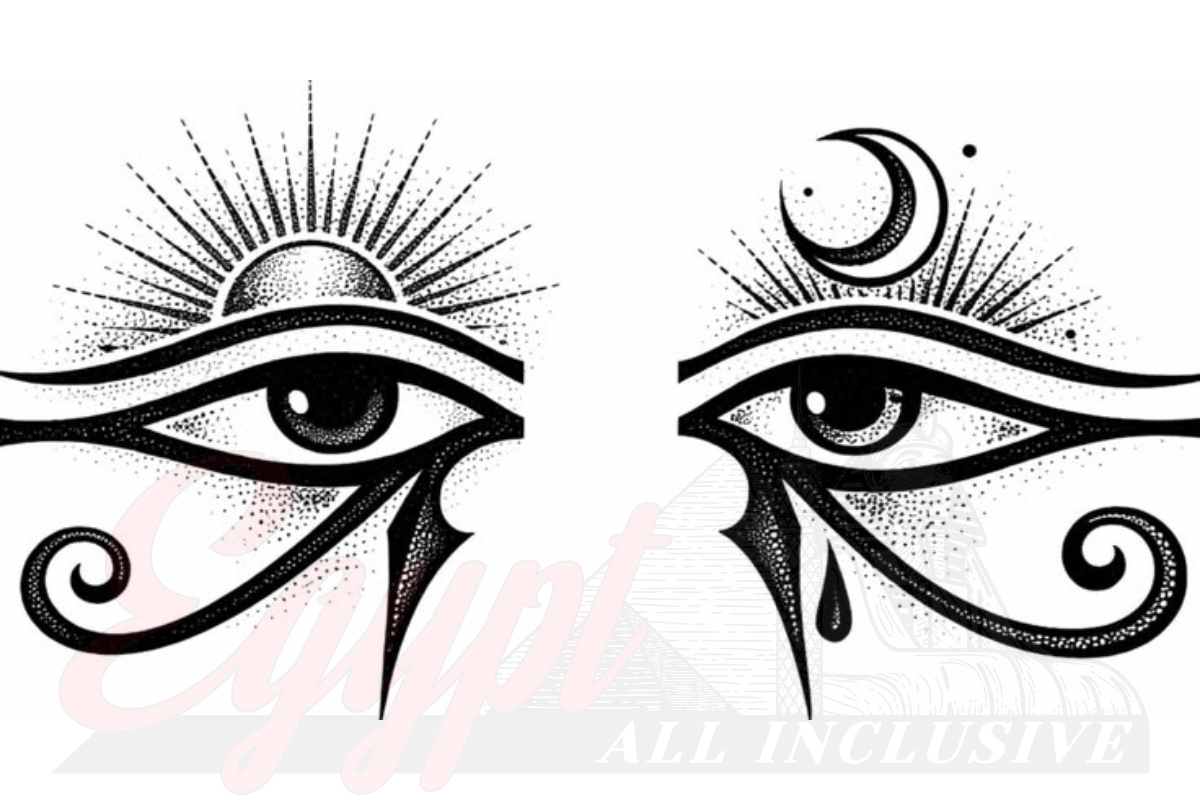
The Eye of Horus Meaning Spiritual
The Eye of Horus meaning spiritual is deeply connected to ancient Egyptian beliefs about protection, healing, balance, and renewal. For thousands of years, the Eye of Horus was considered one of the most powerful symbols in Egypt, representing the restoration of what was damaged and the protection of both the living and the dead. Although the symbol is often recognized today for its beautiful design, its original meaning was rooted in mythology, religion, and the Egyptian understanding of harmony.
The spiritual meaning of the Eye of Horus comes from the ancient story of Horus, the falcon-headed god of kingship and the sky. According to Egyptian mythology, Horus lost his eye during his battle with Seth, the god associated with chaos and conflict. The eye was later restored by Thoth, the god of wisdom and magic. Because the damaged eye was healed, it became a symbol of recovery, completeness, and the ability to overcome difficult experiences.
When asking what does the Eye of Horus mean, the answer goes beyond a simple symbol of protection. Historically, it represented healing, wisdom, health, safety, and spiritual restoration. Ancient Egyptians believed that the restored eye carried protective qualities and could guard against harm. This is why the symbol was commonly placed on amulets, jewelry, coffins, and sacred objects.
The Eye of Horus Amulet and Its Importance
The Eye of Horus amulet was one of the most popular protective objects in ancient Egypt. People wore these amulets because they believed the symbol provided safety, healing, and divine support. Amulets were used by different members of Egyptian society, from ordinary citizens to pharaohs, and were especially important in funerary traditions.
During burial rituals, the Eye of Horus amulet was often placed with the deceased to provide protection during the journey into the afterlife. Egyptians believed that the same power that restored Horus’s eye could also help restore and protect the soul. This connection made the symbol an essential part of Egyptian spiritual and cultural traditions.
Eye of Horus and Eye of Ra: Different Spiritual Meanings
Many people compare the Eye of Rah and Eye of Horus because both symbols have a similar appearance and are among the most famous Egyptian eye symbols. However, their spiritual meanings are different.
The Eye of Horus represents:
- Healing and restoration.
- Personal protection.
- Wisdom and awareness.
- Completeness and recovery.
- Balance after conflict.
The Eye of Ra represents:
- Solar power and divine authority.
- Protection of cosmic order.
- Strength and justice.
- The power of the sun god.
- Defense against chaos.
The comparison between the Eye of Horus and Ra difference shows that these symbols were created from different myths but shared a common purpose: protecting life and maintaining balance.
Eye of Horus vs Eye of Ra: Understanding the Difference
A common question is what’s the difference between the Eye of Horus and the Eye of Ra. The simplest explanation is that the Eye of Horus is connected to healing, while the Eye of Ra is connected to power and protection through divine authority.
The Eye of Horus v Eye of Ra comparison can be summarized as:
| Symbol | Main Meaning | Associated Deity | Main Role |
|---|---|---|---|
| Eye of Horus | Healing, protection, restoration | Horus | Protecting individuals and restoring balance |
| Eye of Ra | Strength, justice, solar power | Ra | Protecting creation and defeating chaos |
Although they have different meanings, neither symbol was considered more important than the other. Ancient Egyptians viewed them as complementary forces that represented different aspects of divine protection.
Horus and Ra Difference in Egyptian Mythology
The diferencia entre Horus y Ra is an important part of understanding these symbols. Horus and Ra were both major Egyptian gods, but they had different roles.
Horus was the god of the sky, kingship, and rightful rule. He represented the living pharaoh and the restoration of order after conflict. Ra was the sun god and creator deity who represented light, creation, and the power that sustained the universe.
The horus ve ra nın farkı (the difference between Horus and Ra) is that Horus focused more on kingship, protection, and restoration, while Ra represented creation, solar energy, and universal authority.
Eyes of Ra and Horus in Ancient Egyptian Beliefs
The eyes of Rah and Horus together represent two important ideas in Egyptian spirituality: strength and healing. The Eye of Ra protected the world from destructive forces, while the Eye of Horus protected individuals and helped restore what had been damaged.
Ancient Egyptians believed that balance was essential for life. This is why both symbols remained important throughout Egyptian history. They reflected the belief that the universe required both powerful protection and the ability to recover from challenges.
The Lasting Spiritual Meaning of the Eye of Horus
Today, the Eye of Horus continues to attract interest around the world. Many people associate it with personal growth, inner strength, protection, and spiritual awareness. While modern interpretations may differ from ancient Egyptian beliefs, they are inspired by the symbol’s original connection to healing and restoration.
For travelers visiting Egypt in 2026, understanding the spiritual meaning of the Eye of Horus adds a deeper perspective when exploring temples, museums, and ancient artifacts. From the Temple of Edfu dedicated to Horus to museum collections displaying ancient amulets, this symbol provides a direct connection to the beliefs and traditions of one of history’s greatest civilizations.
The Eye of Horus is not simply an ancient design—it is a story of recovery, protection, and balance that has survived for more than three thousand years.
What Power Is in the Eye of Horus?
The Egyptian Eye of Horus was believed to hold powerful protective and healing qualities in ancient Egyptian religion. More than a simple artistic symbol, it represented restoration, health, wisdom, and divine protection. Ancient Egyptians believed that the Eye of Horus carried the power to repair what was damaged, protect people from danger, and restore balance after conflict. This belief made it one of the most important sacred symbols in Egyptian history.
To understand what does the Eye of Horus mean, it is necessary to look at the myth behind the symbol. According to ancient Egyptian mythology, Horus, the falcon-headed god of kingship and the sky, lost one of his eyes during his battle with Seth. The eye was later restored by Thoth, the god of wisdom and magic. This act of healing transformed the eye into a symbol of renewal, completeness, and the power to overcome loss.
The power of the Eye of Horus came from this story of restoration. Ancient Egyptians believed that because the eye had been healed, it represented the ability to recover from illness, injury, or hardship. The symbol became associated with protection, good health, and spiritual strength, which is why it appeared on amulets, jewelry, coffins, and sacred objects throughout ancient Egypt.
The Protective Power of the Eye of Horus
One of the most important powers associated with the Egyptian Eye of Horus was protection. Egyptians wore Eye of Horus amulets because they believed the symbol could guard them against danger, negative forces, and misfortune. These protective objects were used by people from all levels of society, including ordinary citizens, soldiers, sailors, and royalty.
The Eye of Horus was especially important in funerary traditions. Ancient Egyptians believed it could protect the deceased during the journey to the afterlife and help restore spiritual balance. For this reason, the symbol was often placed on coffins, burial objects, and mummies.
The Power of Healing and Restoration
The greatest meaning behind the Eye of Horus is its connection to healing. Because Horus’s damaged eye was restored, the symbol became a representation of recovery and completeness. It reminded ancient Egyptians that even after destruction or suffering, balance could be restored.
This idea is one reason the Eye of Horus became associated with medicine and healing practices in ancient Egypt. Some historians connect the symbol with ideas of health, measurement, and restoration, showing how deeply it was connected to the Egyptian understanding of physical and spiritual well-being.
Wisdom and Spiritual Awareness
Beyond physical protection, the Eye of Horus also represented wisdom, vision, and awareness. The eye symbolized the ability to see beyond ordinary appearances and understand deeper truths. Ancient Egyptians connected sight with knowledge, making the Eye of Horus a symbol of intelligence and spiritual understanding.
This meaning explains why the symbol remained important in temples and religious artwork. It represented not only seeing the world but also understanding the hidden forces that shaped life and the universe.
Eye of Horus Meaning vs Eye of Ra
A common question is the Eye of Horus meaning vs Eye of Ra because both symbols look similar and are often confused. However, their meanings developed from different myths.
The Eye of Horus represents:
- Healing and restoration.
- Personal protection.
- Wisdom and completeness.
- Recovery after conflict.
- Health and spiritual balance.
The Eye of Ra represents:
- Solar power and divine authority.
- Justice and strength.
- Protection of the universe.
- The destructive and protective power of the sun.
- The defense of cosmic order.
The difference between these symbols shows two important aspects of Egyptian belief: the Eye of Horus focuses on healing and restoration, while the Eye of Ra focuses on power and protection on a larger cosmic scale.
Eye of Horus vs Eye of Ra Tattoo Meaning
The popularity of the Eye of Horus vs Eye of Ra tattoo comparison comes from the deep meanings associated with both symbols. People often choose the Eye of Horus tattoo because they connect with ideas of protection, healing, resilience, and overcoming challenges.
The Eye of Ra tattoo is usually chosen by those who associate with strength, leadership, confidence, authority, and personal power. Although both designs come from ancient Egypt, their symbolism communicates different messages.
The Connection Between the Ankh and Eye of Ra
The Ankh Eye of Ra combination is another important Egyptian symbol. The ankh represents life and immortality, while the Eye of Ra represents divine protection and the power of the sun. Together, they symbolize life protected by divine strength and the continuation of existence.
Similarly, the Eye of Horus was also combined with the ankh in ancient artwork. These combinations show how Egyptian symbols often worked together to express ideas of protection, life, and spiritual balance.
Eye of Horus and Ra Meaning Together
The Eye of Horus and Ra meaning becomes clearer when both symbols are viewed together. They represent complementary forces within ancient Egyptian spirituality:
- The Eye of Horus restores and heals.
- The Eye of Ra protects and defends.
- Horus represents kingship and recovery.
- Ra represents creation and solar authority.
Together, they express the Egyptian belief that life requires both the power to protect against danger and the ability to restore balance after hardship.
Difference Between Horus and Ra
Understanding the difference between Horus and Ra helps explain the difference between their eye symbols.
Horus was the god of the sky, kingship, and rightful rule. He represented the living pharaoh and the restoration of justice after conflict.
Ra was the sun god and creator deity who represented light, creation, and the force that maintained the universe.
Although both gods were extremely important, their roles were different. Horus focused on protection and kingship, while Ra represented creation, solar power, and cosmic authority.
Eye of Ra and Eye of Horus Meaning
The Eye of Ra and Eye of Horus meaning reflects the balance that was central to ancient Egyptian beliefs. The Eye of Ra symbolized the strength needed to maintain order, while the Eye of Horus symbolized the healing needed to restore harmony.
For travelers exploring Egypt in 2026, understanding these differences makes visits to temples, museums, and archaeological sites more meaningful. Whether seen on ancient walls, royal artifacts, or traditional jewelry, the Eye of Horus remains a powerful reminder of Egypt’s ancient beliefs about protection, healing, and the eternal search for balance.
The Eye of Horus Symbol
The Eye of Horus is one of the most famous symbols of ancient Egypt and one of the most recognizable religious emblems in world history. Known for its distinctive eye shape with markings inspired by a falcon, the symbol represented protection, healing, wisdom, restoration, and balance. For ancient Egyptians, the Eye of Horus was not simply an artistic design—it carried deep religious meaning connected to one of their most important gods.
The story behind the Eye of Horus comes from the myth of Horus and his battle with Seth. Horus, the falcon-headed god of kingship and the sky, fought Seth to avenge his father Osiris and reclaim the rightful throne of Egypt. During this legendary conflict, Horus lost one of his eyes. The eye was later restored by Thoth, the god of wisdom and magic, and this restoration transformed it into a powerful symbol of healing, protection, and completeness.
Because of this myth, the Eye of Horus became a symbol of recovery after hardship. Ancient Egyptians believed that anything damaged could be restored and that balance could return after conflict. This idea made the symbol especially meaningful in Egyptian religion, where maintaining harmony and order was considered essential for life.
The Meaning of the Eye of Horus Symbol
The Eye of Horus symbol carried several important meanings in ancient Egyptian culture, including:
- Protection: Egyptians believed it guarded against danger and harmful forces.
- Healing: The restored eye represented recovery and renewal.
- Wisdom: The eye symbolized knowledge, awareness, and understanding.
- Completeness: It represented the return of balance after loss.
- Spiritual protection: It was believed to safeguard both the living and the dead.
The symbol was commonly placed on amulets, jewelry, coffins, boats, statues, and temple walls. Many ancient Egyptians wore the Eye of Horus as a protective charm because they believed it connected them with divine power and safety.
The Eyes of Horus in Ancient Egyptian Beliefs
The phrase eyes of Horus refers to the sacred symbolism connected with Horus’s vision and divine power. In Egyptian mythology, the eye was not only a physical organ but also a representation of awareness, protection, and spiritual strength.
Ancient Egyptian artwork often showed Horus with the eye symbol to emphasize his ability to see, protect, and restore balance. Because Horus was associated with the sky, his eyes were sometimes connected with celestial forces—the sun and moon—representing the complete vision of the universe.
Ankh With Eye of Horus Meaning
The combination of the ankh with Eye of Horus meaning represents two of the most important ideas in ancient Egyptian symbolism: life and protection.
The ankh, known as the “key of life,” symbolizes:
- Eternal life.
- Immortality.
- The continuation of existence.
The Eye of Horus symbolizes:
- Healing.
- Protection.
- Restoration.
- Divine guidance.
When these two symbols appear together, they express the idea of a life protected by divine forces and supported by balance and renewal. This combination appears frequently in Egyptian temple carvings, religious artwork, jewelry, and museum artifacts.
Eye of Horus and Eye of Ra: Are They the Same?
A common question is whether the Eye of Horus and the Eye of Ra are the same symbol. The answer is no. Although they look similar and are sometimes confused, they come from different myths and represent different forms of divine power.
The Eye of Horus is connected to Horus and represents:
- Healing.
- Restoration.
- Personal protection.
- Health and completeness.
The Eye of Ra is connected to Ra, the sun god, and represents:
- Solar energy.
- Divine authority.
- Justice.
- Protection of the universe.
- The power to defeat chaos.
Understanding the difference between them helps explain why both symbols were important in ancient Egypt. They were not competing symbols but complementary ones, each representing a different aspect of divine protection.
What Does Eye of Ra Mean?
Many people ask what does Eye of Ra mean because it is one of the most powerful symbols in Egyptian mythology. The Eye of Ra represents the active power of the sun god Ra and his ability to protect creation. It symbolizes strength, authority, justice, and the force that maintains balance in the universe.
According to Egyptian myths, the Eye of Ra could act independently from Ra and sometimes appeared as powerful goddesses such as Sekhmet or Hathor. These stories show that the Eye represented both protection and controlled power.
Are Horus and Ra the Same?
Another common question is: Are Horus and Ra the same?
The answer is no. Horus and Ra were different gods with different roles in ancient Egyptian religion.
Horus:
- God of the sky and kingship.
- Son of Osiris and Isis.
- Symbol of the pharaoh’s authority.
- Associated with protection and restoration.
Ra:
- God of the sun and creation.
- Responsible for the daily journey of the sun.
- Symbol of divine power and cosmic order.
However, these gods became connected in later periods of Egyptian history. Some traditions combined them into a single deity called Ra-Horakhty, meaning “Ra-Horus in the Horizon,” showing how Egyptian religious beliefs evolved over time.
Why the Eye of Horus Symbol Still Matters Today
The Eye of Horus continues to fascinate people around the world because it represents timeless ideas: healing after difficulty, protection from danger, and the restoration of balance. Visitors exploring Egypt in 2026 can discover this symbol carved into ancient temples, displayed in museums, and preserved on thousands-year-old artifacts.
From the temples of Luxor and Karnak to the collections of Egyptian museums, the Eye of Horus provides a connection to the beliefs of one of the world’s oldest civilizations. What appears to be a simple eye design carries a powerful story of mythology, protection, and the enduring legacy of ancient Egypt.
The Roles of the Eye of Horus
The Eye of Horus played many important roles in ancient Egyptian religion, mythology, and daily life. It was more than a simple symbol or decorative image; it represented healing, protection, wisdom, restoration, and the return of balance after conflict. For ancient Egyptians, the Eye of Horus carried deep spiritual and cultural importance, appearing in temples, tombs, jewelry, and protective amulets throughout Egyptian history.
Understanding what was the Eye of Horus begins with the famous myth of Horus and Seth. Horus, the falcon-headed god of kingship and the sky, lost one of his eyes during his battle with Seth. The eye was later restored by Thoth, the god of wisdom and magic. Because the damaged eye was healed and made whole again, it became a powerful symbol of recovery, protection, and the ability to overcome challenges.
1. The Eye of Horus as a Symbol of Protection
One of the most important roles of the Eye of Horus was providing protection. Ancient Egyptians believed the symbol could guard people from danger, illness, and negative forces. This belief led to the creation of thousands of Eye of Horus amulets made from materials such as faience, gold, stone, and glass.
These protective objects were worn by ordinary Egyptians as well as royalty. They were placed in homes, carried during journeys, and included in burials because people believed the symbol offered divine protection in both life and the afterlife.
2. The Eye of Horus as a Symbol of Healing and Restoration
The Eye of Horus spiritual meaning is strongly connected with healing and renewal. The story of Horus losing and regaining his eye represented the idea that something damaged could become complete again.
For ancient Egyptians, this represented more than physical healing. It also reflected emotional and spiritual recovery, the restoration of balance, and the belief that life could continue after hardship.
Because of this connection, the Eye of Horus became associated with:
- Recovery after suffering.
- Renewal and rebirth.
- Strength after difficult experiences.
- Restoring harmony and balance.
3. The Eye of Horus in the Afterlife
The Eye of Horus had an important role in Egyptian funerary traditions. Ancient Egyptians believed that protection was necessary during the journey to the afterlife. As a result, the symbol was often placed on coffins, sarcophagi, burial objects, and mummy wrappings.
The purpose was to help protect the deceased and support their transformation into the next life. The restored eye represented the idea that the soul could achieve completeness and continue its journey beyond death.
4. The Eye of Horus and Divine Wisdom
Another important role of the Eye of Horus was representing knowledge and awareness. In Egyptian thought, the eye was connected with the ability to see, understand, and recognize truth.
Because Horus was associated with the sky and divine kingship, his eye became a symbol of vision—not only physical sight but also spiritual awareness and wisdom.
5. Ankh and the Eye of Horus Meaning
The combination of the ankh and the Eye of Horus brought together two powerful Egyptian symbols.
The ankh represented:
- Life.
- Immortality.
- Eternal existence.
- The gift of life from the gods.
The Eye of Horus represented:
- Protection.
- Healing.
- Restoration.
- Divine guidance.
Together, the ankh and the Eye of Horus symbolized life protected by divine power. This combination appeared frequently in temple carvings, religious scenes, jewelry, and ancient Egyptian artwork.
6. The Eye of Horus as a Symbol of Balance
Ancient Egyptian civilization was deeply connected to the idea of balance, known as Ma’at. The Eye of Horus represented the restoration of order after chaos because Horus regained what he had lost.
The symbol reminded Egyptians that balance could return after destruction and that harmony was an essential part of life. This idea explains why the Eye of Horus remained important for thousands of years.
Are Ra and Horus the Same?
A common question is are Ra and Horus the same? The answer is no. Ra and Horus were different gods in ancient Egyptian mythology, although they became connected in later religious traditions.
Horus:
- God of the sky, kingship, and protection.
- Son of Osiris and Isis.
- Represented rightful rule and restoration.
- Connected with the Eye of Horus.
Ra:
- God of the sun and creation.
- Represented solar power and divine authority.
- Responsible for the daily journey of the sun.
- Connected with the Eye of Ra.
Although they were separate gods, Egyptian religion often combined different traditions. In later periods, Ra and Horus were linked through the deity Ra-Horakhty, meaning “Ra-Horus in the Horizon.”
Eye of Horus and Eye of Ra: Different Roles
The Eye of Horus and the Eye of Ra are often compared because they look similar, but their roles were different.
| Eye of Horus | Eye of Ra |
|---|---|
| Connected with Horus | Connected with Ra |
| Represents healing and restoration | Represents power and divine authority |
| Protects individuals | Protects cosmic order |
| Symbolizes recovery and completeness | Symbolizes solar strength and justice |
Together, these symbols show two important aspects of ancient Egyptian belief: the need for healing and the need for protection.
Why the Eye of Horus Remains Important Today
The Eye of Horus continues to be one of the most recognizable symbols of ancient Egypt. Its meaning has survived because it represents universal ideas that people still value today: protection, healing, resilience, and the ability to restore balance after challenges.
For travelers exploring Egypt in 2026, understanding the roles of the Eye of Horus adds deeper meaning to visits to temples, museums, and archaeological sites. From the Temple of Edfu, dedicated to Horus, to ancient artifacts displayed in Egyptian museums, this symbol provides a direct connection to the beliefs and stories of one of the world’s greatest civilizations.
Mythology About The Eye of Horus
The mythology of the Eye of Horus is one of the most famous and meaningful stories in ancient Egyptian religion. The symbol was not simply a representation of an eye; it carried a powerful connection to healing, protection, restoration, and the eternal struggle between order and chaos. The story behind this symbol explains why it became one of the most respected sacred emblems in ancient Egypt and why it remains popular around the world today.
The Eye of Horus Egyptian god connection begins with Horus himself, one of the most important deities in Egyptian mythology. Horus was the falcon-headed god of the sky, kingship, protection, and divine authority. He was the son of Osiris, the god of the afterlife, and Isis, the goddess of magic and motherhood. The story of his eye is closely linked to his battle against Seth, the god associated with chaos and conflict.
According to ancient Egyptian mythology, Seth murdered Osiris and attempted to take control of Egypt. Horus eventually challenged Seth to restore his father’s honor and claim his rightful position as ruler. During their legendary conflict, Seth injured Horus and damaged one of his eyes. Different ancient traditions describe the injury in different ways, but the central idea remains the same: Horus lost his eye during a struggle against chaos.
The damaged eye became known as the original Eye of Horus, and its restoration created the powerful symbolism that influenced Egyptian religion for thousands of years. According to myth, Thoth, the god of wisdom, writing, and magic, restored Horus’s injured eye. The restored eye became a symbol of healing, completeness, and renewal because something broken had been made whole again.
This story is the foundation of the Eye of Horus meaning. For ancient Egyptians, the symbol represented much more than physical sight. It represented the restoration of balance, the return of harmony after conflict, and the protection provided by divine forces. Because Horus recovered what he had lost, Egyptians viewed the symbol as a powerful reminder that recovery and renewal were always possible.
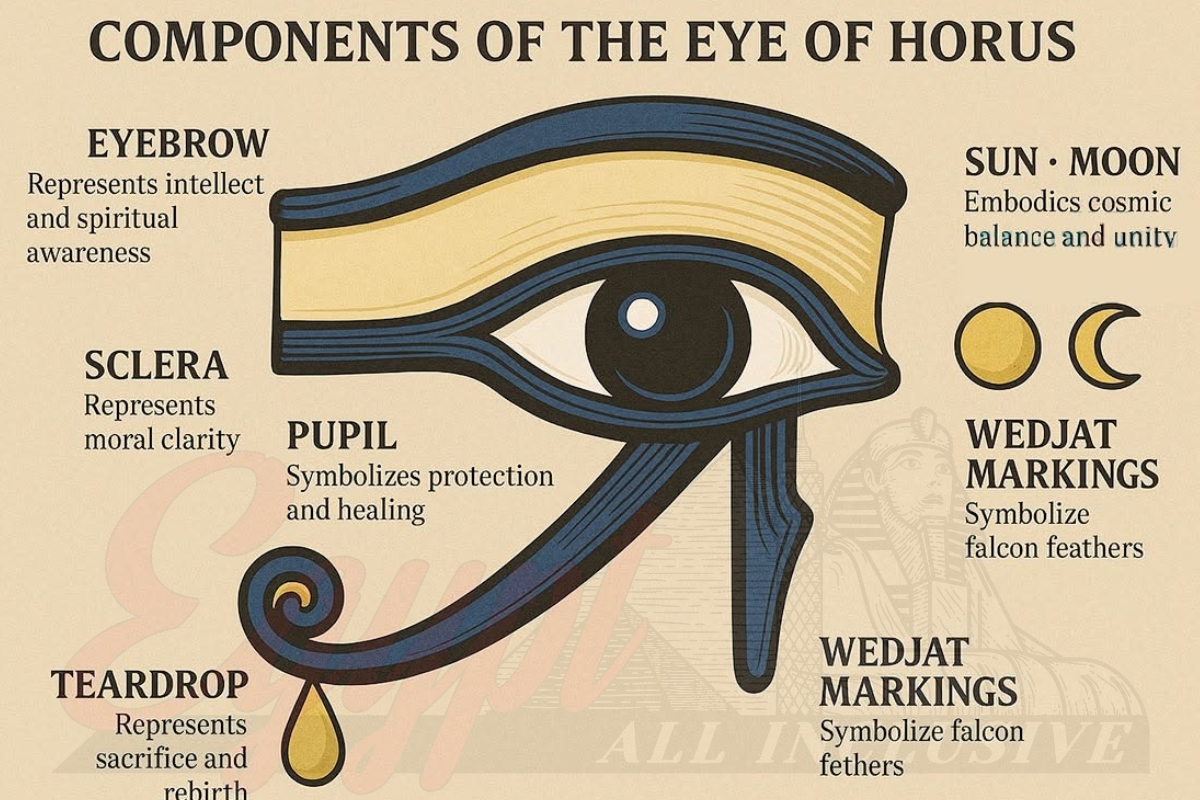
The Spiritual Meaning of the Eye of Horus
The Eye of Horus meaning spiritual is closely connected to protection, wisdom, healing, and inner balance. Ancient Egyptians believed that the eye carried protective qualities because it had been restored through divine power. This belief led to the widespread use of Eye of Horus amulets, which were worn or placed with the dead to provide safety and guidance.
Spiritually, the Eye of Horus represented:
- Healing: The ability to recover after physical or emotional damage.
- Protection: A divine shield against danger and negative forces.
- Wisdom: The ability to understand hidden truths and see beyond appearances.
- Balance: The restoration of harmony after disorder.
- Renewal: The idea that life can continue after loss or transformation.
These meanings explain why the symbol remained important in temples, tombs, and everyday Egyptian life.
The Eye of Horus in Ancient Egyptian Religion
The Eye of Horus became one of the most widely used symbols in ancient Egypt. It appeared on:
- Protective amulets.
- Royal jewelry.
- Temple walls.
- Tomb decorations.
- Coffins and burial objects.
- Religious manuscripts.
Ancient Egyptians believed that the symbol could protect both the living and the deceased. In funerary traditions, the Eye of Horus was especially significant because it represented restoration and safety during the journey to the afterlife.
The symbol was also connected with the idea of completeness. Since Horus’s eye was restored after being damaged, it represented the belief that a person could achieve wholeness and renewal even after experiencing hardship.
The Original Eye of Horus and Its Symbolism
The original Eye of Horus refers to the mythological eye that Horus lost and later regained. It became known as a symbol of perfection because its restoration represented the return of something incomplete to a complete state.
Ancient Egyptians used this story to express important ideas about life and existence. They believed that destruction was not always the end; through divine power and balance, restoration could occur. This idea was central to Egyptian beliefs about nature, kingship, and the afterlife.
The Eye of Horus and Egyptian Protection
The mythology surrounding the Eye of Horus made it one of the most popular protective symbols in Egyptian history. People believed it could guard against illness, accidents, and harmful influences. Sailors sometimes placed the symbol on their boats, while families used it in homes and personal items.
The symbol’s protective role was also important for Egyptian kings. Pharaohs associated themselves with Horus because they were considered his earthly representatives. Displaying the Eye of Horus reinforced the connection between royal power and divine protection.
The Difference Between Myth and Modern Interpretations
Today, the Eye of Horus is often associated with spirituality, intuition, and personal growth. Many modern interpretations connect it with awareness, inner strength, and protection. However, these meanings are modern reflections inspired by ancient Egyptian beliefs rather than exact representations of historical religious practices.
The original Egyptian meaning focused primarily on healing, restoration, divine protection, and maintaining balance.
Why the Eye of Horus Myth Still Matters in 2026
The mythology of the Eye of Horus continues to attract historians, travelers, and visitors exploring Egypt because it reveals how ancient Egyptians understood life, death, and the universe. Seeing the symbol carved into temples or displayed in museums becomes more meaningful when visitors understand the story behind it.
From the Temple of Edfu, one of Egypt’s best-preserved temples dedicated to Horus, to ancient artifacts found throughout the country, the Eye of Horus remains a powerful reminder of a civilization that valued healing, protection, and balance.
The story of the Eye of Horus has survived for more than three thousand years because its message remains universal: even after loss or destruction, restoration and renewal are possible.
Which Symbol Resonates with You Between the Eyes of Horus and Ra? (2026 Guide)
Choosing between the Eye of Horus and the Eye of Ra often depends on which qualities a person connects with most. Both are powerful Egyptian eye symbols, but they represent different ideas within ancient Egyptian mythology. The Eye of Horus is associated with healing, restoration, wisdom, and personal protection, while the Eye of Ra represents strength, authority, justice, and the protective power of the sun.
Understanding the Eye of Ra vs Eye of Horus meaning helps explain why these symbols continue to attract interest today. They are not symbols of good versus evil or opposing forces. Instead, they represent two different forms of divine power that ancient Egyptians believed were necessary to maintain balance in life and the universe.
Eye of Horus vs Eye of Ra Meaning: The Main Difference
The most important difference between the Eye of Horus vs Eye of Ra is the source of their mythology and the type of power they represent.
The Eye of Horus comes from the story of Horus, the falcon-headed god who lost his eye during his battle with Seth. After the eye was restored by Thoth, it became a symbol of healing, recovery, protection, and completeness.
The Eye of Ra comes from myths surrounding Ra, the sun god and creator deity. His Eye represented an active force that defended creation, punished disorder, and maintained cosmic balance.
A simple comparison:
| Symbol | Associated God | Main Meaning | Represents |
|---|---|---|---|
| Eye of Horus | Horus | Healing and restoration | Protection, wisdom, recovery, balance |
| Eye of Ra | Ra | Strength and authority | Solar power, justice, protection, leadership |
The Eye of Horus: A Symbol of Healing and Protection
The Eye of Horus is often chosen by people who connect with ideas of recovery, transformation, and overcoming challenges. Because Horus regained what he lost, the symbol represents the ability to become whole again after difficult experiences.
The Eye of Horus is commonly associated with:
- Healing after hardship.
- Protection from danger.
- Wisdom and awareness.
- Spiritual balance.
- Renewal and restoration.
In ancient Egypt, people wore Eye of Horus amulets because they believed they offered protection and helped preserve health. The symbol was also placed in tombs and burial objects to protect the deceased during the journey to the afterlife.
The Eye of Ra: A Symbol of Power and Divine Strength
The Eye of Ra meaning is connected with the power of the sun god and his role as a protector of the universe. Unlike the Eye of Horus, which focuses on restoration, the Eye of Ra represents active strength and the ability to defend order against chaos.
The eyes of Ra were considered powerful forces connected with:
- The energy of the sun.
- Divine authority.
- Justice and judgment.
- Protection of creation.
- Strength against enemies.
In Egyptian mythology, the Eye of Ra could appear as powerful goddesses such as Sekhmet or Hathor. These stories show that the Eye represented both protection and controlled power.
Is the Eye of Ra Evil?
A common modern question is: Is the Eye of Ra evil?
The answer is no. Ancient Egyptians did not consider the Eye of Ra an evil symbol. Although myths describe the Eye as fierce and capable of destruction, its purpose was to protect divine order and defeat forces that threatened harmony.
The Eye of Ra represented justice and protection, not evil. Its destructive power was directed toward restoring balance, which was a central belief in ancient Egyptian religion.
Eye of Ra Tattoo Meaning
The Eye of Ra tattoo meaning is often connected with strength, confidence, protection, and personal power. People who choose this design may be attracted to the symbol because it represents leadership, courage, and the ability to overcome challenges.
However, tattoo meanings today can vary from the original ancient Egyptian interpretation. While modern wearers may associate it with personal beliefs or identity, its historical roots remain connected to Ra’s divine authority and protective power.
Horus and Ra: Are They Connected?
The relationship between Horus and Ra is an important part of Egyptian mythology. They were different gods with different roles, but they became connected in later periods.
Horus represented:
- Kingship.
- The sky.
- Protection.
- Restoration.
Ra represented:
- The sun.
- Creation.
- Divine authority.
- Cosmic order.
Later traditions combined their identities in the form of Ra-Horakhty, meaning “Ra-Horus in the Horizon.” This shows how Egyptian religion evolved by connecting different divine traditions.
The Eye of Ra vs Horus: Which One Is More Powerful?
The comparison of the Eye of Ra vs Horus is not about deciding which symbol is stronger. Ancient Egyptians viewed them as different expressions of divine power.
The Eye of Horus represents the power to heal and restore.
The Eye of Ra represents the power to protect and enforce order.
One focuses on recovery, while the other focuses on strength and defense. Together, they reflect the Egyptian belief that life requires both healing and protection.
Eyes of Rah: Another Name for the Eye of Ra
Some people search for eyes of Rah, using an alternative spelling of Ra. Historically, this refers to the same concept: the powerful eyes associated with the sun god Ra. The spelling variation does not change the meaning or symbolism.
The Eye of Ra remains one of the most recognized symbols of ancient Egypt, representing divine protection, solar energy, and the authority of the gods.
Which Symbol Resonates With You?
Choosing between these symbols depends on the qualities that speak to you:
The Eye of Horus may resonate with you if you value:
- Healing and personal growth.
- Recovery after challenges.
- Wisdom and understanding.
- Protection and balance.
The Eye of Ra may resonate with you if you value:
- Strength and confidence.
- Leadership and authority.
- Courage and protection.
- Justice and determination.
For travelers exploring Egypt in 2026, understanding the difference between these symbols adds deeper meaning to visits to temples, museums, and ancient sites. Whether you connect more with the Eye of Horus or the Eye of Ra, both symbols represent the remarkable beliefs of a civilization that valued balance, protection, and the enduring power of life.
What Is the Difference Between the Eye of Ra and the Eye of Horus?
The Eye of Horus vs Eye of Ra is one of the most common comparisons when exploring ancient Egyptian symbols. Although both symbols look similar and are connected to powerful Egyptian gods, they have different origins, meanings, and roles in mythology. The Eye of Horus represents healing, restoration, protection, and completeness, while the Eye of Ra represents solar power, authority, justice, and the protection of cosmic order.
Understanding the difference between these two symbols helps travelers, history enthusiasts, and anyone interested in Egyptian culture appreciate their true meanings beyond their similar appearance.
Eye of Horus vs Ra: Origin and Mythology
The Eye of Horus vs Ra difference begins with their myths.
The Eye of Horus comes from the story of Horus, the falcon-headed god of kingship and the sky. According to Egyptian mythology, Horus fought Seth after the death of his father Osiris. During their battle, Horus lost one of his eyes. The god Thoth later restored the damaged eye, transforming it into a symbol of healing, renewal, and protection.
The Eye of Ra comes from the mythology of Ra, the ancient Egyptian sun god and creator deity. His Eye was considered an active extension of his power, capable of protecting the universe, punishing enemies, and restoring order when chaos threatened creation.
Eye of Horus vs Eye of Ra Meaning
The Eye of Horus vs Eye of Ra meaning can be understood by looking at what each symbol represents.
Eye of Horus Meaning:
The Eye of Horus represents:
- Healing after loss.
- Restoration and renewal.
- Personal protection.
- Wisdom and awareness.
- Balance and completeness.
Because Horus regained his damaged eye, the symbol became a reminder that broken things can be restored and that recovery is possible after hardship.
Eye of Ra Meaning:
The Eye of Ra represents:
- The power of the sun.
- Divine authority.
- Strength and courage.
- Justice and judgment.
- Protection of the universe.
The Eye of Ra was a force that defended creation and maintained the balance between order and chaos.
Egyptian Eye of Horus vs Ra: Main Differences
The Egyptian Eye of Horus vs Ra comparison can be summarized in the following table:
| Feature | Eye of Horus | Eye of Ra |
|---|---|---|
| Associated God | Horus | Ra |
| Main Symbolism | Healing and restoration | Power and protection |
| Mythological Origin | Horus losing and regaining his eye | Ra’s divine solar power |
| Main Role | Protecting individuals | Protecting creation |
| Represents | Recovery, health, wisdom | Strength, justice, authority |
| Common Use | Amulets and personal protection | Royal and temple symbolism |
Eye of Horus vs Eye of Ra Tattoo Meaning
The popularity of the Eye of Horus vs Eye of Ra tattoo comes from the deep meanings associated with both ancient symbols. Many people choose these designs because they represent powerful personal ideas.
Eye of Horus Tattoo Meaning
An Eye of Horus tattoo is often associated with:
- Protection from negative influences.
- Healing and personal transformation.
- Overcoming challenges.
- Wisdom and spiritual awareness.
- Finding balance in life.
People who choose the Eye of Horus often connect with its message of recovery and renewal.
Eye of Ra Tattoo Meaning
An Eye of Ra tattoo is commonly associated with:
- Strength and confidence.
- Leadership and authority.
- Courage and determination.
- Protection and power.
- Personal energy and resilience.
Historically, the Eye of Ra represented the protective power of the sun god rather than an evil force.
Eye of Ra vs Horus: Which Symbol Is More Powerful?
The comparison of Eye of Ra vs Horus is not about one symbol being stronger than the other. Ancient Egyptians viewed them as different expressions of divine power.
The Eye of Horus represented the ability to heal, restore, and protect individuals.
The Eye of Ra represented the ability to defend creation, enforce justice, and maintain universal order.
Together, they reflected the Egyptian belief that both healing and strength were necessary to maintain balance.
Eyes of Horus vs Eye of Ra: Are They Connected?
The eyes of Horus vs Eye of Ra are connected because both symbols reflect the importance of vision, protection, and divine power in Egyptian culture. Ancient Egyptians viewed the eye as more than a physical organ—it represented awareness, knowledge, and the presence of the gods.
However, they remained separate symbols with different meanings:
- The Eye of Horus focuses on restoration.
- The Eye of Ra focuses on protection through power.
- The Eye of Horus protects individuals.
- The Eye of Ra protects cosmic order.
The Eye of Horus vs The Eye of Ra in Ancient Egypt
The Eye of Horus vs the Eye of Ra comparison shows two important sides of Egyptian spirituality.
The Eye of Horus reflects the human experience of suffering, healing, and becoming whole again. Its story is about recovery and renewal.
The Eye of Ra reflects divine strength and authority. Its story is about defending life, maintaining justice, and protecting the universe.
Both symbols were respected and widely used throughout ancient Egyptian history.
Conclusion: Eye of Horus vs Eye of Ra Meaning (2026)
The Eye of Horus vs Eye of Ra meaning reveals two powerful but different symbols from ancient Egypt. The Eye of Horus represents healing, restoration, wisdom, and personal protection, while the Eye of Ra represents solar power, authority, justice, and divine protection.
The Eye of Ra vs Eye of Horus comparison is not a battle between two symbols. Instead, they represent complementary forces that ancient Egyptians believed were essential: the power to protect and the ability to restore.
The Eye of Ra vs Horus and the Eye of Horus vs the Eye of Ra continue to fascinate people around the world because they preserve the beliefs, stories, and wisdom of one of history’s greatest civilizations.