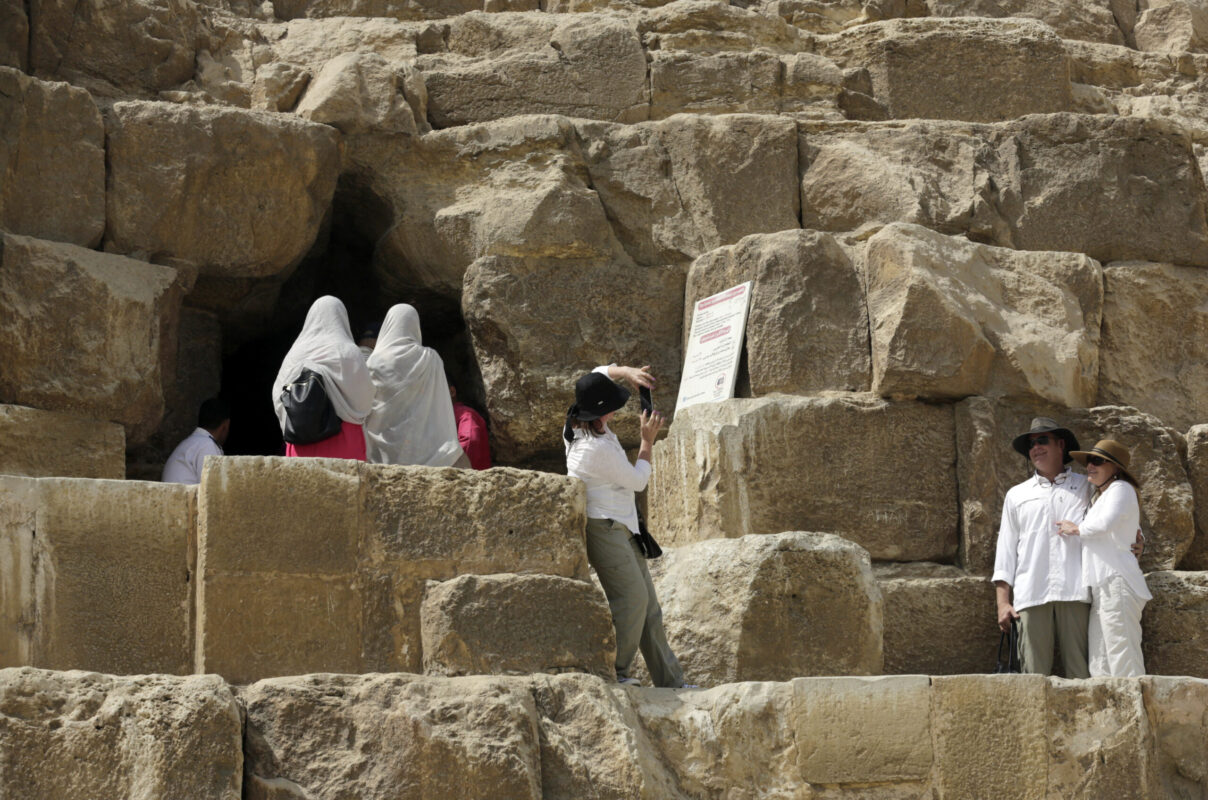
Can you go inside the pyramids in 2027? YES, you absolutely can. Visitors can enter three of the Giza pyramids, including the Great Pyramid of Khufu, and climb down narrow passages into the burial chambers where pharaohs were laid to rest over 4,500 years ago.
In four lines: yes, entry is open and confirmed for 2026 and 2027; only Khufu, Khafre, and Menkaure offer public access, each with a separate ticket; the experience involves narrow, low-ceilinged tunnels that are not suitable for everyone; and booking ahead through a licensed Egypt tour operator like Egypt All Inclusive is the easiest way to guarantee your spot, your Egyptologist guide, and skip-the-line entry during peak season.
If you’ve been searching “can you go inside the great pyramid of Giza,” “which pyramid can you go inside,” or “inside the pyramids of Giza,” you’re in exactly the right place.
This guide answers every question a traveler planning a 2026 or 2027 trip to Egypt could possibly have, written by a team that has organized pyramid tours for thousands of guests.
We’ll walk through which pyramids you can enter, what it actually feels like inside, ticket prices, the best private-access experiences (including the rare Osiris Shaft and the Sphinx’s little-known internal chamber), and insider tips that most other websites simply don’t mention.
By the end of this article, you won’t just know the answer to “can you go inside the pyramids” — you’ll know exactly how to plan the visit, what to wear, when to go, and how to book it so your trip to the pyramids of Giza becomes the highlight of your entire Egypt itinerary.
Can You Go Inside the Pyramids? The Short Answer
Let’s settle this right away, because it’s the question that brought you here.
Yes, you can go inside the pyramids in Egypt — but not all of them, and not in the way most people picture from movies. At the Giza Plateau, three pyramids stand open to visitors on any given day: the Great Pyramid of Khufu (also called Cheops), the Pyramid of Khafre, and the smaller Pyramid of Menkaure. Each requires its own separate entry ticket, purchased in addition to the general Giza Pyramids admission ticket.
Inside, there are no painted hieroglyphic walls like you’d find in the Valley of the Kings. The interior of the pyramids is intentionally plain — bare limestone or granite corridors built purely to protect the burial chamber and confuse tomb robbers. What you’re paying for isn’t decoration; it’s the experience of physically standing inside a structure that has stood for more than four and a half thousand years, walking the same passages that ancient priests and, later, medieval explorers once walked.
Quick facts most visitors want to know:
| Question | Answer |
|---|---|
| Can you go inside the Great Pyramid of Giza? | Yes, with a separate ticket, limited daily entries |
| Can you go inside all three Giza pyramids in one day? | Yes, if you buy all three tickets and have enough time |
| Is it safe? | Yes, though passages are narrow, hot, and low |
| Is it good for claustrophobic travelers? | Generally not recommended |
| Do you need a guide? | Not required, but strongly recommended for context and smoother access |
| Can children go inside? | Allowed, but the crouched walk can be tough for younger kids |
The interior visit typically lasts between 20 and 40 minutes depending on the pyramid and how busy it is. It is physically demanding in short bursts — expect to bend at the waist for a stretch of the entrance corridor — but it does not require any special fitness beyond basic mobility.
Tip: If this is your first time in Egypt and you only have time or budget for one pyramid interior, choose the Great Pyramid of Khufu. It’s the tallest, the most historically significant, and the one every traveler wants to say they’ve stood inside.
One thing that surprises first-time visitors: the pyramids you see in postcards, glowing gold at sunset with the Sphinx in the foreground, are the exact same pyramids you can walk into. This isn’t a roped-off monument you only view from outside — Giza is one of the few ancient wonders on Earth where you can still physically enter the original structure.
Can You Go Inside the Great Pyramid of Giza? Everything About Visiting Khufu’s Pyramid
This is the single most searched question about the Giza Plateau, and for good reason. The Great Pyramid of Giza — built for Pharaoh Khufu around 2560 BCE — is the last surviving wonder of the ancient world, and standing inside it is genuinely one of the most memorable things you can do in Egypt.
So, can you go inside the Great Pyramid of Khufu? Yes. It remains open to the public in 2026 and 2027, though access is more limited than it once was. Egyptian antiquities authorities cap the number of daily entries to protect the structure from humidity damage caused by visitors’ breath, so tickets can sell out, especially during peak travel months like October through April.
What the Entrance Experience Is Really Like
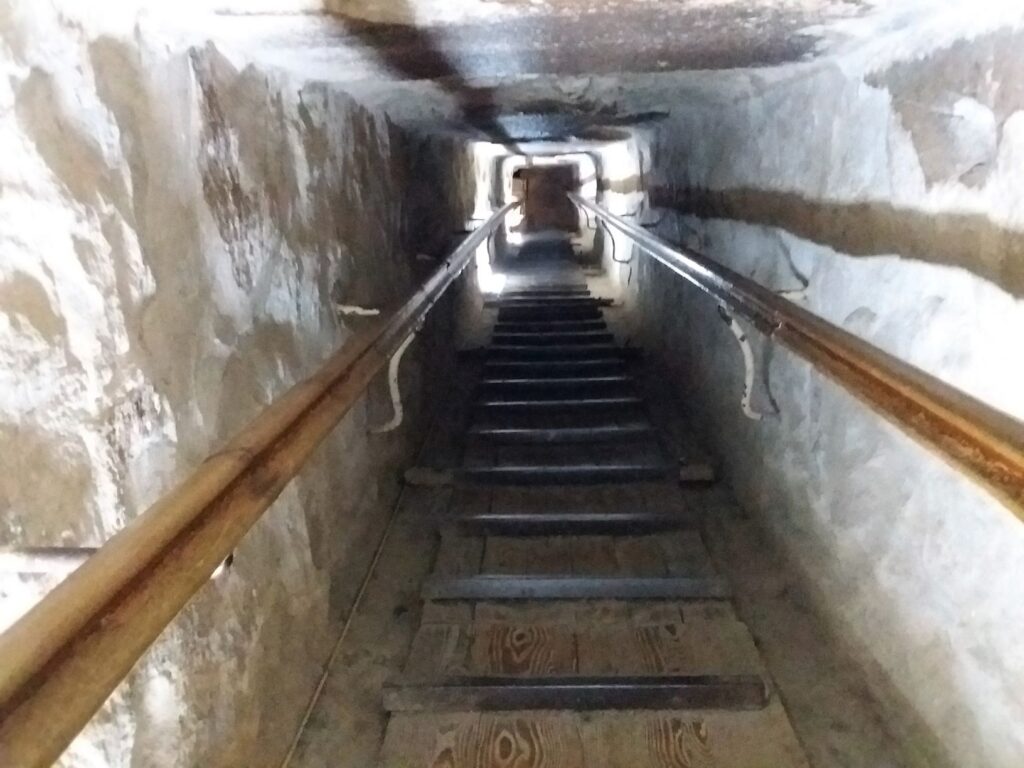
Entry is through the Robbers’ Tunnel, a passage cut by 9th-century caliph Al-Ma’mun’s men searching for treasure, rather than the pyramid’s original sealed entrance higher up the face. From there, visitors climb through the Ascending Passage — a corridor roughly 1.2 meters (about 4 feet) high, meaning most adults will need to walk in a crouched or bent position for several minutes.
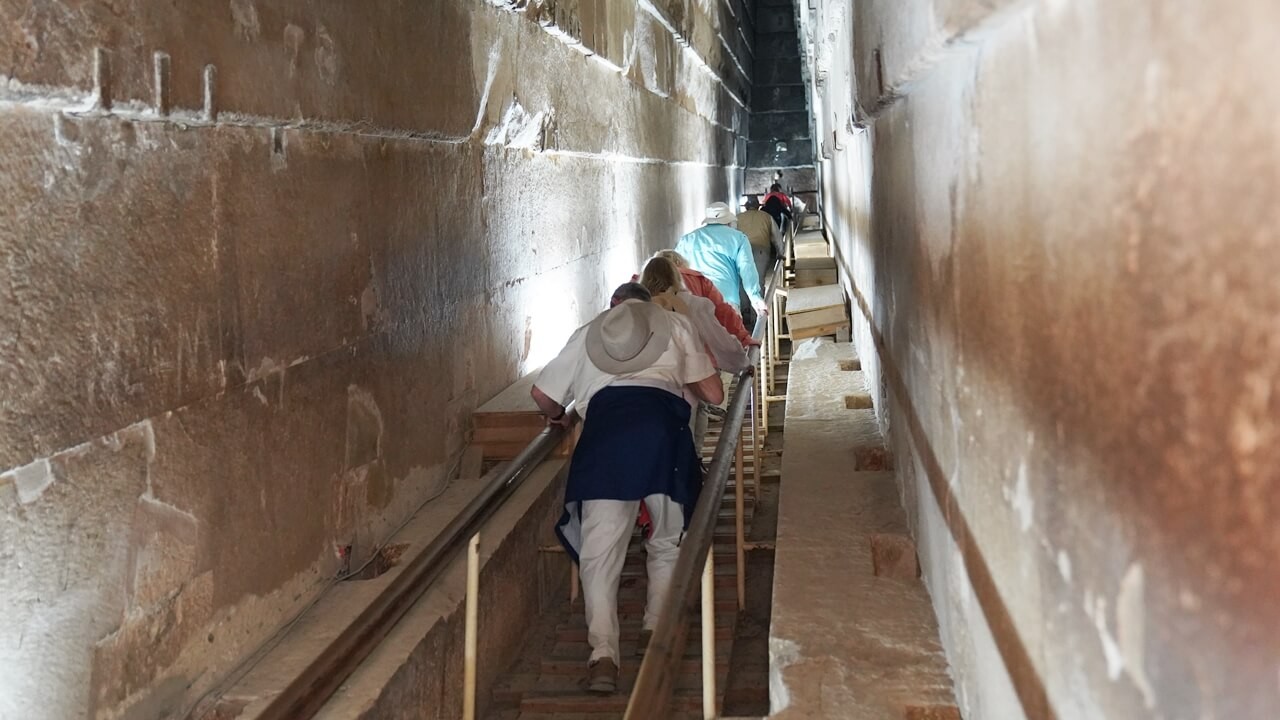
The passage opens into the Grand Gallery, a soaring corbelled corridor over 8 meters (26 feet) tall, which is genuinely breathtaking and one of the most impressive pieces of ancient engineering anywhere in the world. From the Grand Gallery, a short final passage leads to the King’s Chamber, a room built entirely from red Aswan granite, containing Khufu’s massive empty granite sarcophagus. The chamber is bare, cool relative to outside, and surprisingly large — big enough for a dozen or more visitors to stand comfortably.
Some tours also include access to the lower Queen’s Chamber, though this is not always open and its purpose remains debated by Egyptologists to this day.
| Feature | Detail |
|---|---|
| Built for | Pharaoh Khufu (Cheops), 4th Dynasty |
| Height | 146.6 meters originally (now ~138.5 m) |
| Interior highlight | Grand Gallery and King’s Chamber |
| Entry ticket cost (2026/2027) | Separate from general Giza ticket, roughly 700–900 EGP for foreigners (subject to change) |
| Daily visitor cap | Limited, often around 300 tickets split into morning/afternoon sessions |
| Best time to enter | Early morning, right at opening |
Tip: Buy your Great Pyramid interior ticket first thing in the morning at the ticket office near the pyramid, or better yet, have a licensed guide secure it for you in advance. Tickets are sold on-site only, in limited quantities, and they routinely run out by midday during high season.
If you take away one thing from this section: yes, you can go inside the Great Pyramid of Giza, it is not overrated, and it deserves to be the anchor of your Giza Plateau visit.
Which Pyramid Can You Go Inside? Comparing Khufu, Khafre, and Menkaure
A common follow-up question is “which pyramid can you go inside” — because many travelers don’t realize that Giza has three major pyramids, and each one offers a completely different interior experience, price, and difficulty level.
The Great Pyramid of Khufu (Cheops)
Covered in detail above, this is the largest, most famous, and most expensive to enter. It offers the tallest interior chamber (the Grand Gallery) and the most historically significant burial chamber.
The Pyramid of Khafre
Khafre’s pyramid is the second-largest at Giza and, because of its slightly higher elevation and the limestone casing still visible near its peak, it can actually look taller than Khufu’s from certain angles. Its interior is simpler: a single straight descending passage leading to a burial chamber cut partly into bedrock. There’s less to see structurally compared to Khufu, but it’s usually far less crowded, and the ticket is cheaper.
The Pyramid of Menkaure
The smallest of the three main pyramids, Menkaure’s interior involves a steeper, more physically demanding descent, followed by a small but atmospheric burial chamber with decorative wall paneling — a rare interior detail among the Giza pyramids. It’s the least visited of the three, which means a quieter, more personal experience.
| Pyramid | Difficulty | Interior Highlight | Crowd Level | Best For |
|---|---|---|---|---|
| Khufu (Great Pyramid) | Moderate | Grand Gallery, King’s Chamber | High | First-time visitors, history lovers |
| Khafre | Easy–Moderate | Simple descending passage | Low–Medium | Travelers short on time |
| Menkaure | Moderate–Hard | Decorated burial chamber | Very Low | Repeat visitors, photographers |
Tip: If you have a full day at the Giza Plateau and want to compare all three, start with Khufu early in the morning when the line is shortest, move to Khafre mid-morning, and finish with Menkaure, which rarely has a queue at all.
Many guests ask which one is “worth it” if they can only pick one. Our honest, experience-based answer: choose Khufu for the bragging rights and scale, choose Menkaure if you’ve already done Khufu on a previous trip and want something quieter, and choose Khafre if your main goal is simply saying you’ve been inside a pyramid without spending extra time or money.
Inside the Pyramids of Giza: What You’ll Actually See (Room by Room)
Search terms like “inside pyramid of Giza” and “inside the great pyramids of Egypt” tell us that most travelers want a realistic preview before they go — not marketing fluff, but an honest walkthrough of what’s actually inside.
The Entrance Corridor
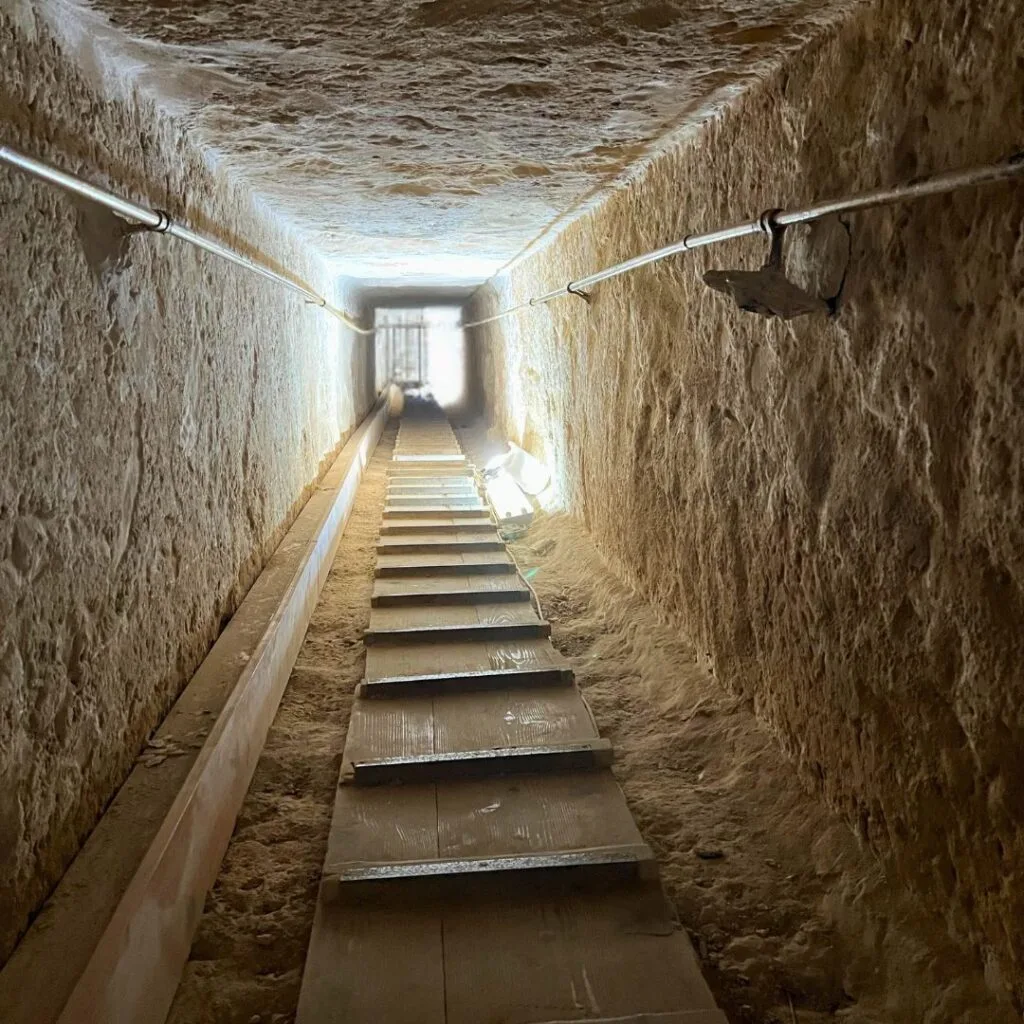
Every pyramid interior begins the same way: a steep, narrow passage descending or ascending into the structure. Ceiling height in these entry corridors is typically under 1.5 meters, so expect to duck. Wooden ramps and handrails have been installed in most sections to make footing easier, and lighting is dim but sufficient.
The Grand Gallery (Khufu Only)
This is the showstopper. Rising nearly 9 meters with a corbelled ceiling built from precisely cut limestone blocks, the Grand Gallery is one of the finest examples of ancient stonework anywhere on Earth. Wooden ramps with side grooves — believed to have guided the granite blocks used to seal the King’s Chamber — are still visible along the floor.
The King’s Chamber
A rectangular room lined entirely in polished red granite, containing Khufu’s sarcophagus (lid missing, believed removed or destroyed centuries ago). The air is noticeably different here — cooler and drier than outside, and many visitors describe an odd sense of stillness. Acoustically, the room has a subtle natural resonance that tour guides sometimes demonstrate.
The Queen’s Chamber
Located lower and smaller than the King’s Chamber, this room’s true function remains a mystery — it may never have been intended for a queen at all. Two narrow shafts lead from this chamber toward the pyramid’s exterior; their purpose is still debated among Egyptologists, ranging from ventilation to symbolic “star shafts” aligned with specific constellations.
Inside Khafre and Menkaure
Khafre’s interior is more austere: a single descending passage into a rock-cut chamber with a plain granite sarcophagus base. Menkaure’s chamber is smaller but includes carved wall paneling, a rare decorative touch among Giza’s pyramid interiors, added during a later restoration attempt by Menkaure’s son.
What you will NOT see inside any Giza pyramid:
- Painted hieroglyphics or colorful wall art (these are found in tombs in the Valley of the Kings, not the pyramids)
- Mummies (removed centuries ago; Khufu’s mummy has never been found)
- Treasure or artifacts (looted in antiquity)
- Air conditioning (interiors are naturally cool but can feel humid and warm with crowds)
Tip: Bring a small flashlight or use your phone’s light. Interior lighting is functional but dim, and having your own light source makes reading inscriptions and seeing wall texture much easier.
Knowing exactly what’s inside beforehand means you’ll walk in prepared rather than confused, and you’ll get far more out of the fifteen minutes you spend inside the King’s Chamber than someone who didn’t do their research.
Where Are the Pyramids in Egypt? Cheops Pyramid Location and How to Get There
If you’re asking “where are the pyramids in Egypt” or specifically searching “Cheops pyramid location,” here’s exactly what you need to know for planning your 2026 or 2027 trip.
The Giza Pyramid Complex sits on the Giza Plateau, on the western edge of Cairo, roughly 9 kilometers (5.6 miles) southwest of the city center and about 25–30 minutes from most downtown Cairo hotels depending on traffic. It is not, contrary to what some travelers imagine, out in a remote desert — it borders the modern city directly, which is part of what makes the view of pyramids rising behind Cairo apartment blocks so surreal.
The Great Pyramid of Khufu (Cheops) itself sits at coordinates approximately 29.9792° N, 31.1342° E, at the northeastern corner of the plateau, closest to the main entrance gate. Khafre’s pyramid sits just southwest of it, and Menkaure’s smaller pyramid completes the trio further southwest, with the Great Sphinx positioned near Khafre’s valley temple.
| Location Detail | Information |
|---|---|
| Region | Giza Governorate, Egypt |
| Distance from Cairo center | ~9 km / 5.6 miles |
| Distance from Cairo Airport | ~30–35 km / 35–45 minutes by car |
| Nearest city | Giza (part of Greater Cairo metro area) |
| GPS (Great Pyramid) | 29.9792° N, 31.1342° E |
| Opening hours | Typically 8:00 AM–4:00/5:00 PM (seasonal) |
How to Get to the Pyramids
- Private car/driver: The most comfortable and recommended option, especially when booked through a licensed agency that includes an Egyptologist guide.
- Uber/Careem: Widely available in Cairo and can be booked directly to the Giza gate.
- Cairo Metro + taxi: Take the metro to Giza or El-Omraneya station, then a short taxi ride to the plateau.
- Organized tour: Most day tours combine Giza with Saqqara or the Egyptian Museum/Grand Egyptian Museum.
Tip: Traffic between downtown Cairo and Giza can be unpredictable, especially in the late afternoon. If your flight or schedule is tight, always add a 30-minute buffer, and consider visiting the pyramids first thing in the morning before the city fully wakes up — you’ll also get better light for photos and shorter lines for pyramid interior tickets.
Understanding the pyramid location also helps explain why Giza is so easy to combine with other sites — the Grand Egyptian Museum sits just a few minutes from the plateau, making it simple to build a full day around the pyramids, the Sphinx, and Egypt’s newest world-class museum in a single, well-organized itinerary.
Can You Go Inside the Egyptian Pyramids Outside Giza? Saqqara and Dahshur
Most travelers searching “can you go inside the Egypt pyramids” are picturing Giza, but Egypt has more than a hundred pyramids scattered across the country, and several outside Giza also allow interior access — often with far fewer crowds.
Saqqara: The Step Pyramid of Djoser
Located about 30 km south of Giza, Saqqara is home to the Step Pyramid of Djoser, the oldest large-scale stone monument in the world, built roughly 4,700 years ago — even older than the Giza pyramids.
In recent years, after extensive restoration, limited interior access to its underground burial chambers and tunnels has reopened for visitors, offering a completely different experience: narrower, older, and far less commercialized than Giza.
Dahshur: The Bent Pyramid and Red Pyramid
Dahshur, about 40 km south of Cairo, is one of Egypt’s most underrated sites and a favorite among repeat visitors and photographers.
- The Red Pyramid, Egypt’s first successful true smooth-sided pyramid, is fully open for interior visits, and its entrance passage and chambers are actually roomier than Khufu’s, making it a more comfortable option for travelers concerned about tight spaces.
- The Bent Pyramid, famous for its unusual double-angled shape, has more restricted interior access but is being progressively opened to visitors as restoration work continues.
| Site | Distance from Cairo | Interior Access | Crowd Level | Notable For |
|---|---|---|---|---|
| Saqqara (Djoser) | ~30 km | Limited/seasonal | Low | Oldest stone pyramid on Earth |
| Dahshur – Red Pyramid | ~40 km | Yes, fully open | Very low | Roomiest interior of any Egyptian pyramid |
| Dahshur – Bent Pyramid | ~40 km | Partial | Very low | Unique double-slope design |
Tip: If you already went inside the Great Pyramid on a previous trip to Egypt, add Dahshur to your 2026 itinerary. The Red Pyramid interior is often described by return visitors as more comfortable and, surprisingly, more atmospheric than Giza simply because you might be the only group inside.
Saqqara and Dahshur are easily combined into a single day trip, often paired with a visit to Memphis, Egypt’s ancient capital, and can be booked as an add-on to your Giza pyramid tour for a deeper, less touristy look at Egypt’s pyramid-building history.
Private Access Tour to the Great Pyramid of Khufu (Cheops): The VIP Experience
For travelers who want more than a standard ticket queue, a Private Access Tour to the Great Pyramid of Khufu is, without question, the single best upgrade you can make to your Giza itinerary in 2026 or 2027.
Standard interior access follows a fixed, shared schedule with other visitors moving through the same narrow corridors — meaning waiting, crowding, and rushed time inside the King’s Chamber. A private access experience changes this completely.
What’s Included in a Private Access Tour
- Early or after-hours entry, before or after general public access, when the plateau is nearly empty
- A dedicated Egyptologist guide walking you through the Ascending Passage, Grand Gallery, and King’s Chamber with full historical context, rather than a rushed group narration
- Skip-the-line ticket handling, so you never stand in the general ticket queue
- Unhurried time inside the chamber to take photos, absorb the space, and ask questions without other groups pressing in behind you
- Often paired with private vehicle transport directly to and from your Cairo or Giza hotel
| Feature | Standard Entry | Private Access Tour |
|---|---|---|
| Wait time | 30–90+ minutes in peak season | Minimal to none |
| Guide | Optional, shared group | Dedicated Egyptologist |
| Time inside chamber | Rushed, shared with crowds | Relaxed, personal pace |
| Photography | Difficult with crowds | Clear shots, fewer people |
| Booking | On-site only, same day | Reserved in advance |
Tip: Book your private access slot at least a few weeks ahead for peak season (October–April) since availability is limited and this experience is increasingly popular with travelers who’ve already read about the standard entry crowds.
This is exactly the kind of experience Egypt All Inclusive specializes in arranging — because we’ve seen firsthand how different a rushed 10-minute shuffle through the King’s Chamber feels compared to a calm, guided fifteen-to-twenty-minute private visit where you can genuinely take it all in.
Private Access Tour to the Sphinx Hall: The Chamber Few Travelers Know Exists
If you thought the Sphinx was purely an exterior monument to admire from a viewing platform, you’re in for a surprise. A lesser-known but increasingly requested experience is the Private Access Tour to the Sphinx Hall, giving travelers access to areas around and beneath the Sphinx enclosure that general ticket holders never see.
What Is the Sphinx Hall?
Beneath and around the Great Sphinx, archaeologists have documented a series of passages and chambers, some linked to the Sphinx Temple directly in front of the monument, and others tied to ongoing excavation work exploring what lies beneath the limestone body itself. Access to these areas is tightly controlled by Egyptian antiquities authorities and typically requires special permits arranged in advance — which is exactly why a private access booking through an experienced local agency matters so much here.
Why This Experience Stands Out
- You get up-close access to Sphinx Temple structures normally viewed only from a distance
- Your guide can explain the restoration history of the Sphinx, including 20th-century repair work on its paws and body
- It’s a rare, low-crowd add-on that most standard Giza day-tour itineraries don’t include at all
- It pairs perfectly with sunrise or sunset visits, when the lighting on the Sphinx and the pyramids behind it is at its most dramatic
| Detail | Information |
|---|---|
| Access type | Special permit, private booking required |
| Group size | Typically small/private groups only |
| Best paired with | Great Pyramid private access, sunrise photography |
| Recommended booking window | 2–4 weeks in advance |
Tip: If photography is a priority for you, request this experience during the first hour after sunrise. The light hits the Sphinx’s face directly, and with a private access booking, you’ll have space to set up shots without dozens of other visitors in frame.
This is one of those additions that genuinely separates a good Egypt trip from an unforgettable one — and it’s a strong example of why working with a specialized local agency, rather than piecing together tickets yourself, opens doors that simply aren’t available to walk-in visitors.
Private Access Tour to the Osiris Shaft in Giza Pyramids: Egypt’s Hidden Underground Chamber
Of all the experiences available at Giza, the Private Access Tour to the Osiris Shaft is the most exclusive, the most mysterious, and — for serious history enthusiasts — the most rewarding.
What Is the Osiris Shaft?
The Osiris Shaft is a multi-level underground structure located near the causeway of the Great Pyramid, discovered in the 1930s and linked symbolically to Osiris, the ancient Egyptian god of the afterlife and resurrection.
It descends roughly 30 meters underground through several levels, with the lowest chamber partially surrounded by water, giving it an almost otherworldly, tomb-within-a-tomb atmosphere unlike anything else on the plateau.
Some Egyptologists believe the shaft was a symbolic tomb, representing the mythological burial of Osiris himself, deliberately built beneath the pyramid complex as a spiritual extension of it — a theory that adds a layer of intrigue you won’t find anywhere else at Giza.
Why It’s Worth the Extra Booking
- It is not included in the standard Giza Pyramids ticket and requires a special permit, arranged only through licensed operators
- Visitor numbers are extremely limited, often just a handful of people per day
- The descent involves metal stairs and low clearance, making it more adventurous than the standard pyramid interiors
- It offers a genuinely rare perspective: an underground chamber connected to the mythology of the pyramids rather than just their architecture
| Detail | Information |
|---|---|
| Location | Near the Great Pyramid causeway, Giza |
| Depth | Approximately 30 meters underground |
| Access type | Special permit only |
| Physical difficulty | Moderate to high (stairs, tight clearance) |
| Recommended for | History enthusiasts, repeat Egypt visitors |
Tip: This isn’t the right add-on for travelers uncomfortable in tight, dark spaces — but for those seeking something beyond the standard tourist route, it is one of the most memorable underground experiences in all of Egypt. Combine it with your Great Pyramid private access booking for a full-day underground-and-above-ground exploration of Giza’s engineering and mythology.
Ticket Prices, Booking Rules, and What to Expect in 2026 and 2027
Pricing and access rules at Giza are updated periodically by Egyptian antiquities authorities, and understanding the structure before you arrive will save you time, money, and confusion at the gate.
How Giza Ticketing Works
Entry to the Giza Plateau itself (to see the pyramids from outside, visit the Sphinx, and walk the grounds) requires a general admission ticket. Going inside any of the three pyramids requires a separate additional ticket per pyramid, purchased on top of general admission. This catches a lot of first-time visitors off guard — many assume the general ticket includes interior access, and it does not.
| Ticket Type | What It Covers | Notes for 2026/2027 |
|---|---|---|
| General Giza admission | Plateau access, Sphinx viewing, exterior photos | Required for everyone |
| Great Pyramid (Khufu) interior | Entry into Ascending Passage, Grand Gallery, King’s Chamber | Separate, limited daily quota |
| Khafre pyramid interior | Entry into descending passage and chamber | Separate ticket, usually available |
| Menkaure pyramid interior | Entry into descending passage and burial chamber | Separate ticket, lowest demand |
| Solar Boat Museum / Khufu Boat exhibit | Ancient royal boat display | Optional add-on |
| Private access experiences | Sphinx Hall, Osiris Shaft, VIP Khufu access | Requires advance booking through a licensed agency |
Prices are set in Egyptian pounds and periodically adjusted, so exact figures change year to year — this is one of many reasons booking through a local specialist who tracks current pricing in real time is more reliable than relying on outdated numbers from an old blog post.
Practical Booking Rules
- Interior pyramid tickets are typically sold only on-site, on the day of your visit, not online — except when arranged in advance by a licensed tour operator with special allocation
- Tickets can and do sell out, particularly for the Great Pyramid, during high season (October to April) and around major holidays
- Payment at official counters is usually accepted in Egyptian pounds, with card payment increasingly available but not guaranteed at every window
- Children generally pay reduced rates; proof of student status can unlock discounted general admission
Tip: The single biggest mistake independent travelers make is arriving at midday expecting to buy a Great Pyramid interior ticket and finding it sold out. Book through Egypt All Inclusive and this simply isn’t a concern — our team secures your interior access and private experiences before you ever leave home, so your Giza day is planned around your schedule, not the ticket counter’s availability.
Tips for Visiting the Pyramid Interiors: What Every Traveler Should Know Before Going
After years of organizing pyramid tours, we’ve compiled the tips that actually matter — not generic travel advice, but specifics that make the difference between a great pyramid interior visit and an uncomfortable one.
Before You Go
- Wear closed, comfortable shoes. The interior ramps can be slippery, and flip-flops make the descent genuinely uncomfortable.
- Dress in breathable layers. Interiors are warm and humid from visitor traffic, even though outside temperatures vary by season.
- Skip large bags or backpacks. Storage lockers are available near the entrances; large bags won’t fit through narrow passages anyway.
- Charge your phone and bring a small flashlight. Interior lighting is functional but limited.
During the Visit
- Pace yourself on the Ascending Passage. The crouched walk is short but can feel long if you rush; take it slow.
- Mind your head, literally. Ceiling clearance changes suddenly in several spots — this is the single most common minor injury reported by visitors (a bumped head), and it’s completely avoidable if you move carefully.
- Don’t touch or lean on the walls. Oils from skin contact accelerate erosion of ancient surfaces, and guards do enforce this.
- Ask your guide about the shafts and airholes. These small details are often the most interesting part of the visit and rarely explained on a rushed self-guided walk-through.
Who Should Think Twice
- Travelers with claustrophobia or significant anxiety in enclosed spaces
- Anyone with serious knee, hip, or back conditions that make crouched walking difficult
- Guests with heart conditions, due to the combination of heat, humidity, and physical exertion
- Young children under about six or seven, who often struggle with the crouched entrance corridor
| Concern | Recommendation |
|---|---|
| Claustrophobia | Consider Khafre (simpler passage) or skip interior, enjoy exterior views instead |
| Mobility issues | Choose Dahshur’s Red Pyramid, which has a roomier interior |
| Traveling with young kids | Menkaure or Khafre are gentler options than Khufu |
| Heat sensitivity | Visit early morning or during cooler months (November–February) |
Tip: If you’re unsure whether the pyramid interior is right for you, ask your guide before committing to the ticket — a good Egyptologist guide, like the ones we work with at Egypt All Inclusive, will give you an honest read on the day’s conditions and crowd levels rather than simply upselling every add-on.
Can You Go Inside the Mayan Pyramids? A Quick Comparison for Curious Travelers
Some travelers researching Egypt’s pyramids also search “can you go inside the Mayan pyramids,” often while comparing bucket-list destinations. It’s worth a short, honest comparison here, since the two experiences are quite different.
Unlike the Egyptian pyramids, most Mayan pyramids across Mexico, Guatemala, and Belize are not open for interior climbing or entry today. Sites like Chichén Itzá closed climbing access to El Castillo years ago for preservation reasons, and interior chambers at Mayan sites are generally far more restricted, sometimes accessible only to researchers. A few exceptions exist, such as certain structures at Uxmal or specific excavated tunnels at sites like Chichén Itzá’s substructure, but public interior access is the exception rather than the rule.
Egypt, by contrast, remains one of the only places in the world where you can walk directly into the heart of one of humanity’s oldest and largest monumental structures and stand inside the actual burial chamber. This is a genuinely unique selling point for Egypt as a travel destination — it’s not just about seeing ancient wonders from behind a rope, it’s about physically entering them.
| Feature | Egyptian Pyramids (Giza) | Mayan Pyramids (typical) |
|---|---|---|
| Interior access | Yes, three pyramids at Giza open | Mostly closed to climbing/entry |
| Climbing exterior | Not permitted | Rarely permitted |
| Age | ~4,500 years | ~1,000–1,500 years (varies) |
| Burial chamber access | Yes, King’s Chamber and others | Very limited, research-only in most cases |
Tip: If entering an actual ancient pyramid interior is on your bucket list, Egypt should be at the top of that list — it currently offers the most accessible and best-preserved pyramid interior experience of any ancient civilization’s monuments on Earth.
Best Time to Visit the Pyramids Inside in 2026 and 2027
Timing your visit correctly can be the difference between a peaceful, memorable walk through the King’s Chamber and a hot, crowded shuffle behind dozens of other groups.
Best Season
November through February offers the most comfortable exterior temperatures for the Giza Plateau, generally in the pleasant range for walking around outside between pyramid visits. March and April are also good, before the intense summer heat sets in. June through August brings very high temperatures, often exceeding 40°C (104°F), which makes the exterior walk between pyramids genuinely exhausting, even though the interior chambers themselves stay relatively cooler.
Best Time of Day
Early morning, right at opening (typically 8:00 AM), is consistently the best time to enter any of the pyramids. Crowds are thinner, temperatures are lower, and interior ticket quotas haven’t been exhausted yet. Late afternoon, closer to closing, is the second-best window, especially for photography with softer light.
| Season | Exterior Comfort | Crowd Level | Interior Ticket Availability |
|---|---|---|---|
| Nov–Feb | Excellent | High (peak season) | Sells out fastest |
| Mar–Apr | Very good | Moderate–high | Good, book early |
| May, Sep–Oct | Warm, manageable | Moderate | Generally available |
| Jun–Aug | Very hot | Lower | Easiest availability |
Tip: If you’re targeting a 2026 winter trip (our busiest season), plan your Great Pyramid interior ticket for the very first entry slot of the day and have your agency arrange it in advance. If you’re more flexible, a shoulder-season visit in October or May offers a strong balance of manageable heat and thinner crowds.
Sample 2026 Giza Day Itinerary: How to Fit Everything In
One question we hear constantly is simple: “How do I actually plan a day around going inside the pyramids without wasting hours in line or missing something important?” Here’s a realistic, field-tested itinerary based on how our guides structure a full Giza day for travelers who want to see it all.
Morning: Prime Time for Interior Access
Arrive at the Giza gate right at opening, ideally 8:00 AM. This is the single most important scheduling decision you’ll make all day. Head straight to the Great Pyramid of Khufu and go inside first, while the interior ticket quota is still fresh and the passage isn’t backed up with tour groups. Budget about 45 minutes total for the ticket process, the walk up to the entrance, and the interior visit itself.
Mid-Morning: Panoramic Views and the Second Pyramid
After exiting Khufu, walk or take a short camel/horse ride to the panoramic viewpoint on the plateau’s southern edge, where you get the classic wide shot of all three pyramids together. From there, head to Khafre’s pyramid for its interior, which usually has a shorter line even by mid-morning.
Midday: The Sphinx and Optional Private Additions
By late morning, move to the Sphinx and its temple. This is the ideal window to slot in a Private Access Tour to the Sphinx Hall if you’ve booked one, since crowds around the Sphinx viewing platform build steadily through the afternoon. If you’ve also arranged the Osiris Shaft experience, this is typically scheduled either right before or right after the Sphinx visit, since both are close together geographically.
Afternoon: Menkaure and the Solar Boat Museum
Finish your pyramid interiors with Menkaure, the quietest of the three, then visit the Solar Boat Museum area to see the reconstructed royal barge discovered buried beside the Great Pyramid — a fascinating detail most first-time visitors don’t even know exists.
| Time | Activity |
|---|---|
| 8:00–8:45 AM | Arrival, Great Pyramid of Khufu interior |
| 8:45–9:30 AM | Panoramic viewpoint, photos |
| 9:30–10:15 AM | Khafre pyramid interior |
| 10:15–11:30 AM | Sphinx visit + optional Sphinx Hall private access |
| 11:30 AM–12:15 PM | Optional Osiris Shaft private access |
| 12:15–1:00 PM | Menkaure pyramid interior |
| 1:00–1:30 PM | Solar Boat Museum area |
Tip: Trying to see everything without a plan almost always backfires, either from ticket lines eating your morning or from the afternoon heat cutting your energy short. A private guide handles this logistics puzzle for you, adjusting the order in real time based on crowd levels that day.
Common Mistakes Travelers Make When Visiting the Pyramid Interiors
After organizing pyramid visits for travelers from all over the world, certain mistakes come up again and again. Avoiding them is often the difference between a smooth, satisfying visit and a frustrating one.
Mistake 1: Assuming the general Giza ticket includes pyramid entry. As covered earlier, it doesn’t. Budget separately, and don’t be caught off guard at the ticket window.
Mistake 2: Arriving in the afternoon and expecting Great Pyramid tickets to still be available. During busy months, Khufu’s interior quota can be gone by early afternoon. Morning arrival isn’t just a nice-to-have; it’s often the only way to guarantee entry.
Mistake 3: Wearing the wrong shoes or clothing. Sandals, high heels, and long flowing dresses all make the crouched passages harder and dirtier than they need to be. Closed shoes and simple, breathable clothing are the way to go.
Mistake 4: Skipping a guide to save money, then missing the context entirely. Without a guide, most visitors walk through the King’s Chamber, take a photo, and leave without understanding what they’re looking at. A good Egyptologist transforms a bare granite room into one of the most fascinating fifteen minutes of your trip.
Mistake 5: Not accounting for the heat between pyramids. The walk between the three pyramids across open desert ground is more tiring than it looks on a map, especially from spring through early autumn. Bring water and pace yourself.
Mistake 6: Booking a rushed, oversized group tour when a private tour was affordable and available. Many travelers assume private access tours are far more expensive than they actually are, and end up in large shared groups shuffling through in single file with almost no time to actually absorb the King’s Chamber or Grand Gallery.
| Mistake | Simple Fix |
|---|---|
| Assuming pyramid entry is included | Budget for separate interior tickets |
| Arriving late in the day | Arrive at opening, 8:00 AM |
| Wrong footwear/clothing | Closed shoes, breathable layers |
| No guide | Book an Egyptologist-led tour |
| Underestimating heat | Carry water, wear a hat, pace the walk |
| Choosing a rushed group tour | Consider a private access upgrade |
Tip: Almost every one of these mistakes is solved automatically when you book through an established local agency rather than piecing your visit together independently. It’s not just about convenience — it directly affects whether you actually get inside the Great Pyramid at all on the day you’re there.
What to Pack for Your Pyramid Interior Visit
A short, practical checklist based on what our guides consistently recommend to guests before heading into the Giza pyramids:
- Closed, flat, comfortable walking shoes
- Light, breathable clothing that still respects local dress norms (shoulders and knees covered is a safe standard)
- A small bottle of water (large bags aren’t ideal inside, so keep it minimal)
- Sunscreen and a hat for the exterior walk between pyramids
- A phone or small flashlight for the dimmer sections inside
- Cash in Egyptian pounds for small purchases, tips, or on-site ticket counters
- A camera or phone with decent low-light performance for interior chamber shots
Tip: Leave large backpacks, tripods, and bulky camera bags at your hotel or in your private vehicle. Storage lockers exist near the entrances, but traveling light makes the crouched passages far easier to manage and speeds up your time through security checks at the gate.
Frequently Asked Questions About Going Inside the Pyramids
Can you go inside the pyramids in Egypt in 2027?
Yes. Interior access to the Great Pyramid of Khufu, the Pyramid of Khafre, and the Pyramid of Menkaure at Giza remains open in 2027, along with the Red Pyramid at Dahshur and limited access at Saqqara.
Can you go inside the Great Pyramid of Giza without a guide?
Yes, a guide isn’t strictly required to purchase and use an interior ticket, but a knowledgeable Egyptologist guide dramatically improves the experience by explaining what you’re looking at and helping you navigate ticket lines efficiently.
Which pyramid can you go inside for the best experience?
The Great Pyramid of Khufu offers the most dramatic interior, including the Grand Gallery and King’s Chamber, but Khafre and Menkaure are strong lower-crowd alternatives.
Is it worth paying for a private access tour to the pyramids?
For most travelers, yes, especially during peak season, since it eliminates queueing, adds expert context, and allows a relaxed, unhurried visit inside the chamber.
Can you go inside the pyramids if you’re claustrophobic?
It’s possible but not always advisable. The Ascending Passage in the Great Pyramid is narrow and low. Travelers with significant claustrophobia often prefer to view the pyramids from outside or choose the roomier Red Pyramid at Dahshur.
Do you need to book pyramid interior tickets in advance?
Standard tickets are usually purchased on-site, but they can sell out. Booking through a licensed agency that secures interior access and private experiences in advance removes this risk entirely.
Can you go inside the Sphinx?
The Sphinx itself isn’t a walk-in structure like the pyramids, but special permitted access to the surrounding Sphinx Hall and Temple area is available through private access bookings.
Can you go inside the pyramids of Giza with kids?
Yes, children are permitted inside all three Giza pyramids. Menkaure and Khafre tend to be easier for younger children than the longer crouched passage inside Khufu.
Can you go inside the Egyptian pyramids at Saqqara and Dahshur too?
Yes. The Red Pyramid at Dahshur is fully open with a roomy interior, and Saqqara offers limited seasonal access to underground chambers near the Step Pyramid of Djoser.
How long does it take to go inside the Great Pyramid?
Most visitors spend between 20 and 40 minutes total inside the Great Pyramid, including the walk through the Ascending Passage, time in the Grand Gallery, and a few minutes in the King’s Chamber.
Is photography allowed inside the pyramids?
Yes, personal photography is generally allowed inside the pyramid chambers, though flash photography and tripods may be restricted in certain areas, and rules can be enforced differently by on-site staff from day to day.
What is the cheapest way to see inside a pyramid at Giza?
Purchasing the Menkaure or Khafre interior ticket alongside general admission is typically the lowest-cost way to experience a pyramid interior, since Khufu’s ticket carries a higher price due to demand and its more elaborate interior.
Why Travelers Choose Egypt All Inclusive for Their Giza Pyramid Tour
With so many operators offering “pyramid tours,” it’s fair to ask what actually sets one apart from another. Here’s what our guests consistently tell us matters most.
- Local expertise, not a script. Our Egyptologist guides don’t recite memorized facts; they’ve spent years studying and walking these sites, and they tailor each explanation to your questions and interests, whether you’re a history buff or a first-time visitor who just wants the highlights explained simply.
- Real ticket security. Because we work directly with site authorities and have established relationships built over years of operation, we can secure Great Pyramid interior access, Sphinx Hall permits, and Osiris Shaft bookings well in advance, removing the uncertainty of sold-out counters.
- Flexible, honest planning. We won’t push every possible add-on. If a guest tells us they’re uncomfortable in tight spaces, we’ll recommend the Red Pyramid at Dahshur over a forced Khufu visit. Our goal is a trip you’ll actually enjoy, not just a longer invoice.
- Full-service comfort. Private, air-conditioned transport, bottled water, entrance fees, and knowledgeable guiding are handled from pickup to drop-off, so your only job on pyramid day is to enjoy it.
| What Matters to Travelers | How Egypt All Inclusive Delivers |
|---|---|
| Guaranteed Great Pyramid access | Advance ticket coordination |
| Skipping long queues | Private access tour options |
| Understanding what you’re seeing | Licensed Egyptologist guides |
| Comfort and safety | Private vetted transport, hydration, planning |
| Rare experiences | Sphinx Hall and Osiris Shaft private bookings |
Final Thoughts: Book Your 2026 Pyramid Experience With Egypt All Inclusive
So, can you go inside the pyramids in 2027? Absolutely — and now you know exactly which ones, what to expect inside, what it costs, and how to make the experience unforgettable rather than rushed. From the Grand Gallery of the Great Pyramid to the rare underground mystery of the Osiris Shaft and the hidden passages near the Sphinx, Giza offers a depth of experience that goes far beyond a quick photo stop.
This is exactly where Egypt All Inclusive comes in. As the best travel agency in Egypt in 2026, we specialize in turning a standard pyramid visit into a fully planned, stress-free, and genuinely memorable journey — securing your Great Pyramid interior tickets before they sell out, arranging private access to the Sphinx Hall and Osiris Shaft, and pairing every tour with a licensed Egyptologist guide who brings the history to life in a way no guidebook can. Whether you want a single unforgettable day at Giza or a full multi-day Egypt itinerary covering Cairo, Luxor, Aswan, and the Red Sea, our team handles every detail, from private transport to skip-the-line access, so all you have to do is enjoy the trip.
Don’t leave your Great Pyramid entry to chance or a sold-out ticket counter. Book your 2026 or 2027 Egypt tour with Egypt All Inclusive today, and let us take you inside the pyramids the right way — with expert guidance, private access options, and a team that genuinely cares about making your trip to Egypt the best one of your life.