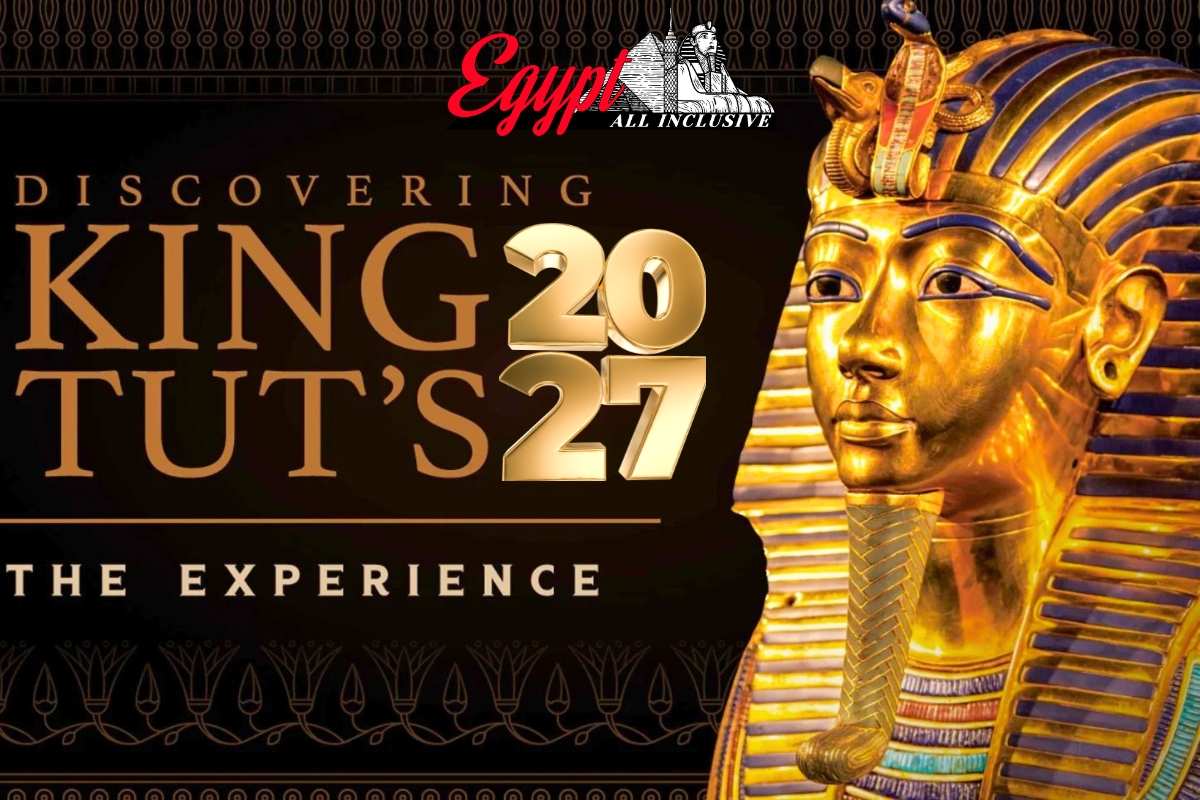
Grand Egyptian Museum Tutankhamun is now the single most searched travel topic among visitors planning a trip to Egypt in 2026, and for good reason. After a century of waiting, the golden mask, the nested coffins, the chariots, and thousands of pieces of royal jewelry that once lay hidden in a small tomb in the Valley of the Kings are finally displayed together, in one purpose-built gallery, for the first time in history.
If you have ever typed “where is King Tut now,” “which museum is the mask of Tutankhamun in,” or “is Tutankhamun in Luxor,” this guide answers every one of those questions in plain, simple language.
Here is the four-line summary of everything you need to know before you read further: The Grand Egyptian Museum (GEM) in Giza now holds the complete Tutankhamun collection, more than 5,398 artifacts, including the iconic golden mask, displayed together for the first time since Howard Carter’s 1922 discovery.
Tutankhamun’s mummy itself remains in his original tomb, KV62, in the Valley of the Kings in Luxor, not in any museum. Tickets for the Tutankhamun exhibition at the Grand Egyptian Museum must be booked online in advance, since on-site ticket sales have ended. And if you want the smoothest, most memorable, and most affordable way to see it all in 2026, a guided tour with a specialized Egypt travel agency will save you hours of queuing and confusion.
In the sections below, we will walk through the museum itself, the Tutankhamun gallery in detail, the mask, the mummy, the virtual tour options for people who want to explore before they arrive, ticket prices and hours for 2026, a full comparison between visiting the treasures in Giza and visiting the tomb in Luxor, answers to the most common questions travelers ask about King Tut, the mystery of his death, the best tour packages available this year, insider tips that most articles never mention, and why so many travelers are now booking their Grand Egyptian Museum Tutankhamun exhibition tour with Egypt All Inclusive.
What Is the Grand Egyptian Museum? A 2026 Overview
The Grand Egyptian Museum, often shortened to GEM, is the largest archaeological museum in the world dedicated to a single civilization. It sits on roughly 500,000 square meters of land on the Giza Plateau, only about two kilometers from the Pyramids of Giza and the Sphinx, which means it can easily be combined with a pyramids tour on the same day.
The museum held its grand opening ceremony on November 1, 2025, and opened fully to the public on November 4, 2025, a date chosen deliberately because it fell exactly 103 years after Howard Carter first broke into Tutankhamun’s tomb on November 4, 1922. That kind of attention to historical detail runs through the entire museum, and it is one of the reasons the Grand Egyptian Museum Tutankhamun exhibition feels less like a static display case and more like a journey through an actual royal story.
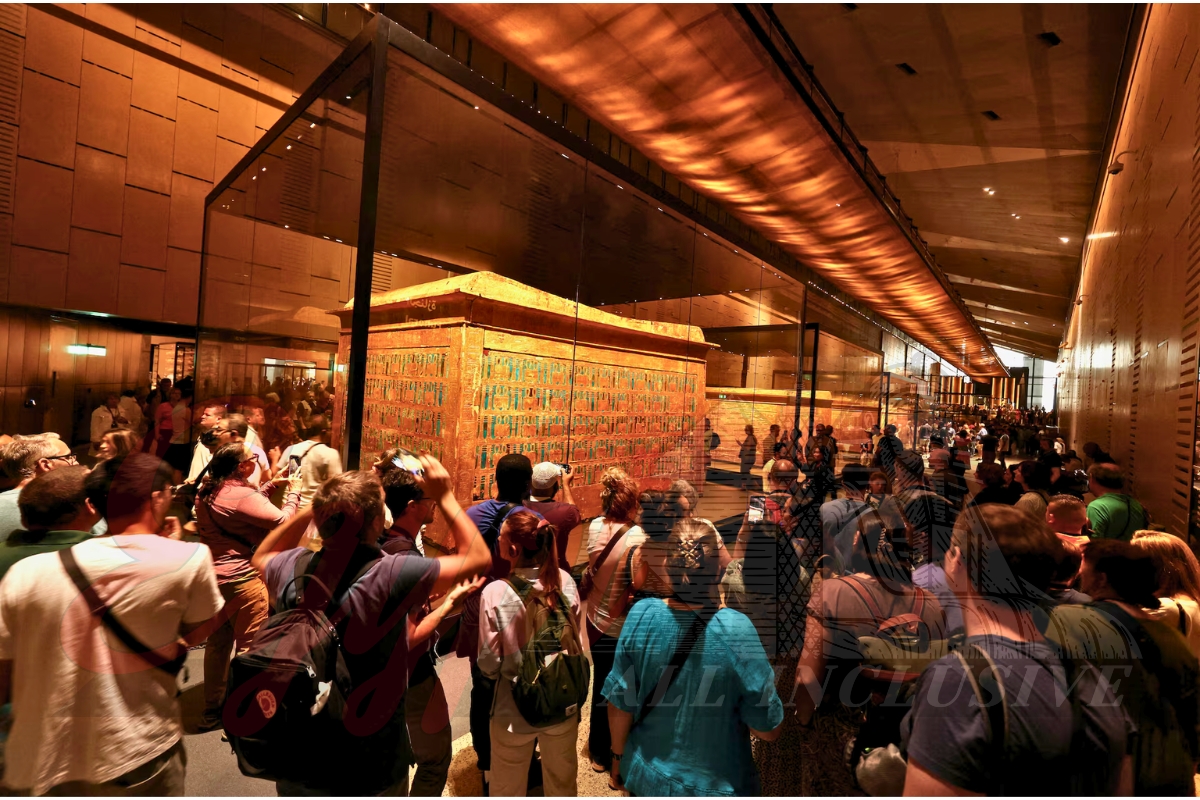
As of 2026, every permanent gallery is open to visitors. That includes twelve main galleries tracing Egyptian history from prehistoric times through the Graeco-Roman period, the towering atrium where a 3,200-year-old colossal statue of Ramesses II greets every visitor, the Khufu Solar Boat Museum housing a full-size wooden boat buried beside the Great Pyramid more than 4,500 years ago, and of course the Tutankhamun Gallery, which has quickly become the centerpiece of the entire museum. Early reports from Egypt’s State Information Service noted close to 19,000 visitors a day during the museum’s first week, and that pace has continued as word has spread about how complete and immersive the King Tut exhibit really is.
What makes GEM different from the old Egyptian Museum in Tahrir Square, where many of these artifacts were displayed for decades in crowded, poorly lit halls, is the sheer scale of curation. Each piece in the tutankhamun grand egyptian museum collection now has room to breathe, proper climate control, and modern lighting designed specifically to bring out the shine of gold leaf and the color of inlaid semi-precious stones the way they would have looked to the ancient Egyptians themselves.
The museum also uses interactive digital displays, multilingual audio guides, and detailed wall panels that explain not just what an object is, but why it mattered to a king who ruled for only nine years yet became the most famous pharaoh in modern history.
For travelers planning a 2026 Egypt itinerary, GEM is no longer an optional add-on. It has become the anchor point of most Cairo and Giza tour packages, the way the Pyramids always have been. Anyone booking a trip this year should expect their itinerary to include at least half a day, and ideally a full day, dedicated to walking through this museum properly.
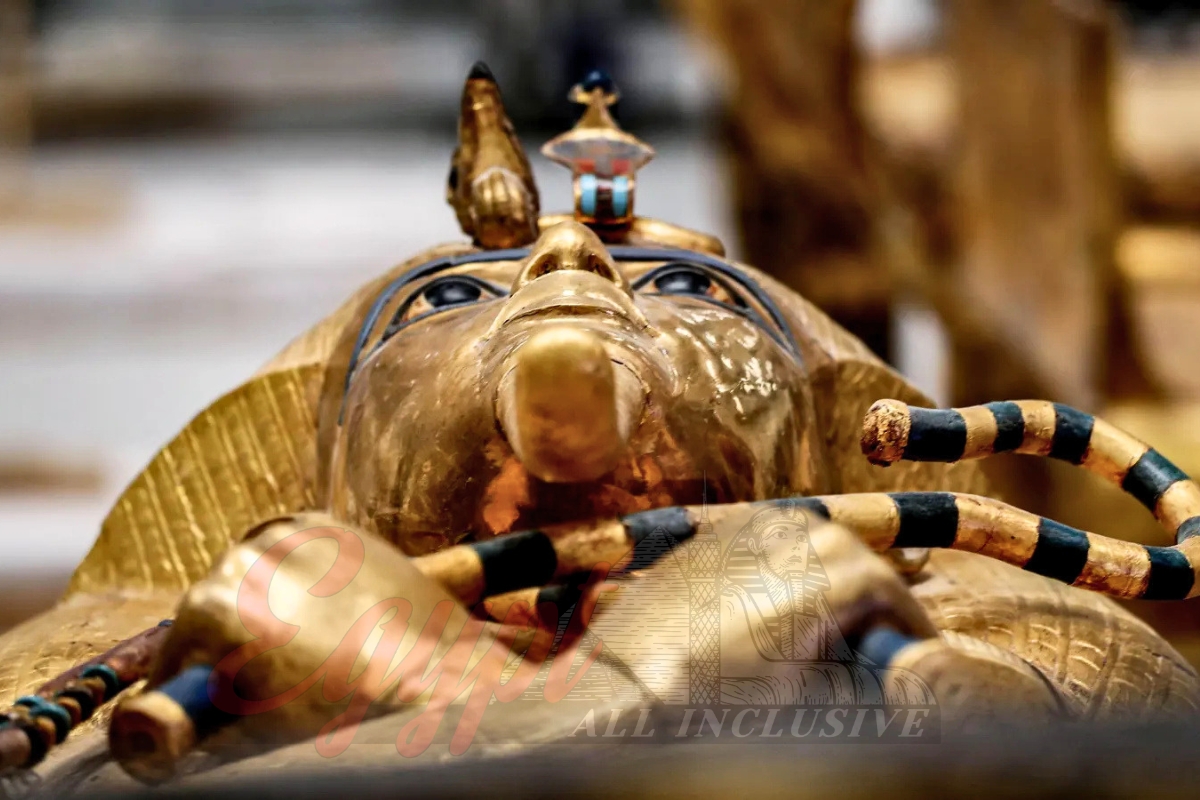
Where Is Tutankhamun Now? Setting the Record Straight
This is, by far, the single most common question travelers ask, and the honest answer requires splitting it into two parts, because “Tutankhamun” actually refers to two different things: the king’s physical remains, and the thousands of objects buried with him.
The treasures, the golden mask, the jewelry, the furniture, the chariots, the shrines, and the coffins, are now housed at the Grand Egyptian Museum in Giza. This is the answer to where is king tut now and where is tutankhamun now when people are asking about the objects everyone recognizes from photographs. For the first time since 1922, the complete set of over 5,398 items recovered from tomb KV62 is displayed together in one purpose-built gallery instead of being scattered across different rooms of the old museum or, worse, packed away in storage because there simply was not enough display space.
The mummy itself tells a different story. Tutankhamun’s actual body remains inside his original tomb, KV62, in the Valley of the Kings on the West Bank of Luxor. It has not been moved to Cairo, and it is not part of the Grand Egyptian Museum collection.
Egyptian authorities made a deliberate decision years ago to keep the king’s mummy resting in the tomb where it was discovered, both out of respect for the site’s historical integrity and because the Valley of the Kings itself is one of Egypt’s most protected archaeological zones. So if you are wondering in which museum is Tutankhamun’s mummy, the honest answer is that his mummy is not in a museum at all. It remains inside a climate-controlled display case within his own tomb, viewable by visitors who purchase a ticket to KV62 while touring Luxor.
This split answers several closely related questions at once. Is Tutankhamun in Luxor? Yes, his mummy is, resting exactly where Howard Carter found it more than a hundred years ago. Which museum is King Tut in? His treasures are in the Grand Egyptian Museum in Giza. Does the Grand Egyptian Museum have King Tut? Yes, it holds his entire funerary collection, though not his physical remains.
Which museum has the tomb of Tutankhamun? No museum has his tomb, because a tomb, by definition, is not something that gets relocated. It stays exactly where it was carved into the Theban hills more than 3,300 years ago.
Understanding this distinction changes how most people plan their trip. A traveler who wants to see the golden mask, the jewelry, and the famous throne should focus their time in Giza at GEM. A traveler who wants to stand inside the actual burial chamber, see the wall paintings, and feel the scale of the Valley of the Kings should build in time for Luxor. The best 2026 Egypt itineraries do both, and we will show you exactly how to combine them later in this guide.
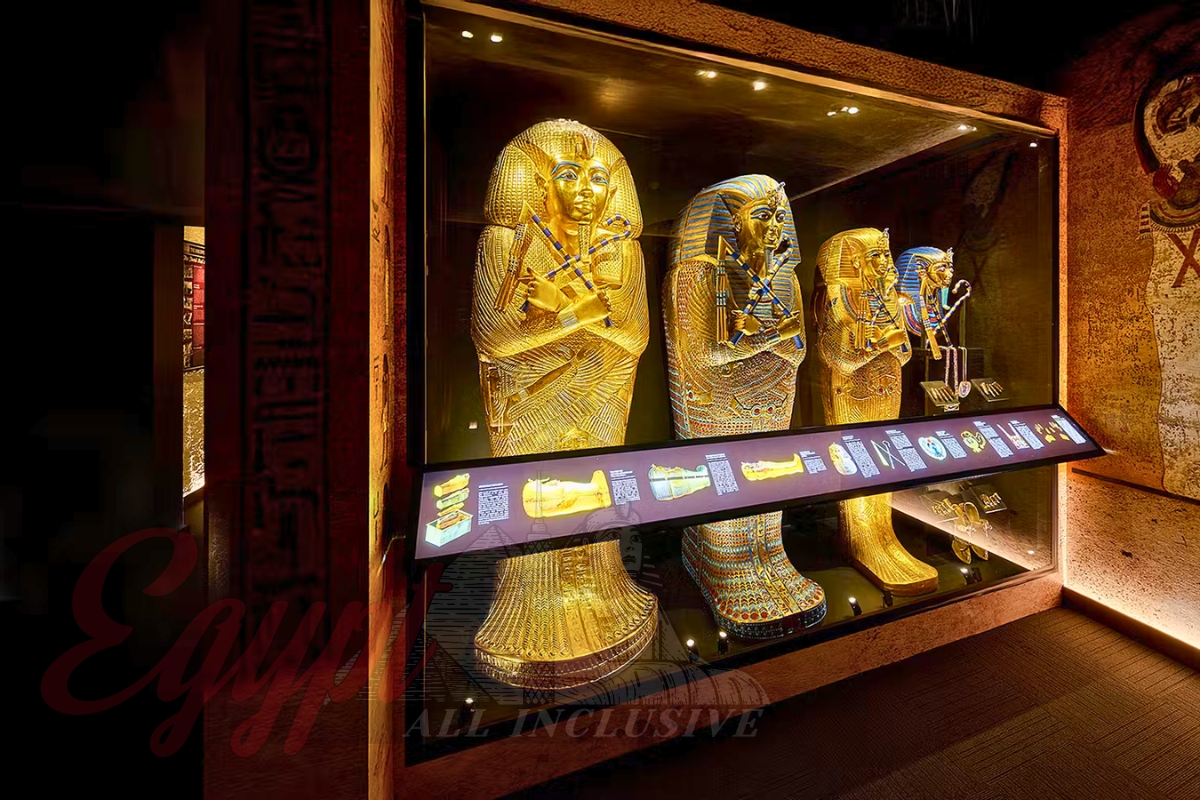
Inside the Tutankhamun Gallery at the Grand Egyptian Museum
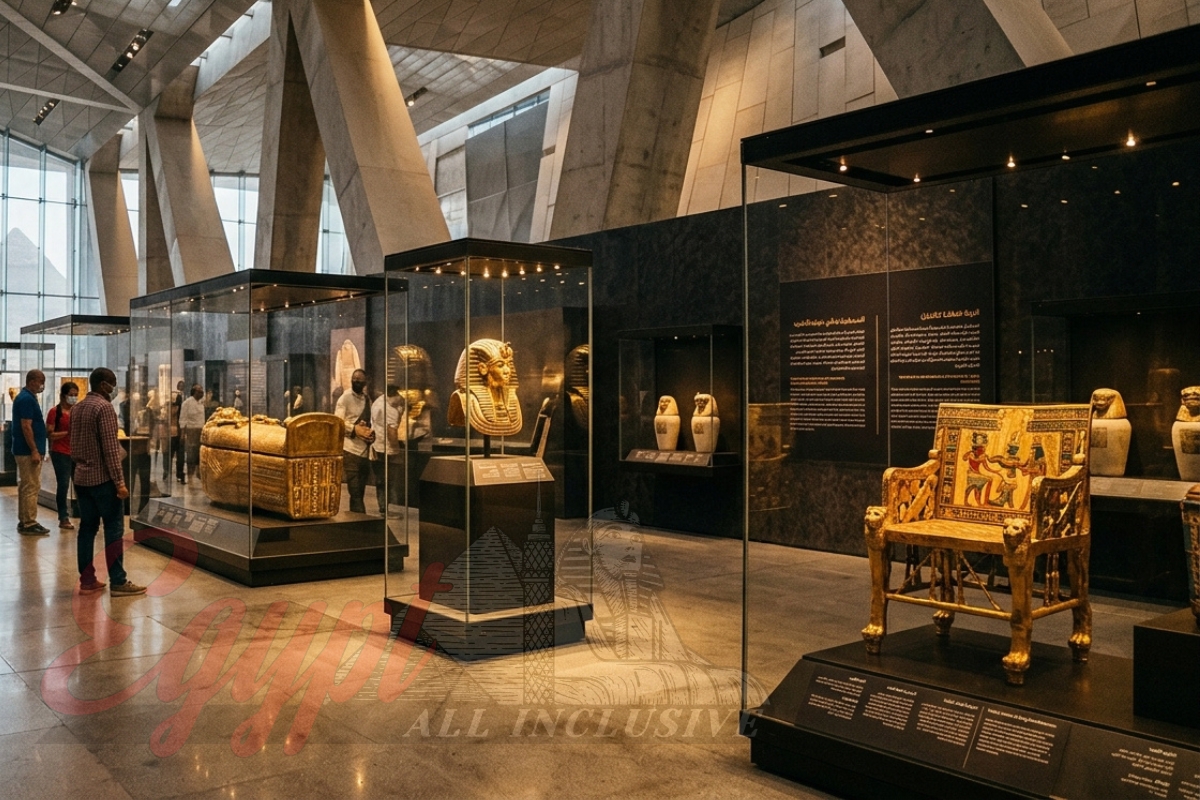
Walking into the Tutankhamun Gallery at GEM is unlike any museum experience most travelers have had before, because it was designed from the ground up around a single collection rather than adapted from an older building. The gallery occupies a dedicated wing of the museum and presents the objects in a sequence that mirrors the order Howard Carter and his team actually removed them from the tomb, moving from the outer shrines through to the innermost coffin and the mask itself.
The grand egyptian museum tutankhamun exhibition begins with the outermost gilded shrines, enormous wooden structures covered in gold leaf that once nested inside one another like Russian dolls around the king’s sarcophagus. Few visitors realize just how large these shrines are until they stand next to one, and the extra ceiling height in this section of GEM was specifically engineered to display them upright for the first time.
From there, the tutankhamun gallery grand egyptian museum layout moves through the king’s chariots, his ceremonial weapons and armor, his royal jewelry, and hundreds of everyday objects he was buried with, including board games, furniture, sandals, and even food offerings meant to sustain him in the afterlife.
One of the features that makes this exhibition stand apart from any previous Tutankhamun exhibition cairo has ever hosted is the way lighting is used. Rather than harsh overhead lighting, curators used directional, low-glare lighting designed to catch the reflective gold surfaces the same way flickering oil lamps would have in the original tomb, giving visitors a sense of what Carter himself might have felt shining a candle into the burial chamber for the very first time in 1922. Several travelers who have already visited describe this as the moment the exhibit stops feeling like a museum and starts feeling like time travel.
The tutankhamun exhibition grand egyptian museum also includes rotating educational stations staffed by Egyptologists during peak hours, offering short talks on specific objects. These are not always advertised clearly online, which is one reason booking a guided tour rather than visiting independently tends to add so much value, since local guides know the schedule of these talks and can time your visit around them.
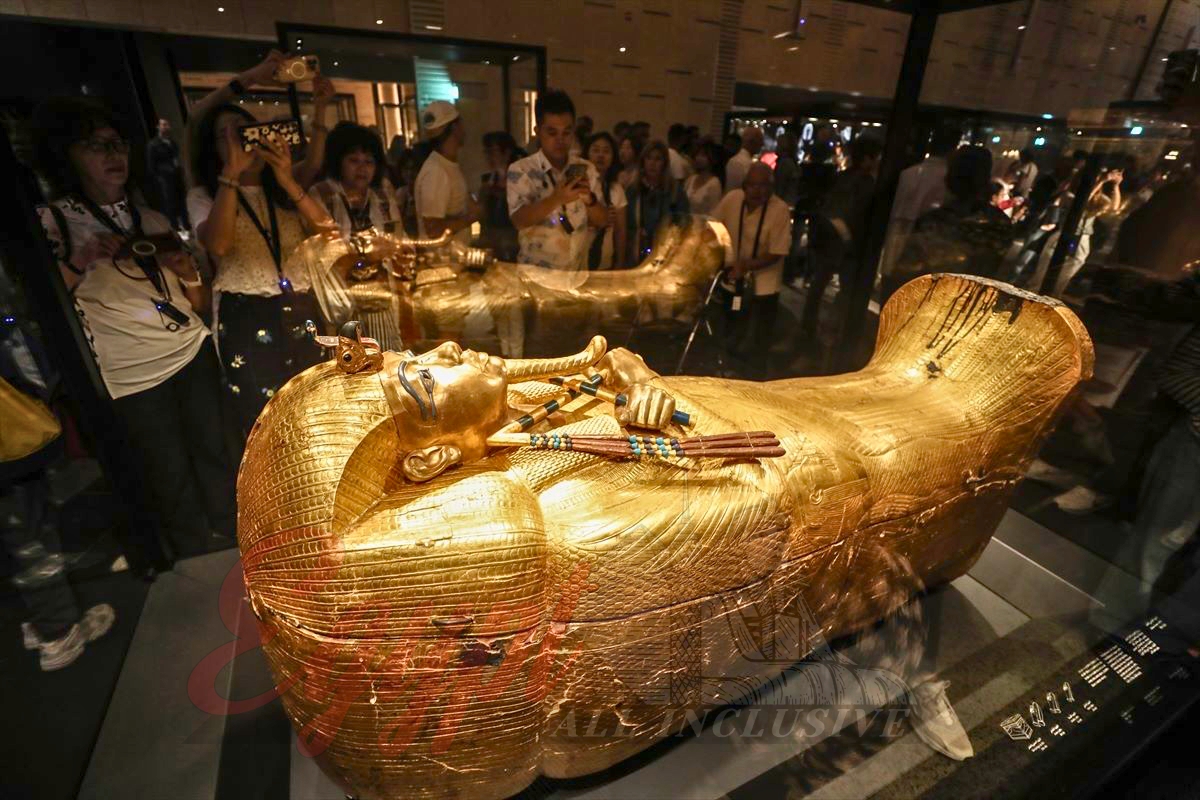
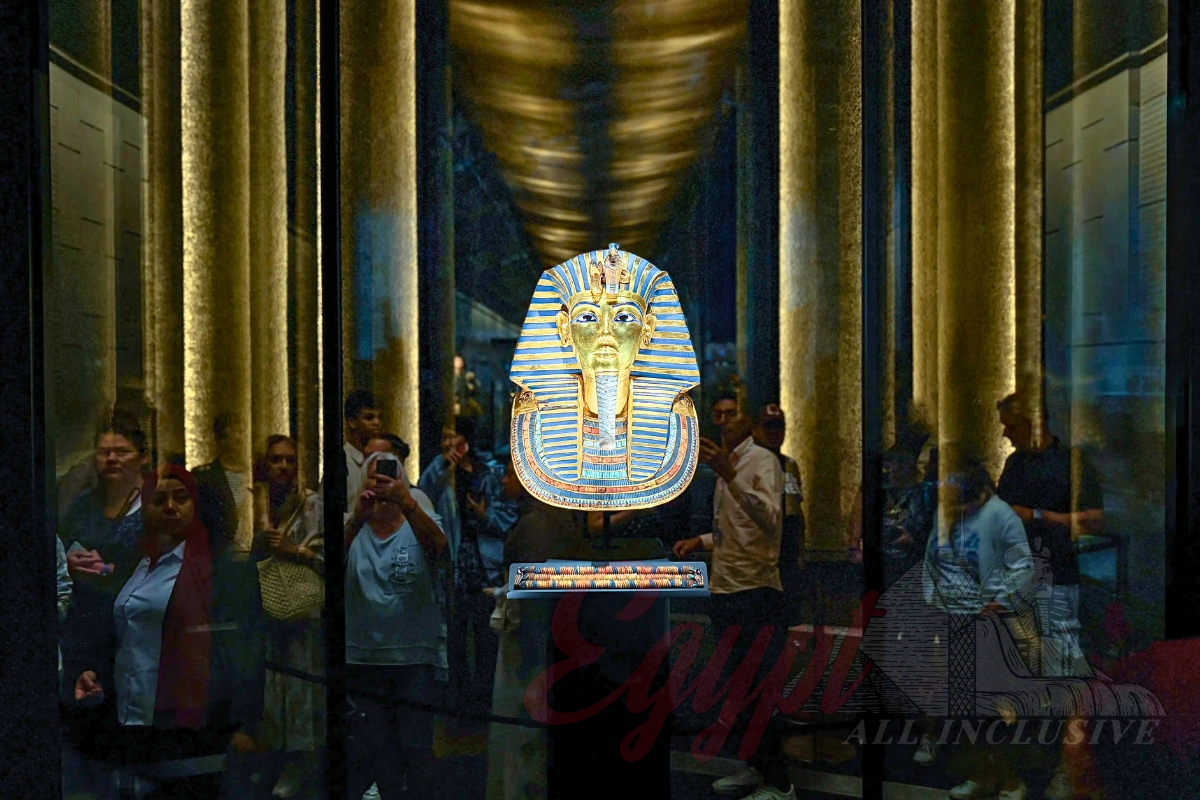
By the time visitors reach the final chamber, where the golden mask is displayed in its own dedicated, heavily secured room, most describe an almost reverent hush falling over the crowd. Even in a gallery that can host hundreds of visitors at once, this final room is managed carefully to avoid overcrowding directly in front of the case, giving everyone a genuine moment to take in what is arguably the most recognizable archaeological object on Earth.
For anyone building an Egypt itinerary around this single exhibit, it is worth knowing that a rushed visit does this gallery a disservice. Most Egyptologists and experienced tour leaders recommend allotting at least ninety minutes for the Tutankhamun Gallery alone, separate from the rest of the museum, simply because of how much there is to absorb.
The Golden Mask of Tutankhamun: Location and Viewing Guide
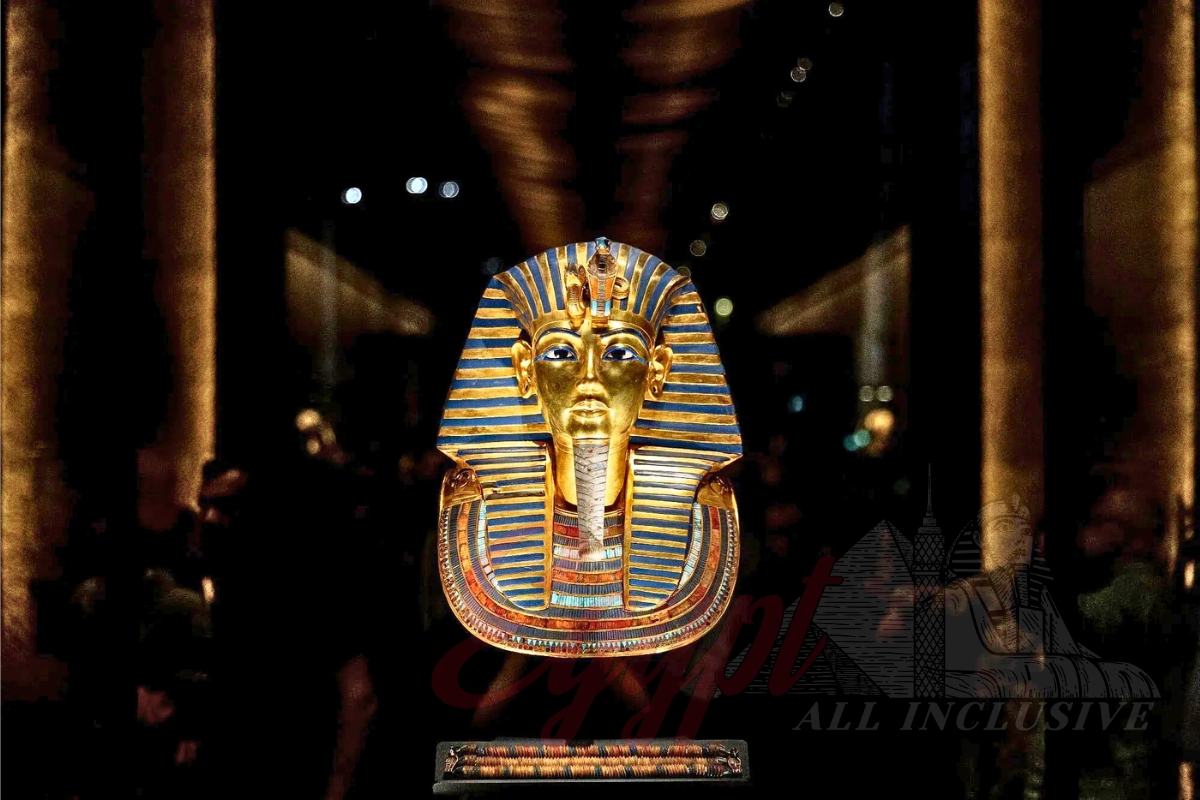
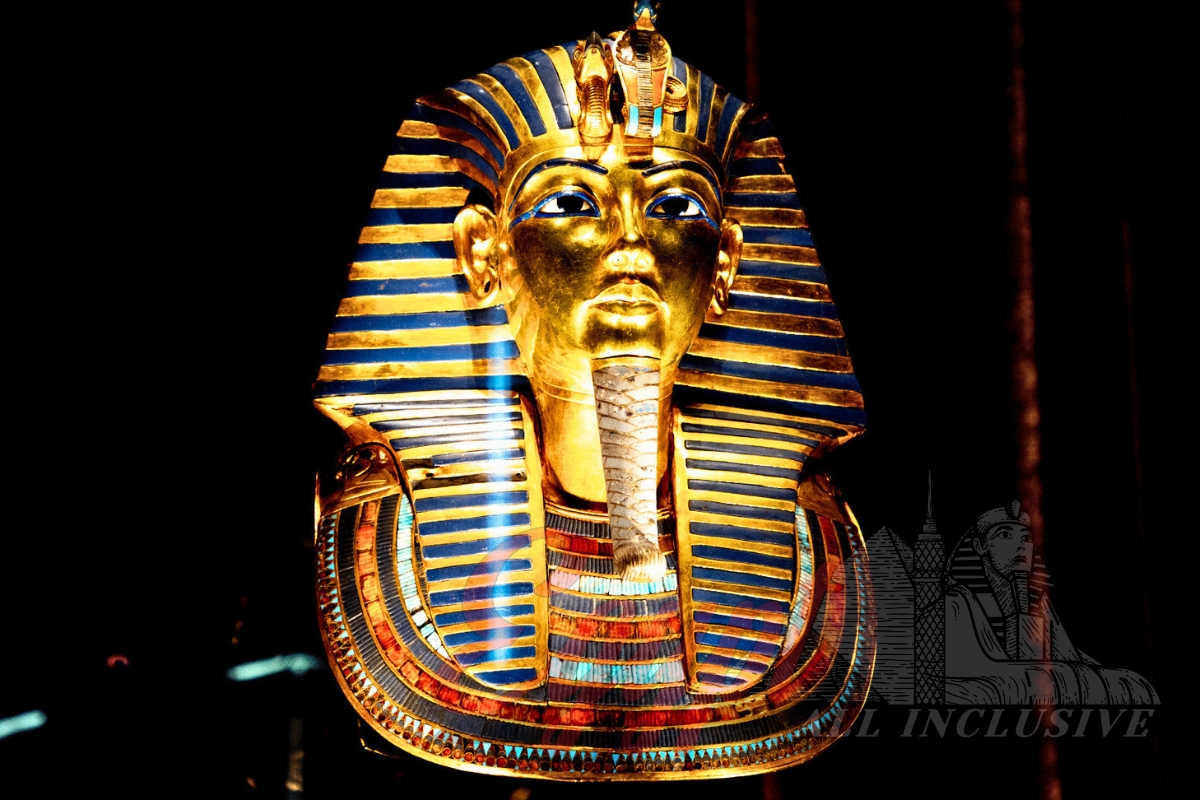
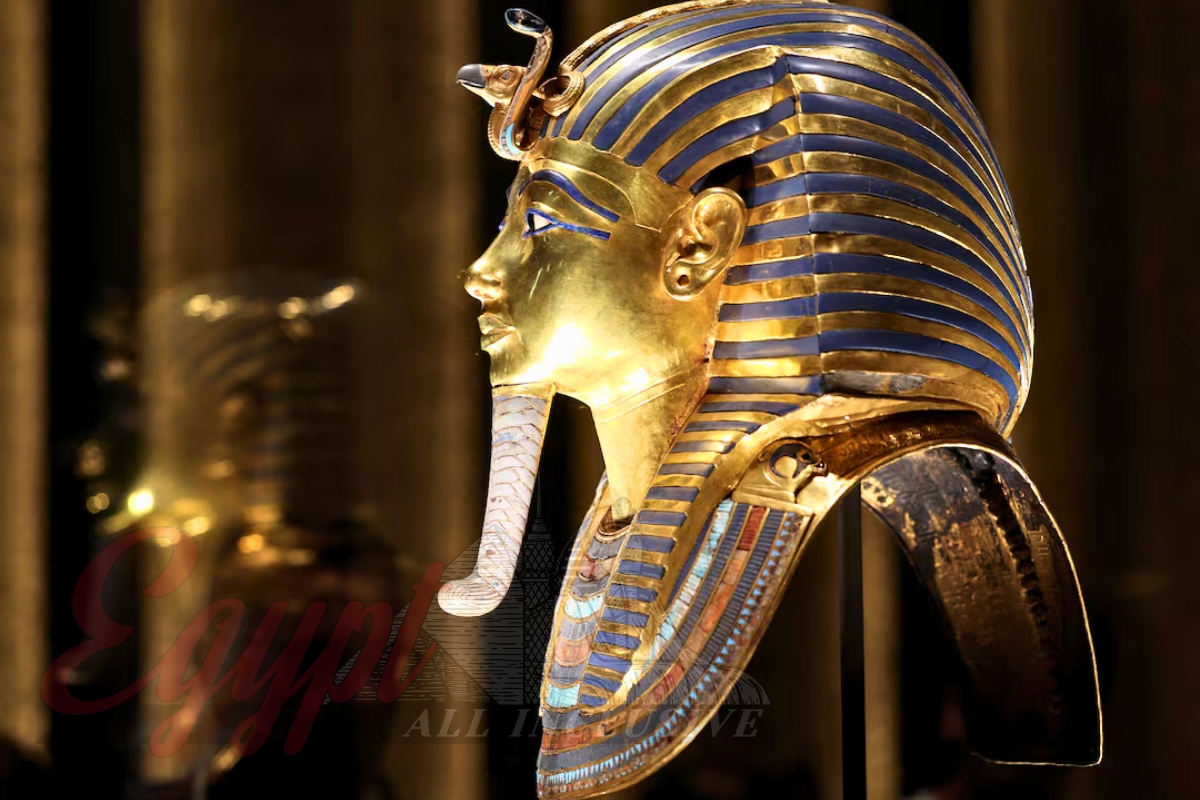
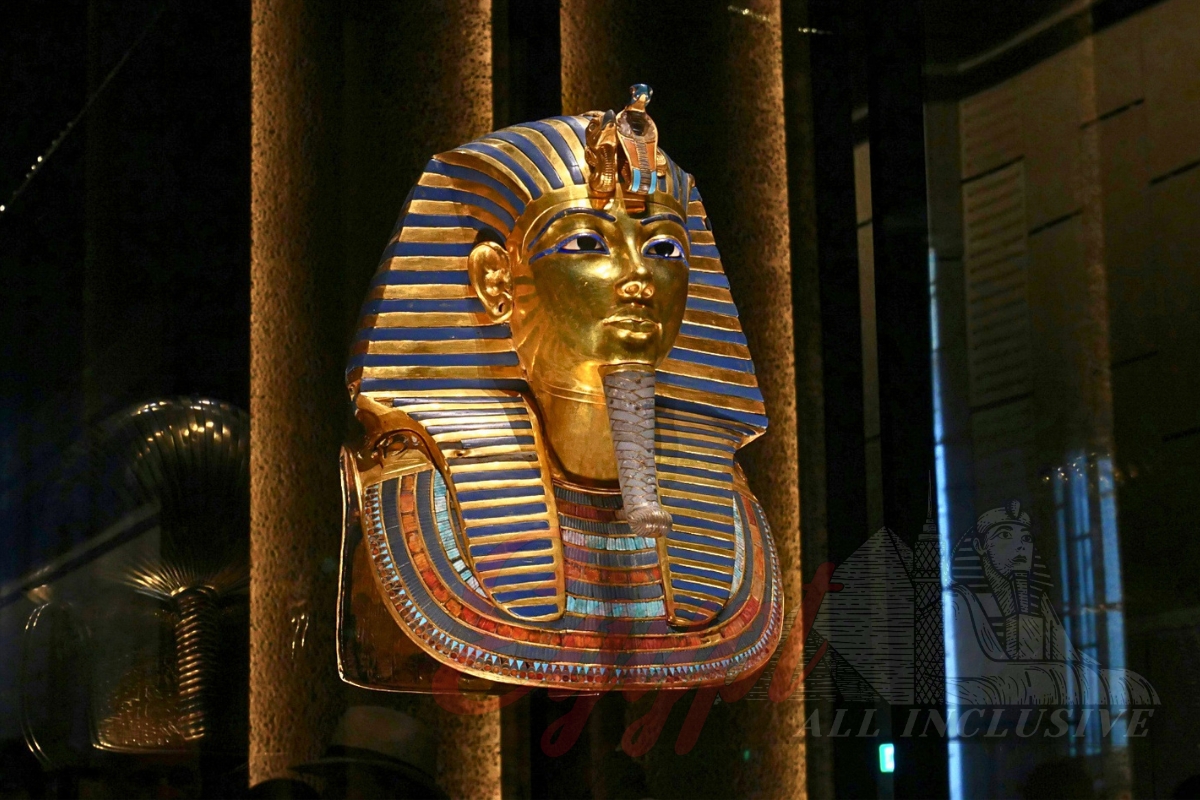
If there is one object that defines Ancient Egypt in the popular imagination, it is the golden funerary mask of Tutankhamun, and travelers searching for grand egyptian museum tutankhamun mask information usually want one simple answer: where is it, and can I actually see it in person in 2026? The answer is yes. The mask is now permanently displayed inside the Tutankhamun Gallery at the Grand Egyptian Museum in Giza, having been relocated there from the old Egyptian Museum in Tahrir Square, where it had been the star attraction for decades before the move.
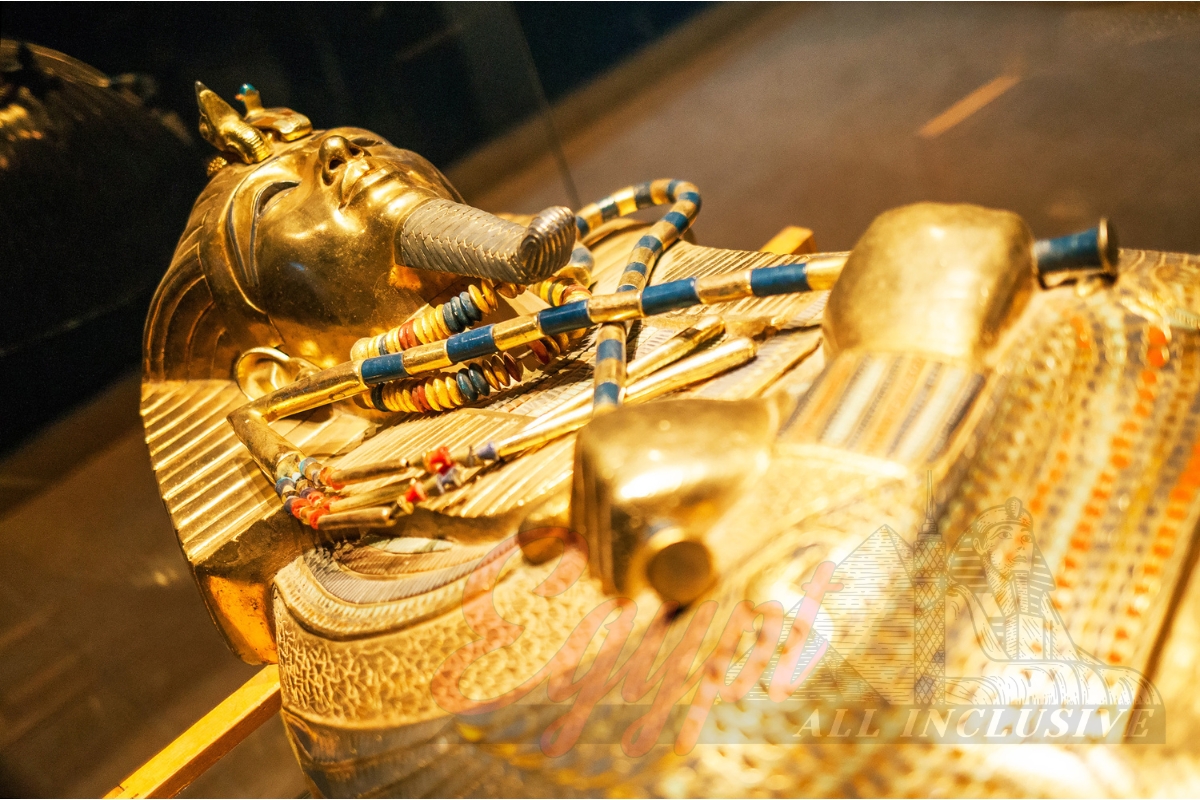
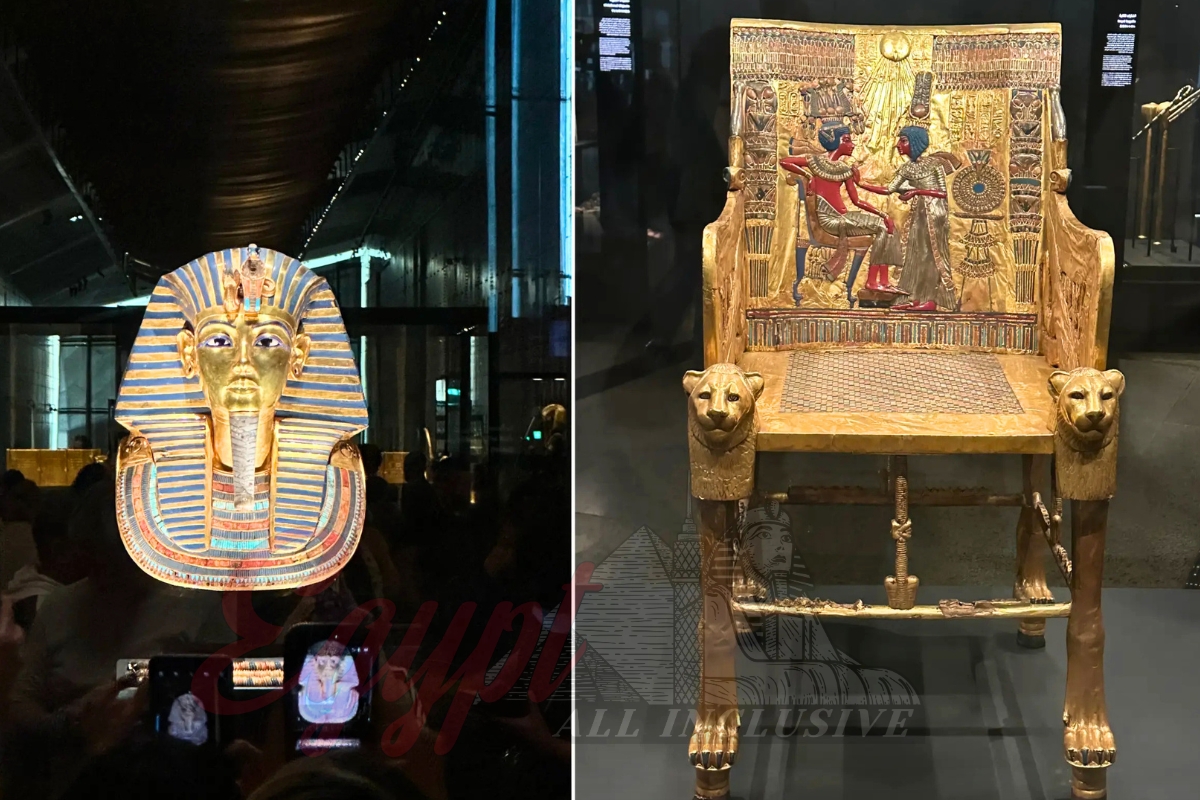
The mask itself weighs around eleven kilograms and is made almost entirely of solid gold, inlaid with lapis lazuli, carnelian, turquoise, and colored glass. It was crafted to cover the head and shoulders of the king’s mummified body and represents him wearing the royal nemes headcloth along with the vulture and cobra symbols of Upper and Lower Egypt joined together, a visual statement of his rule over a unified nation.
Anyone asking which museum is the mask of Tutankhamun in now has a definitive answer: the Grand Egyptian Museum in Giza, not the old downtown Cairo museum, and not Luxor.
The mask’s new display case at GEM was custom-built with anti-reflective, ultraviolet-filtered glass and a rotating base that allows conservators to adjust the angle slightly over time to reduce prolonged light exposure to any single side of the object, a conservation technique that simply was not possible in its old display location. Security around the mask is understandably intense, with dedicated staff, restricted photography zones in the immediate viewing area, and a steady, managed flow of visitors designed to prevent crowding directly at the glass.
For travelers who specifically want to prioritize seeing the mask, timing matters. The quietest windows tend to be right at museum opening, or during the Wednesday and Saturday extended evening hours, when tour bus traffic has usually thinned out. Guided tours booked through experienced operators often build their Tutankhamun Gallery visit around these quieter windows specifically so guests can spend unhurried time in front of the mask rather than being swept past it in a moving crowd.
It is worth noting that no other object has moved location as many times in modern history as this mask, from its original resting place inside the innermost coffin in KV62, to Cairo’s old museum after its 1922 discovery, and now to its permanent home at GEM in Giza.
Each of those moves was treated as a major national event in Egypt, and the current display at the Grand Egyptian Museum is widely considered its final home for the foreseeable future, engineered specifically for long-term preservation rather than temporary exhibition. If seeing this single object in person is on your travel bucket list for 2026, this is now, unquestionably, the place to do it.
The Complete Tutankhamun Treasures Collection: 5,398 Artifacts Under One Roof
Most people know Tutankhamun for the mask, but the tutankhamun treasures grand egyptian museum collection includes far more than a single golden object, and understanding the sheer scope of what was buried with a teenage king who ruled for less than a decade helps explain why this exhibition has generated so much global attention in 2026.
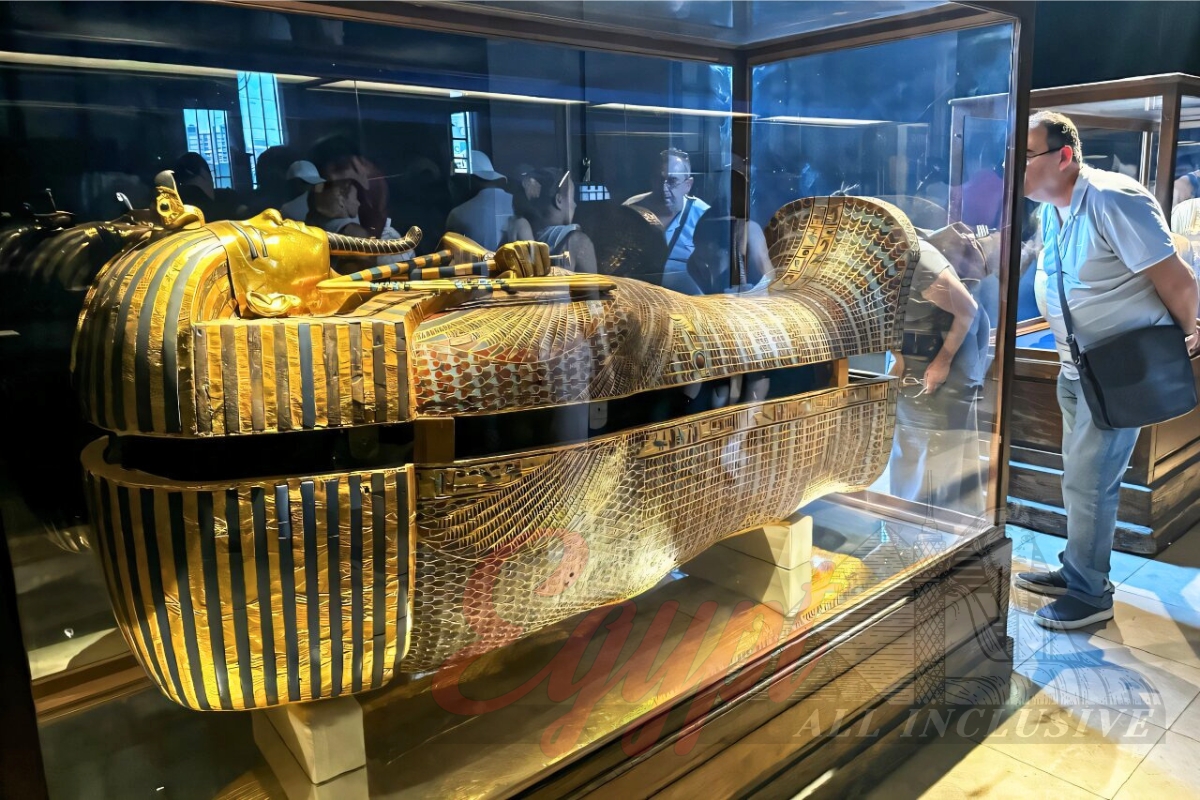
The complete collection numbers 5,398 individual artifacts, all recovered from a tomb that, by royal Egyptian standards, was actually considered modest in size. Among the highlights now on display are the nested coffins, including the solid gold innermost coffin that once held the king’s mummified body directly.
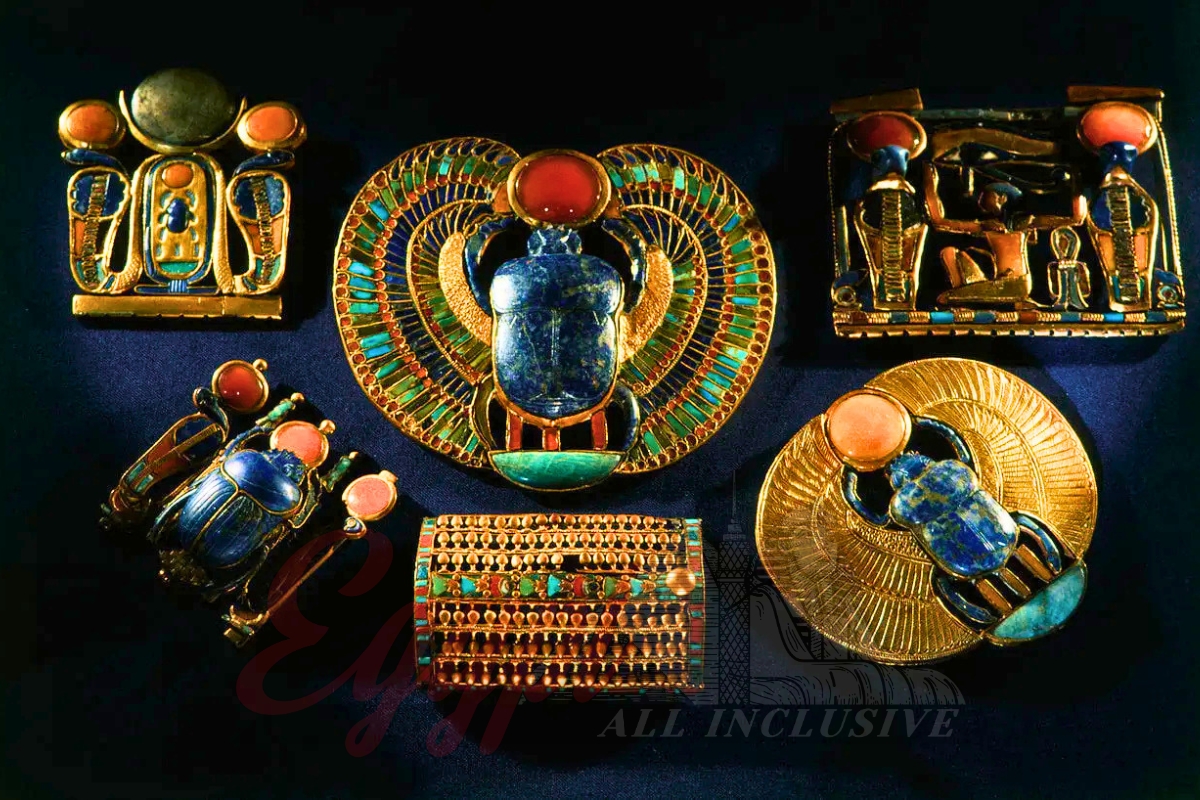
There are four gilded shrines that surrounded his sarcophagus, several dismantled and reassembled ceremonial chariots, ornate thrones including the famous golden throne depicting the king and his wife, hundreds of pieces of jewelry crafted from gold, silver, and semi-precious stones, ceremonial weapons and shields, statues of protective deities, board games, furniture, clothing, sandals, and an extensive array of food and wine jars meant to provide for the king in the afterlife.
One section of the gallery, sometimes called the Royal Armory by museum curators, focuses specifically on Tutankhamun’s role as a defender of Ma’at, the ancient Egyptian concept of cosmic order and balance, displaying his hunting equipment, bows, and ceremonial armor. This curatorial choice reflects a broader shift in how the 2026 exhibition presents Tutankhamun.
Rather than portraying him purely as a fragile boy king, as older exhibitions sometimes did, GEM’s curators present him as an active royal figure engaged in ceremony, governance, and symbolic military leadership, giving the entire gallery a more dynamic and historically grounded feel.
Several pieces on display have never been shown publicly before, having spent decades in storage simply because the old museum lacked the physical space to exhibit the full collection. This is part of what makes the current king tut exhibit genuinely historic rather than simply a relocation of familiar objects. For the first time in over a century, researchers, tour guides, and ordinary visitors alike are seeing Tutankhamun’s full burial assemblage exactly as archaeologists intended it to be studied and appreciated.
For travelers, this scale matters practically as well as emotionally. A rushed hour will only scratch the surface of what is on display. Serious history enthusiasts, and even casually curious travelers, tend to come away wishing they had allotted more time. This is precisely why many 2026 Egypt All Inclusive itineraries now schedule a dedicated half-day or full-day visit to GEM rather than folding it into a single rushed afternoon alongside the pyramids, ensuring guests actually experience the depth of this collection rather than rushing past it.
Tutankhamun’s Mummy: Why It Remains in Luxor
While the treasures have moved to Giza, Tutankhamun’s mummy has stayed exactly where Howard Carter found it in 1922, inside tomb KV62 in the Valley of the Kings, on the West Bank of the Nile near Luxor. This is a deliberate and permanent decision by Egyptian antiquities authorities, and it answers several frequently searched questions at once: where is tutankhamun mummy now, king tut mummy on display, and whether king tut mummy on display can be found anywhere near the Grand Egyptian Museum.
The mummy is displayed inside a specially designed, climate-controlled glass case within an antechamber of the tomb itself, allowing visitors to view the king’s remains without exposing them to the humidity and temperature fluctuations that plague so many other archaeological sites. This setup has actually improved the mummy’s preservation compared to earlier decades, when it was occasionally removed from its case for study and photography.
The decision to leave the mummy in Luxor rather than transferring it to Cairo alongside his treasures reflects both archaeological ethics and practical heritage management. Egyptologists generally consider it best practice to keep human remains within their original burial context whenever feasible, preserving the historical and spiritual integrity of the site.
It also gives Luxor, a city whose entire modern economy depends heavily on tourism to the Valley of the Kings, a continued and irreplaceable reason for travelers to visit, ensuring that the west bank of Luxor remains just as essential to an Egypt itinerary as it always has been, even after the treasures moved north.
For travelers, this means a truly complete Tutankhamun experience in 2026 genuinely requires visiting two locations. Giza delivers the golden mask, the jewelry, the chariots, and the sweeping scale of the tutankhamun gallery grand egyptian museum experience. Luxor delivers something more intimate and, for many visitors, more emotionally powerful: standing in the actual chamber where the boy king was laid to rest more than three thousand years ago, surrounded by the same painted walls his priests once stood before during his funeral rites.
Guided king tut tomb tour packages in Luxor typically include KV62 alongside several other royal tombs in the Valley of the Kings, since a single ticket to the valley does not automatically include entry to Tutankhamun’s tomb, which requires a separate, additional ticket due to its popularity and the delicate conservation needs of the site. Travelers planning their own trip independently should budget this extra cost and confirm current ticket rules before arrival, since Egyptian antiquities pricing and access policies are periodically updated.
Virtual Tour: Exploring King Tut’s Tomb and Treasures Online
Not everyone can travel to Egypt immediately, and plenty of history enthusiasts want to explore before they commit to booking flights. This is where a virtual tour tutankhamun grand egyptian museum experience becomes genuinely useful, both as a planning tool and as a way to preview what an in-person visit will actually look like.
Several official and independent virtual tour king tut’s tomb projects have been developed over the past decade, using high-resolution 3D scanning technology to recreate the burial chamber, antechamber, and treasury of KV62 in remarkable detail.
These virtual tour of king tut’s tomb experiences allow users to rotate their view 360 degrees, zoom into wall paintings, and in some versions, follow a guided narration explaining the significance of each chamber, all from a browser or smartphone. For travelers who want to understand the layout of the tomb before standing inside it in person, spending twenty minutes with one of these virtual tours ahead of a Luxor trip makes the real visit significantly more meaningful, since the tomb’s interior is compact and dimly lit, making it easy to miss details without prior context.
On the Giza side, the Grand Egyptian Museum has also invested heavily in digital tools, including interactive touchscreen displays throughout the Tutankhamun Gallery that let visitors examine 3D models of specific artifacts, rotate them, and read layered information ranging from basic facts to advanced Egyptological detail. Some of this digital content overlaps with online virtual tour experiences, meaning travelers researching before their trip can effectively get a head start on the museum’s own interpretive material.
It is worth being cautious here, since a wave of low-quality websites has appeared over the past year offering supposed virtual tour king tut’s tomb experiences that are little more than static photo galleries with no real interactivity. When researching before a trip, look for virtual tours produced by recognized institutions, established Egyptology researchers, or well-reviewed cultural heritage organizations, rather than generic travel blogs recycling the same handful of stock images.
For serious planning purposes, a virtual tour should be treated as preparation, not a substitute. No screen, however well produced, replicates standing at the actual entrance to the Valley of the Kings with the desert heat on your skin, or watching light catch the gold of the mask in person at GEM.
What a good virtual tour does accomplish is helping you decide how much time to allocate to each site, which specific artifacts you most want to see in person, and which of the many king tut tour options on the market actually cover the details you personally care about. Several Egypt All Inclusive itineraries now include a short pre-departure digital briefing along these exact lines, so guests arrive already knowing what they are looking at rather than discovering it cold.
Grand Egyptian Museum Tutankhamun Exhibition: Tickets, Hours, and 2026 Schedule
Planning a visit to the Grand Egyptian Museum Tutankhamun exhibition in 2026 requires understanding a few practical details that have changed since the museum’s opening in late 2025. The most important change is that on-site ticket sales have ended entirely. Every visitor, Egyptian or foreign, must now book a timed-entry slot online in advance through the museum’s official ticketing platform before arriving at the gates.
There is no separate, additional ticket required specifically for the Tutankhamun Gallery. The standard all-inclusive GEM ticket covers every permanent gallery, including the complete Tutankhamun collection, the Ramesses II atrium, and the Khufu Solar Boat Museum. Below is a simplified overview of 2026 pricing and hours travelers should expect, though prices are set by Egyptian authorities and can be adjusted during the year, so always confirm current rates before booking.
| Category | 2026 Approximate Price | Notes |
|---|---|---|
| Foreign adult visitor | EGP 1,450–1,590 (~$28–30) | Covers all galleries, no separate King Tut ticket |
| Foreign students and children 6–25 | EGP 730 (with valid ID) | Student ID required at entry |
| Children under 6 | Free | No ticket required |
| Egyptian nationals / residents | Approx. EGP 200 | ID or residency proof required |
| Guided tour package | From approx. €40 | Includes timed entry ticket, no queuing |
| Professional photography permit | Approx. EGP 300 | Personal phone photos generally free |
Museum hours currently run daily from 9:00 AM to 6:00 PM for standard gallery access, with extended evening hours on Wednesdays and Saturdays until 9:00 PM, giving travelers more flexibility to plan around cooler evening temperatures, particularly useful for anyone visiting during Egypt’s warmer months. Last entry is typically enforced about one hour before closing, so arriving early in the day remains the safest strategy if you want unhurried time in the Tutankhamun Gallery specifically.
Hours can shift during Ramadan and around major public holidays, so anyone traveling during those periods should double-check the current schedule shortly before their trip rather than relying on standard hours. For those specifically searching king tut exhibit 2026 schedule, the safest approach is confirming exact opening times no more than a few weeks before arrival, since Egypt’s tourism authorities have occasionally adjusted evening hours based on seasonal demand.
The quietest visiting windows tend to be right at 9:00 AM opening or during the Wednesday and Saturday evening sessions, once large day-tour groups have already left. Given the online-only booking system and the popularity of the Tutankhamun Gallery specifically, booking your ticket at least several days in advance, and ideally as part of a guided tour that handles reservations for you, remains the most reliable way to avoid arriving to find your preferred time slot already full.

King Tut Tomb Tour in Luxor vs. Tutankhamun Gallery in Giza: How to Plan Both
One of the most common points of confusion for first-time visitors is understanding that a trip focused on Tutankhamun genuinely benefits from covering two very different locations, roughly 700 kilometers apart. Here is a direct comparison to help you plan a 2026 itinerary that captures both experiences properly.
| Feature | Grand Egyptian Museum (Giza) | Tutankhamun’s Tomb, KV62 (Luxor) |
|---|---|---|
| What you see | Golden mask, treasures, coffins, chariots, jewelry | The actual burial chamber and mummy |
| Distance from Cairo | Inside Greater Cairo, near the Pyramids | Approx. 700 km south, a short flight away |
| Ticket type | Single all-inclusive museum ticket | Separate ticket in addition to Valley of the Kings entry |
| Recommended time | 3–4 hours minimum, half a day ideal | 30–45 minutes inside the tomb itself |
| Best paired with | Pyramids of Giza, Sphinx, Saqqara | Valley of the Kings, Karnak, Luxor Temple |
| Photography | Personal photos generally allowed, permit for professional gear | Restricted, often no photography inside the tomb |
| Ideal for | Seeing the objects, jewelry, and mask up close | Feeling the historical atmosphere of the actual burial site |
A well-designed 2026 Egypt itinerary typically begins in Cairo and Giza, where travelers spend a day exploring the Pyramids, the Sphinx, and the Grand Egyptian Museum, including its Tutankhamun Gallery, before flying south to Luxor. In Luxor, a guided king tut tomb tour usually combines KV62 with several other tombs in the Valley of the Kings, along with Karnak Temple and Luxor Temple on the East Bank, giving travelers a complete arc from the treasures themselves to the actual resting place they came from.
Attempting to see everything in a single rushed day trip is not realistic given the geography involved, and travelers who try to compress both sites into an overly tight schedule often end up exhausted and unable to properly appreciate either location. A minimum of four to five days dedicated to the Cairo-Giza-Luxor route, ideally as part of a broader Nile itinerary that also includes Aswan, is the approach most experienced Egypt travel planners recommend for 2026, and it is exactly how Egypt All Inclusive structures its most popular Tutankhamun-focused packages this year.
Frequently Asked Questions About King Tut and the Grand Egyptian Museum
Travelers researching a 2026 trip tend to arrive with a long list of overlapping questions, so here are direct answers to the ones we hear most often, gathered in one place for easy reference.
Where is the real Tutankhamun kept?
His mummy remains inside his original tomb, KV62, in the Valley of the Kings in Luxor. His treasures, including the mask, are displayed at the Grand Egyptian Museum in Giza.
Which museum is the mask of Tutankhamun in?
The Grand Egyptian Museum in Giza, having been relocated there from the old Egyptian Museum in downtown Cairo.
In which museum is Tutankhamun’s mummy?
No museum. His mummy remains inside his tomb in the Valley of the Kings, viewable on a separate ticket while touring Luxor.
Which museum is King Tut in?
If you mean his treasures, the Grand Egyptian Museum in Giza. If you mean his physical remains, he is not in a museum at all.
Does the Grand Egyptian Museum have King Tut?
Yes, the museum holds the complete Tutankhamun collection of 5,398 artifacts, the largest and most complete display of his burial assemblage ever assembled.
Did King Tut and Cleopatra meet?
No. This is one of the most common historical misconceptions in modern pop culture. Tutankhamun ruled around 1332 to 1323 BCE, while Cleopatra VII lived roughly 1,300 years later, from 69 to 30 BCE. The two never crossed paths, and Cleopatra’s era is closer in time to today than it was to Tutankhamun’s reign.
Which museum has the tomb of Tutankhamun?
None. His tomb, KV62, is a physical site carved into the rock of the Valley of the Kings, and tombs are not relocated into museums.
Is Tutankhamun in Luxor? His mummy, yes. His treasures, no longer, since they now reside permanently at the Grand Egyptian Museum in Giza.
How many babies did King Tut have?
Historical and genetic evidence points to two stillborn daughters, discovered mummified and buried alongside him in his tomb, suggesting his marriage to Queen Ankhesenamun did not produce any children who survived infancy.
Where is King Tut now, and where is Tutankhamun now?
His treasures are on permanent display at the Grand Egyptian Museum in Giza. His mummy remains in his tomb in Luxor.
Where is Tutankhamun’s mummy now?
Inside tomb KV62 in the Valley of the Kings, displayed in a climate-controlled case within an antechamber of the tomb.
Where is the Tutankhamun mask now?
On permanent display in a dedicated, secured gallery room at the Grand Egyptian Museum in Giza.
Is the traveling Tutankhamen exhibit still happening?
No. After touring internationally for decades, including well-known stops abroad, the treasures have returned home permanently and are no longer part of any traveling exhibition. They are now housed exclusively at the Grand Egyptian Museum.
How Did King Tut Die? The Mysteries of the Boy King
Few questions generate as much ongoing fascination as how did king tut die, and the honest answer is that Egyptologists still debate the precise sequence of events, even after decades of forensic research. What is clear is that Tutankhamun died at the young age of nineteen, having become pharaoh at around age nine or ten and ruling for roughly nine years during Egypt’s turbulent 18th Dynasty.
For much of the twentieth century, popular theories leaned toward foul play, partly fueled by a mysterious mark on the back of his skull discovered during early X-ray studies. A CT scan conducted in 2005 largely put that theory to rest, showing the mark was almost certainly caused during the embalming process rather than by any blow to the head. That same scan, however, revealed something equally significant: a severe, unhealed fracture in his left thigh bone, sustained shortly before death.
A landmark 2010 study, involving two years of DNA testing and CT analysis on sixteen royal mummies including Tutankhamun’s, offered the most detailed picture yet. Researchers found that the young king suffered from a cleft palate and a club foot, likely requiring him to walk with a cane. More than one hundred walking sticks were found buried in his tomb, physical evidence supporting this theory. The same study detected DNA from the malaria parasite in his remains, and researchers concluded that a severe malarial infection, combined with the untreated broken leg and his already weakened congenital condition, most likely triggered the fatal chain of events that ended his life. In a world without antibiotics, even a relatively survivable leg fracture could quickly become life-threatening once infection set in.
Other theories have circulated over the years, including a 2014 documentary hypothesis suggesting Tutankhamun died from injuries sustained in a chariot accident, potentially breaking his leg and pelvis in a fall consistent with tomb depictions of him hunting and riding. While this theory remains popular in documentaries, the broader scientific consensus still centers on the combination of congenital illness, malaria, and the untreated leg fracture as the most medically supported explanation.
What all of this research makes clear is that Tutankhamun was, by most accounts, a physically fragile young ruler navigating serious health challenges likely worsened by generations of royal intermarriage within his family line. Far from diminishing his legacy, this human vulnerability has, if anything, deepened public fascination with him, transforming him from an abstract ancient figure into a relatable young person whose short, difficult life ended in tragedy at an age many modern travelers visiting his exhibition today would recognize as barely more than a teenager.
Best Tutankhamun and Grand Egyptian Museum Tour Packages for 2026
With the Grand Egyptian Museum now fully open and the Tutankhamun exhibition drawing enormous global interest, 2026 has become the single best year in a century to build a trip around King Tut, and travel agencies across Egypt have responded with a wide range of dedicated packages. Not all of these tours are created equal, so understanding what separates a genuinely excellent king tut tour from a rushed, generic bus tour matters enormously.
The strongest 2026 packages typically fall into a few categories. Day tour packages from Cairo focus purely on the Grand Egyptian Museum, often combined with the Pyramids of Giza and Sphinx in a single day, ideal for travelers with limited time in the capital. These tours generally include a licensed Egyptologist guide, skip-the-line entry using pre-booked timed tickets, private or small-group transportation, and dedicated time specifically allotted to the Tutankhamun Gallery rather than treating it as one stop among many.
Multi-day Cairo and Luxor combination packages represent the gold standard for anyone serious about the full Tutankhamun story. These itineraries typically spend two to three days in Cairo and Giza, covering the Grand Egyptian Museum, the Pyramids, Saqqara, and often the Egyptian Museum in Tahrir for remaining artifacts, followed by a domestic flight to Luxor for two to three additional days covering the Valley of the Kings, KV62 itself, Karnak Temple, and Luxor Temple. This structure gives travelers the complete arc from golden treasures to the actual burial chamber, and it remains the single most requested itinerary style for 2026 King Tut enthusiasts.
Nile cruise extensions have also grown in popularity, adding a three or four night cruise between Luxor and Aswan onto the Cairo and Luxor core itinerary, allowing travelers to see Edfu and Kom Ombo temples along the way while enjoying a more relaxed pace after the intensity of museum and tomb visits.
For travelers with limited time, private half-day GEM tours focused exclusively on the Tutankhamun Gallery have become increasingly available, aimed specifically at cruise passengers with a single day in Cairo or business travelers looking to fit in a meaningful cultural experience around other commitments.
Whichever format fits your schedule, the packages that consistently earn the best reviews share a few traits: pre-booked timed entry tickets to avoid the online-only booking bottleneck, licensed Egyptologist guides rather than generic drivers doubling as guides, realistic time allocations that do not rush the Tutankhamun Gallery, and transparent, all-inclusive pricing with no hidden entry fees sprung on travelers at the gate. Egypt All Inclusive builds every 2026 King Tut itinerary around exactly these principles, which is a major reason so many travelers researching this exhibition end up booking directly through us rather than piecing together a trip on their own.
Insider Tips to Make the Most of Your Grand Egyptian Museum Tutankhamun Visit
After watching thousands of travelers move through this exhibition since its opening, a few practical insights consistently separate a good visit from a truly great one, and most of these tips rarely appear in generic travel guides.
Arrive at opening time whenever possible. The single biggest factor affecting how much you actually enjoy the Tutankhamun Gallery is crowd density, not the museum itself. The first ninety minutes after 9:00 AM opening consistently offer the calmest viewing conditions, particularly in front of the golden mask’s display case.
Book the Wednesday or Saturday evening slot if your schedule allows it. The extended hours until 9:00 PM tend to attract fewer large tour groups, and the museum’s lighting design was specifically engineered to look even more striking after sunset, when the natural light through the museum’s windows fades and the gallery’s directional artifact lighting becomes the dominant illumination.
Do not try to see the entire museum and the Tutankhamun Gallery properly in under three hours. Many independent travelers make the mistake of treating GEM like a quick stop before or after the Pyramids. The Tutankhamun collection alone genuinely rewards ninety minutes to two hours of unhurried attention, and rushing past it to fit in the rest of the museum does a disservice to both.
Bring a personal phone or camera for casual photography, since this is generally permitted throughout most of the museum, but leave professional camera equipment at your hotel unless you have specifically arranged and paid for a photography permit in advance, since large equipment is otherwise restricted.
Pair your GEM visit with a knowledgeable guide rather than relying solely on wall text and audio guides. The context an experienced Egyptologist provides, explaining why a particular chariot design mattered strategically, or what specific jewelry symbolized about the king’s divine status, transforms the exhibition from an impressive but somewhat overwhelming collection of gold objects into a coherent, gripping historical narrative.
If your itinerary includes both Giza and Luxor, visit the Grand Egyptian Museum first, then travel to KV62 afterward. Seeing the treasures before standing inside the actual tomb gives most travelers a far more emotional experience in Luxor, since they arrive already understanding exactly what once filled that small chamber, rather than viewing an empty room without context.
Finally, book your timed-entry ticket well in advance rather than assuming you can arrange it upon arrival in Cairo. Since on-site ticket sales have ended entirely, travelers who arrive without a confirmed booking risk being turned away or facing a multi-day wait for the next available slot, particularly during Egypt’s busy winter tourism season.

Why Egypt All Inclusive Is the Best Travel Agency for Your 2026 Egypt Trip
Planning a trip built around one of the most significant cultural openings in modern archaeological history deserves a travel partner who understands every detail covered in this guide, not a generic booking platform that treats the Grand Egyptian Museum as just another line item on a checklist. This is exactly where Egypt All Inclusive has become the leading choice for travelers heading to Egypt in 2026.
Our team builds every Tutankhamun-focused itinerary around pre-secured timed-entry tickets, so you never risk arriving at GEM to find your preferred slot unavailable. We work exclusively with licensed Egyptologist guides who bring the kind of context and storytelling ability that turns a gallery walk-through into an unforgettable experience, the same depth of expertise reflected throughout this article. Our packages are structured with realistic time allocations, giving the Tutankhamun Gallery the ninety minutes to two hours it genuinely deserves rather than squeezing it into a rushed hour between other stops.
We also understand the full geography of the King Tut story better than most agencies, seamlessly combining your Grand Egyptian Museum visit in Giza with a properly paced trip to Luxor’s Valley of the Kings, ensuring you experience both the treasures and the tomb they came from, rather than mistakenly assuming one location covers the entire story. Whether you want a focused day trip from Cairo, a comprehensive Cairo and Luxor combination package, or a full Nile cruise extension through Aswan, our itineraries are fully customizable and transparently priced, with no hidden entry fees or surprise add-ons at the gate.
As Egypt’s tourism landscape enters its most significant year in decades, Egypt All Inclusive stands as the best travel agency in Egypt in 2026 for travelers who want expert guidance, seamless logistics, and a genuinely enriching cultural experience rather than a rushed, generic tour. If seeing the golden mask, walking through the complete Tutankhamun collection, and standing inside the Valley of the Kings is on your travel list this year, now is the time to book with us and turn a bucket-list destination into a beautifully planned reality.
The Discovery Story: How Howard Carter Found King Tutankhamun
Understanding why the tutankhamun grand egyptian museum exhibition carries so much emotional weight requires knowing the story of how these treasures were found in the first place. For years, British archaeologist Howard Carter, funded by Lord Carnarvon, searched the Valley of the Kings convinced that one undiscovered royal tomb still remained hidden beneath the sand. Most established Egyptologists at the time believed the valley had already given up all its secrets.
On November 4, 1922, Carter’s team uncovered a step cut into the rock, the first sign of a hidden entrance. Days later, after clearing a stairway and a sealed doorway bearing royal necropolis seals, Carter made a small hole in the doorway and, holding a candle up to the gap, peered into the chamber beyond. When Lord Carnarvon anxiously asked if he could see anything, Carter reportedly answered with the now-famous line describing wonderful things glinting in the candlelight, gold everywhere. That single moment is widely regarded as one of the greatest archaeological discoveries in human history, and it is the same moment museum curators tried to recreate through the deliberate, warm lighting design used throughout today’s tutankhamun exhibition grand egyptian museum gallery.
What made the discovery so extraordinary was not simply that a tomb was found, but that it had survived almost entirely intact for over 3,300 years, having escaped the tomb robbers who looted nearly every other pharaoh’s burial chamber in antiquity. It took Carter and his team nearly a decade to fully catalogue, conserve, and remove every object from the tomb, a process so meticulous that many of the detailed photographs and notes from that excavation are still used by Egyptologists today to correctly identify and display each artifact in its proper historical context at GEM.
This history matters for travelers because it explains why the current exhibition is organized the way it is. The sequence of galleries, moving from outer shrines toward the inner coffin and mask, deliberately mirrors the order in which Carter’s team encountered and removed these objects, giving visitors in 2026 a chance to essentially retrace the excavation itself, chamber by chamber, exactly a century after it happened.
Common Mistakes Travelers Make When Planning a King Tut Visit
Even well-prepared travelers occasionally make avoidable mistakes when planning their trip to see the Grand Egyptian Museum Tutankhamun exhibition, and knowing these pitfalls in advance can save real time, money, and frustration.
The most frequent mistake is assuming tickets can still be purchased at the gate. Since the museum switched to a fully online, timed-entry booking system in December 2025, arriving without a confirmed reservation has left some travelers unable to enter on their intended day, particularly during peak winter and spring travel months. Always book several days ahead, and during major holidays, book even further in advance.
A second common error is underestimating travel time between Cairo and Luxor and trying to combine both King Tut experiences into an impossibly short trip. The 700-kilometer distance means a same-day round trip is simply not realistic, and travelers who attempt it often end up exhausted, rushing through the Valley of the Kings, or missing their flight connection entirely. Building in at least one overnight stay in Luxor makes an enormous difference to how much travelers actually enjoy the tomb visit.
A third mistake is treating the Grand Egyptian Museum as a quick add-on to a pyramids day trip. Given the sheer size of the museum and the depth of the Tutankhamun Gallery specifically, trying to see the Pyramids, Sphinx, and the entire museum in a single afternoon typically means rushing past the most significant collection in the building. Splitting these into either two separate days, or allocating a genuine full day to both, produces a far more satisfying experience.
Some independent travelers also assume the Tutankhamun ticket automatically includes access to the mummy in Luxor, not realizing these are two entirely separate sites with separate tickets, seven hundred kilometers apart. Confusing the two can lead to serious itinerary planning errors, particularly for travelers working with a tight schedule.
Finally, many travelers underestimate how quickly guided tour slots and skip-the-line packages fill up during peak season, especially now that all bookings are online and demand for the exhibition remains extremely high throughout 2026. Waiting until the last week before a trip to arrange guided access to GEM, particularly evening slots on Wednesdays and Saturdays, often means settling for a less convenient time or missing out on a licensed Egyptologist guide altogether. Booking your full itinerary, including the Grand Egyptian Museum and Luxor tombs, at least a month or two ahead of travel remains the safest approach for 2026.
Quick Facts: King Tutankhamun at a Glance
For travelers who want a fast reference before their trip, here is a condensed snapshot of the essential facts covered throughout this guide.
| Fact | Detail |
|---|---|
| Full name | Tutankhamun (also historically written Tutankhamen) |
| Became pharaoh | Around age 9–10, roughly 1333 BCE |
| Length of reign | Approximately 9 years |
| Age at death | 19 years old |
| Tomb discovered | November 4, 1922, by Howard Carter |
| Tomb location | KV62, Valley of the Kings, Luxor |
| Number of artifacts recovered | 5,398 |
| Current location of treasures | Grand Egyptian Museum, Giza |
| Current location of mummy | Remains inside KV62, Luxor |
| Known children | Two stillborn daughters |
| Believed cause of death | Malaria combined with an untreated broken leg and congenital illness |
| Museum public opening | November 4, 2025 |
This table is designed to answer, in seconds, many of the exact questions travelers search for again and again, from king tut tomb details to where his treasures sit today, making it easy to confirm the essentials before diving deeper into planning an actual visit.
Best Time of Year to Visit the Grand Egyptian Museum Tutankhamun Exhibition in 2026
Timing a trip around the Egyptian calendar can significantly change how comfortable and enjoyable your visit feels, and this matters just as much for a museum visit as it does for outdoor sightseeing at the Pyramids or the Valley of the Kings.
Winter, from November through February, remains the single most popular season to visit Egypt, and 2026 is expected to be busier than usual given the continued excitement around the Grand Egyptian Museum’s first full year of operation. Daytime temperatures in Cairo and Giza during these months typically sit in a comfortable range, making it pleasant to combine an outdoor morning at the Pyramids with an afternoon inside the museum. The tradeoff is higher demand for timed-entry tickets and guided tour slots, meaning advance booking becomes even more essential during this window.
Spring, particularly March and April, offers a strong middle ground, with warm but generally manageable temperatures and slightly thinner crowds than peak winter months, at least until the approach of Easter holidays, when European travel volume tends to spike. This period also frequently overlaps with school holidays in several source markets, so families should expect moderate crowd levels even outside the core winter season.
Summer months, June through August, bring intense heat across most of Egypt, often exceeding 40 degrees Celsius in Luxor and Aswan, which can make outdoor sightseeing genuinely exhausting. The Grand Egyptian Museum itself, however, is fully air-conditioned, making it one of the more comfortable summer activities available in Giza, and travelers visiting during these months often shift their itinerary to prioritize indoor experiences like GEM during the hottest parts of the day, saving outdoor sites like the Pyramids exterior or Karnak Temple for early morning or late afternoon hours when temperatures are more bearable.
Autumn, especially October and November, offers another excellent window, combining cooling temperatures with crowd levels that sit between the intensity of peak winter and the relative quiet of deep summer. Since the museum’s original public opening fell in early November, this period each year now carries a certain symbolic significance as well, occasionally coinciding with special commemorative programming or extended evening events tied to the anniversary of Howard Carter’s original 1922 discovery.
Whatever season you choose, remember that Wednesday and Saturday evening extended hours, running until 9:00 PM, tend to offer a cooler, calmer experience regardless of the time of year, since Cairo’s temperatures typically drop noticeably after sunset even during the hottest summer months. Pairing an evening museum visit with a daytime Pyramids visit earlier the same day, before the worst of the heat sets in, has become one of the most popular strategies among experienced 2026 Egypt travelers looking to make the most of both major Giza attractions without exhausting themselves in the process.
What Makes This Exhibition Different From Any Other Museum Experience in the World
Travelers who have visited major museums elsewhere, from the Louvre to the British Museum, consistently describe the Grand Egyptian Museum Tutankhamun exhibition as fundamentally different from a typical museum visit, and understanding why helps set the right expectations before you go.
Most museum collections are assembled piece by piece over decades or centuries, drawn from many different sources, cultures, and time periods, then organized thematically by curators long after the fact. The Tutankhamun collection is the opposite. Every single object in this gallery was buried together, at the same moment, for a single specific purpose: equipping one nineteen-year-old king for his journey into the afterlife. That shared origin gives the entire exhibition a coherence that few other museum collections in the world can match. Nothing here is a replica, and nothing is a later addition. What you are looking at is a complete, unaltered time capsule sealed by ancient priests and reopened only once, by Howard Carter, exactly a century before this current exhibition took its final form.
This coherence is precisely why GEM’s curators chose to organize the tutankhamun grand egyptian museum exhibition sequence around Carter’s original excavation order rather than a more conventional chronological or thematic layout. Visitors are not simply viewing gold objects in isolation. They are, in effect, walking through the same physical sequence of discovery that stunned the world in the 1920s, chamber by chamber, shrine by shrine, ending at the same golden mask that made global headlines when it was first revealed.
The scale of investment behind this exhibition also sets it apart. Very few archaeological displays anywhere in the world have been given a purpose-built, several-hundred-million-dollar gallery space, custom lighting engineering, and dedicated conservation labs built specifically around one royal collection. Most museums must fit their prized objects into existing buildings designed for broader, general purposes. GEM’s Tutankhamun Gallery was designed from its foundations upward around this exact collection, which is part of why so many visitors describe the space itself, not just the objects inside it, as genuinely awe-inspiring.
Finally, there is the emotional weight of knowing this collection has waited over a century to be shown complete. Generations of travelers saw only a fraction of these treasures scattered across cramped, poorly lit rooms in the old Cairo museum. Visiting in 2026 means being among the first generations of travelers in history to see everything Carter found, displayed together, exactly as archaeologists always intended. That sense of historical privilege, of witnessing something genuinely unprecedented rather than simply revisiting a familiar exhibit, is ultimately what elevates this King Tut exhibit above nearly every other museum experience on Earth, and it is exactly the kind of once-in-a-lifetime moment worth building your entire 2026 Egypt trip around.
Conclusion
The Grand Egyptian Museum Tutankhamun exhibition represents the most significant Egyptology milestone in over a century, finally reuniting the golden mask, the treasures, and the complete burial collection of the boy king in one purpose-built gallery in Giza, while his mummy remains resting in his original tomb in Luxor. Throughout 2026, travelers from around the world are prioritizing this exhibition above almost every other stop in Egypt, and understanding the practical details covered in this guide, from ticket booking and timing to combining Giza with Luxor properly, makes the difference between a rushed visit and a truly unforgettable one.
Whether your questions centered on where King Tut is now, how he died, or how to see both his treasures and his tomb in a single well-paced trip, this guide has walked through every answer in depth. As Egypt continues welcoming record numbers of visitors this year, there has never been a better or more meaningful time to experience this story firsthand.
Egypt All Inclusive stands ready as the best travel agency in Egypt in 2026 to turn this experience into reality, with expert Egyptologist guides, pre-secured tickets, and seamlessly planned itineraries connecting Cairo, Giza, and Luxor. Do not wait for your dream trip to Egypt to remain just a search query. Book your Grand Egyptian Museum and King Tut tour with Egypt All Inclusive today, and step into the story of Tutankhamun for yourself.