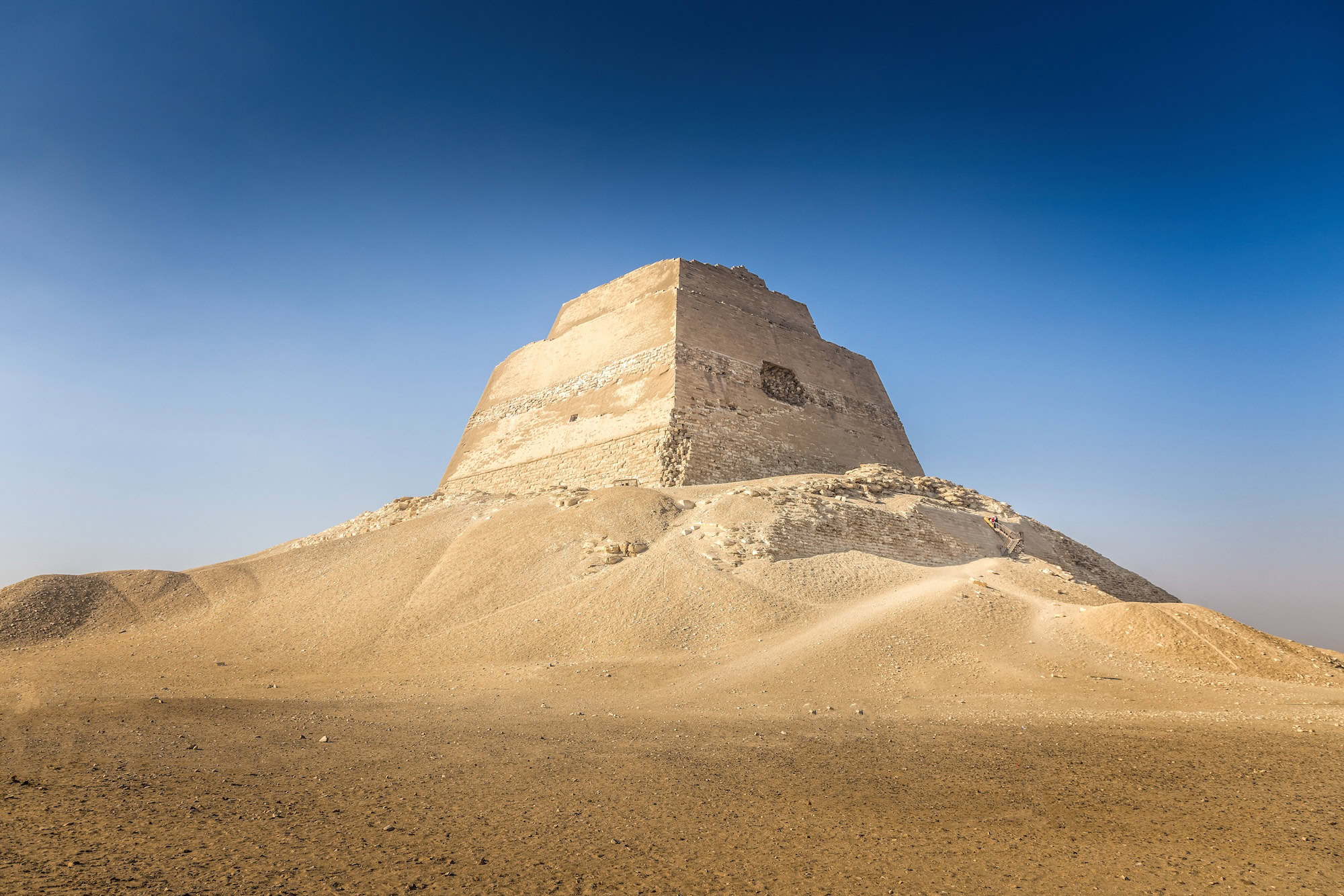
The Meidum Pyramid is one of Egypt’s most mysterious ancient monuments and a key milestone in the evolution of pyramid construction. Located south of Cairo, it reflects the transition from step pyramids to true pyramids and is closely connected to Pharaoh Sneferu’s architectural experiments. This article explains the pyramid’s history, location, construction, collapse, interior design, visitor experience, and travel tips for 2026. You will learn who built it, when it was constructed, why it collapsed, what lies inside, and how to visit it today. The guide also provides practical travel planning advice, expert insights, and booking tips for travelers planning a trip to Egypt in 2026.
Meidum Pyramid Egypt: Complete Overview for Travelers 2026
The Meidum Pyramid Egypt stands at the edge of the desert near the Fayoum region and represents one of the most debated monuments of the Old Kingdom. Known locally as El-Haram El-Kaddab (the False Pyramid), it appears today as a massive tower rising from a sea of collapsed limestone blocks.
Unlike the smooth pyramids of Giza, the pyramid of Meidum looks unfinished or damaged — yet this unusual shape holds enormous historical value. Archaeologists believe it marks Egypt’s first serious attempt to construct a true smooth-sided pyramid.
The structure is traditionally attributed to Pharaoh Sneferu, founder of the Fourth Dynasty and father of Khufu. The Meidum project demonstrates the learning process that eventually led to the Great Pyramid.
For travelers in 2026, the site offers:
-
Fewer crowds than Giza
-
Open desert scenery ideal for photography
-
Access to the interior chamber
-
A raw archaeological atmosphere
Unlike heavily restored monuments, the pyramid at Meidum feels authentic, untouched, and deeply ancient — perfect for travelers seeking off-the-beaten-path experiences.
Sneferu Meidum Pyramid: Who Built It and Why It Matters in 2026
One of the most common questions travelers ask is who built the Meidum Pyramid.
The answer leads directly to Pharaoh Sneferu — one of ancient Egypt’s most important builders.
Sneferu ruled around 2600 BCE and initiated the most ambitious pyramid-building program in Egyptian history. During his reign, three major pyramids were constructed:
-
Meidum Pyramid
-
Bent Pyramid at Dahshur
-
Red Pyramid at Dahshur
The Sneferu Meidum Pyramid is believed to be his earliest experiment.
Originally, the structure may have been started as a step pyramid, similar to Djoser’s pyramid at Saqqara. Later, the steps were filled in to create smooth sides — making it Egypt’s first attempt at a true pyramid.
This transformation explains many of the structural weaknesses that later caused collapse.
From an archaeological perspective, Meidum represents:
-
The transition from step pyramid to smooth pyramid
-
Early engineering trials
-
Lessons learned for later monumental construction
For travelers interested in ancient engineering and history, this pyramid provides insight unavailable anywhere else in Egypt.
When Was the Meidum Pyramid Built? Dating and Historical Context
So, when was the Meidum Pyramid built?
Most Egyptologists date its construction to approximately 2600 BCE, during the late Third Dynasty or early Fourth Dynasty.
There is scholarly debate regarding whether the pyramid was initially begun under Pharaoh Huni and later completed by Sneferu. However, most evidence strongly supports Sneferu’s involvement.
Construction timeline overview:
| Phase | Period | Description |
|---|---|---|
| Initial step structure | c. 2620 BCE | Built as a step pyramid |
| Conversion phase | c. 2600 BCE | Steps filled to create smooth sides |
| Structural failure | Ancient era | Outer casing collapsed |
Unlike later pyramids, Meidum did not benefit from refined construction techniques. The limestone casing was placed on sand rather than bedrock, creating instability.
This experiment — although flawed — directly influenced improvements seen at Dahshur and Giza.
For visitors in 2026, understanding this timeline enhances the experience and explains why the monument looks so different from other pyramids.
Meidum Pyramid Collapse: What Really Happened
The Meidum Pyramid collapse is one of the most discussed mysteries in Egyptian archaeology.
Today, visitors see a towering central core surrounded by enormous limestone debris. This is why it is often called the:
-
Collapsed pyramid at Meidum
-
Collapsed pyramid of Meidum
Why did it collapse?
Most experts agree on several contributing factors:
-
Outer casing placed at a steep angle
-
Construction built outward instead of inward
-
Foundation resting on sand
-
Structural changes made mid-construction
Rather than collapsing suddenly in modern times, evidence suggests the pyramid began failing shortly after completion — possibly even during Sneferu’s reign.
By the New Kingdom period, parts were already ruined.
Interestingly, despite the collapse, the inner core remained stable — which is why visitors today can still explore the interior.
This dramatic failure became a turning point in pyramid engineering and directly influenced the success of later pyramids.
Inside Meidum Pyramid: Interior Design and Hidden Chambers
One of the most fascinating aspects for travelers is going inside Meidum Pyramid.
Unlike many Old Kingdom pyramids, entry is still permitted, offering a rare experience.
Meidum Pyramid interior highlights:
-
Descending corridor cut directly into bedrock
-
Corbelled burial chamber with high ceiling
-
No inscriptions or decoration
-
Massive limestone blocks overhead
The Meidum Pyramid interior feels raw and powerful. There are no reliefs or painted texts — only stone, silence, and ancient geometry.
The burial chamber sits unusually high within the pyramid core, unlike later designs where chambers were placed deeper underground.
This layout again reflects early experimentation.
Visitors often describe the experience as:
-
Intimate
-
Atmospheric
-
Less commercial than Giza
For adventurous travelers, Meidum Pyramid inside exploration is one of the most authentic pyramid visits in Egypt.
Meidum Pyramid Location and How to Visit in 2026
The Meidum Pyramid location is approximately:
-
100 km south of Cairo
-
25 km south of Saqqara
-
Near the Fayoum agricultural region
Location overview:
| Detail | Information |
|---|---|
| Nearest city | Beni Suef |
| Distance from Cairo | 1.5–2 hours |
| Best access | Private car or guided tour |
| Nearby sites | Fayoum, Lahun Pyramid |
Because public transport is limited, most travelers visit Meidum as part of a private archaeological day tour.
In 2026, Meidum is commonly combined with:
-
Dahshur pyramids
-
Saqqara Step Pyramid
-
Memphis ancient capital
The desert scenery surrounding the site makes it ideal for photography, drone footage (with permits), and peaceful exploration.
Step Pyramid Meidum and Architectural Evolution
The Step Pyramid Meidum theory explains much about its unusual form.
Originally, the pyramid likely consisted of seven steps, later expanded to eight. These steps were then filled with limestone casing to create smooth sides.
This conversion process caused:
-
Structural imbalance
-
Increased pressure on outer layers
-
Weak bonding between materials
Unlike Djoser’s step pyramid, Meidum’s transformation was radical — turning an existing structure into something entirely new.
This experiment laid the groundwork for:
-
Bent Pyramid angle correction
-
Red Pyramid’s stable slope
-
Giza’s perfected design
Without Meidum’s failure, Egypt’s greatest pyramids might never have succeeded.
Meidum Pyramid Facts Every Traveler Should Know (2026)
Here are essential Meidum Pyramid facts travelers often search for:
| Fact | Detail |
|---|---|
| Builder | Pharaoh Sneferu |
| Dynasty | Fourth Dynasty |
| Height (original) | Approx. 92 meters |
| Current height | About 65 meters |
| Construction type | Limestone |
| Purpose | Royal tomb |
| Access | Interior open |
| Status | Partially collapsed |
Additional facts:
-
No mummy was ever found
-
No pyramid texts exist inside
-
Considered Egypt’s first true pyramid attempt
-
Nicknamed “The False Pyramid”
These facts make the site especially appealing for travelers interested in early pyramid history.
Meidum Pyramid Drawing, Layout, and Visual Understanding
A Meidum Pyramid drawing helps visitors visualize how the monument once appeared.
Originally, it would have looked similar to the Red Pyramid — smooth, symmetrical, and towering above the desert.
Most reconstructions show:
-
Eight internal steps
-
Smooth outer limestone casing
-
Steep angle of inclination
Modern diagrams and drone images clearly illustrate how the casing collapsed outward, leaving the central tower intact.
Understanding the drawing before visiting greatly improves appreciation of the site’s complexity and ambition.
Best Time to Visit the Pyramid at Meidum in 2026
The best months to visit are:
-
October to April
-
Early morning hours
Travel tips:
-
Bring water and sun protection
-
Wear comfortable walking shoes
-
Visit with a licensed guide
-
Combine with Dahshur or Saqqara
Because the site is uncrowded, visitors can enjoy photography and exploration without time limits.
Why Meidum Pyramid Should Be on Your Egypt Itinerary 2026
For travelers planning Egypt tours in 2026, the pyramid at Meidum offers something unique:
-
No crowds
-
Full interior access
-
Authentic archaeological atmosphere
-
Key historical importance
It is ideal for:
-
Cultural travelers
-
History enthusiasts
-
Photographers
-
Repeat visitors to Egypt
Meidum tells the story of trial, failure, and innovation — the human side of ancient Egyptian achievement.
Conclusion: Visit Meidum Pyramid with Egypt All Inclusive in 2026
The Meidum Pyramid stands as one of Egypt’s most powerful historical lessons — a monument that reveals how ancient engineers learned, adapted, and ultimately perfected pyramid construction. Its collapsed exterior, mysterious interior chambers, and connection to Pharaoh Sneferu make it far more than a ruined structure. It is the birthplace of the true pyramid concept.
For travelers in 2026 seeking deeper understanding beyond the famous Giza Plateau, Meidum offers authenticity, tranquility, and genuine archaeological value. Walking inside the pyramid, standing among its fallen limestone blocks, and viewing its dramatic silhouette against the desert creates a memorable experience unmatched by crowded sites.
To explore this extraordinary monument comfortably and safely, Egypt All Inclusive stands as the best travel agency in Egypt in 2026, offering expertly guided tours, private transportation, professional Egyptologists, and customized itineraries designed for curious travelers. Whether you want to combine Meidum with Saqqara, Dahshur, or a full Egypt journey, our team ensures a smooth, informative, and unforgettable experience.